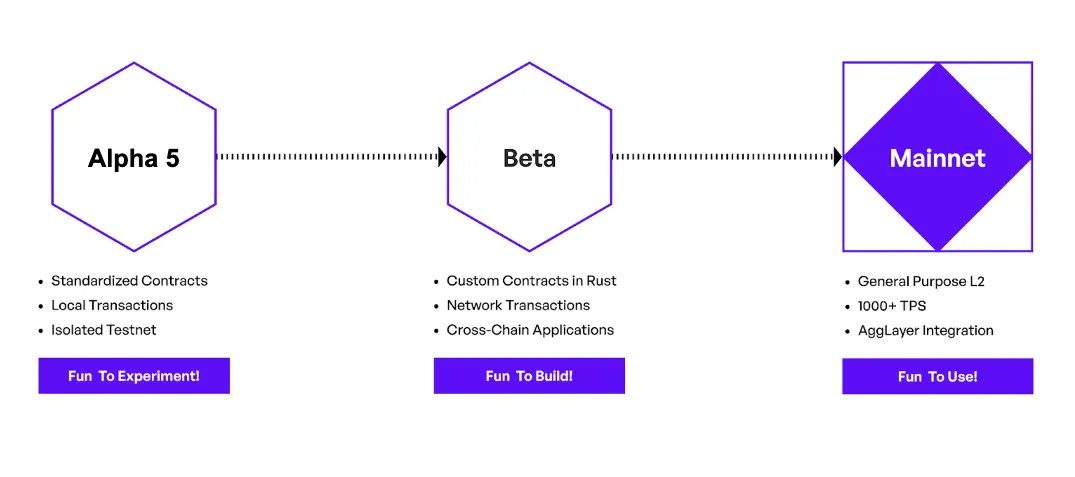
As more pioneers begin to build sovereign dApps on the Polygon Miden ZK rollup, a quick update: Miden Alpha Testnet v5 is live, unlocking new features for builders and making it more stable.
Explore the Polygon Miden tutorials and start building on the testnet today.
Polygon Miden is an innovative zkVM rollup in testnet phase. It enables users to create and execute their own zero-knowledge (ZK) proofs, a process called client-side proving. Developers can build dApps that let users prove their local state, offering sovereignty and much higher throughput than existing architectures.
In the context of an aggregated future via the Agglayer, Polygon Miden is making crypto payments and DeFi better and more efficient by building together with pioneers in the space:
- Wind: Wind merges traditional and onchain finance by providing applications, tools, and API for businesses and developers.
- Copperx: Copperx provides a payment gateway and global payout solution for personal and business purposes.
- FatSolutions: FatSolutions is working to make it easy to do payments, using Polygon Miden via Telegram.
Polygon Miden Testnet v5 now supports custom account components. Create custom smart contracts and start building today!
Future updates will enable developers to execute any logic onchain or offchain, in the same way as other general-purpose blockchains.
So, what new things can developers build with the latest release?
Miden Alpha Testnet v5
- Build your smart contract as an account component: Alpha 5 introduces custom smart contracts. Unlike traditional blockchains, accounts in Polygon Miden can comprise multiple modular components that work seamlessly together. For example, a user can include the basic_wallet component to handle asset transfers and an authentication component to manage public keys and transaction signing. Beyond these, users can develop and deploy bespoke components (custom_component) with exposed methods callable by notes, such as storing data in account storage slots. The AccountBuilder tool simplifies this process, enabling users to configure their accounts efficiently.
- Foreign Procedure Invocation: Polygon Miden smart contracts are now composable. That means accounts can read a particular state of another (foreign) account and include that information in their transaction. This is particularly useful for oracles. In that case, user accounts can read the latest price data and create a note depending on this data. But obviously, there are other exciting things to do with composability. Almost all DeFi protocols rely on it. Maybe we can find a team that can help us facilitate the first flash loan on Miden.
- Delegated proving: Polygon Miden offers delegated proving for users who cannot create ZK proofs fast enough. Anyone can run this service and offer proof generation. Users need to send all their data to this service, but the data isn’t visible for the whole network.. Delegated proving might not be necessary for Rust clients running on high-end laptops. Here, proof generation only takes ~1s. This service can be considered when users are on an older mobile phone or use the WebClient.
- Transaction recency conditions: Now, transactions can expire in Polygon Miden. Users can now set an expiration time for a transaction, e.g., a transaction is invalid unless it is included in the chain by block x. This is useful for foreign procedure invocations; an oracle can ensure that its data, read by other accounts, is only valid for the next couple of blocks. But also for rate-limiting, e.g., only a portion of an account’s assets can be withdrawn in a given period of time. It is easy to build safe wallets using Polygon Miden.
Developers and pioneers can look up all changes for the new version in the corresponding changelogs (base, client, node).
This new version focuses on developer-facing features but includes many other changes, simplifications, and improvements behind the scenes.
What’s Next?
In the coming weeks, expect the following:
- A fully working Rust compiler
- Excellent tutorials and documentation
- Network transactions
Tune into the blog and our social channels to keep up with updates about Polygon.
The future of Web3 is aggregated.
Website | Farcaster | X (Twitter) | Forum | Telegram | Discord | Instagram | LinkedIn | Polygon Knowledge Layer
Hold Dollars in Polygon's Open Money Stack. Convert to Stablecoins the Moment You're Ready.
Get Unlimited Embedded Wallets Free, With Crosschain Routing Included

Polygon Labs Joins NOBO Finance and Dun & Bradstreet in Phase 2 of the Bank of England's Digital Pound Lab
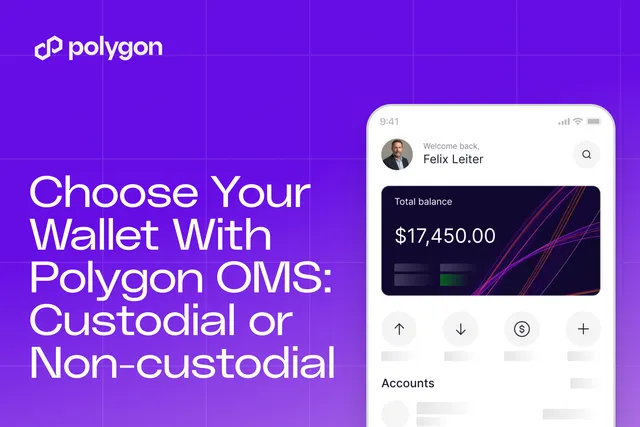
Custodial vs. Non-Custodial Wallets: Which One Should Your Platform Build?
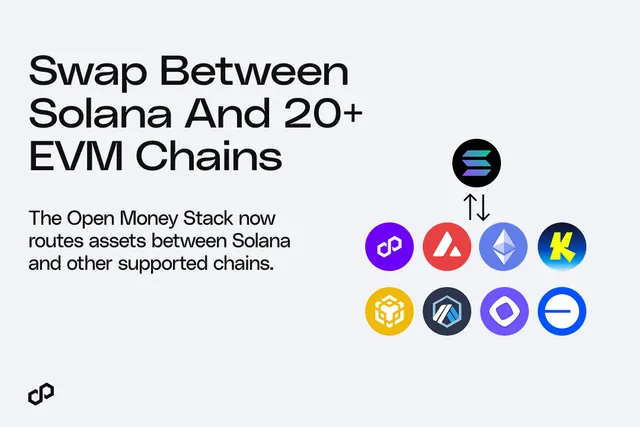
Move Money Between Solana and Polygon, Ethereum, Base + more EVM Chains with Polygon OMS
.CXtdIGFA_Z2ODqj.webp)
Ithaca Upgrade Is Live: Payments on Polygon Chain Are More Reliable Than Ever
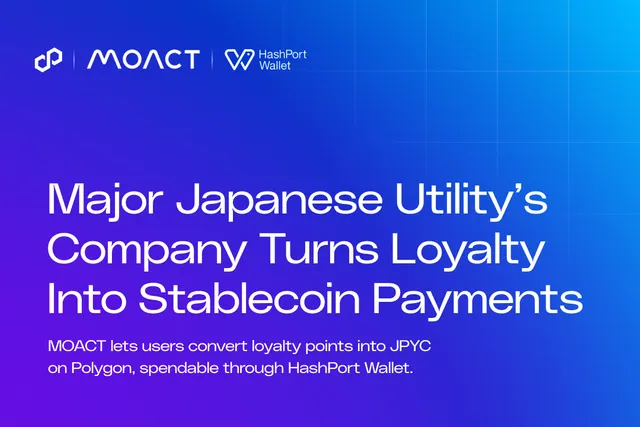
Kansai Electric Power's Rewards Arm Turns Loyalty Points Into Real Stablecoin Payments on Polygon Chain
Mento Protocol Launches on Polygon for Local Currency Stablecoin Payments
PayPal USD Lands on Polygon Chain, Enabling Regulated Onchain Dollars to Move Across Borders in One Integration