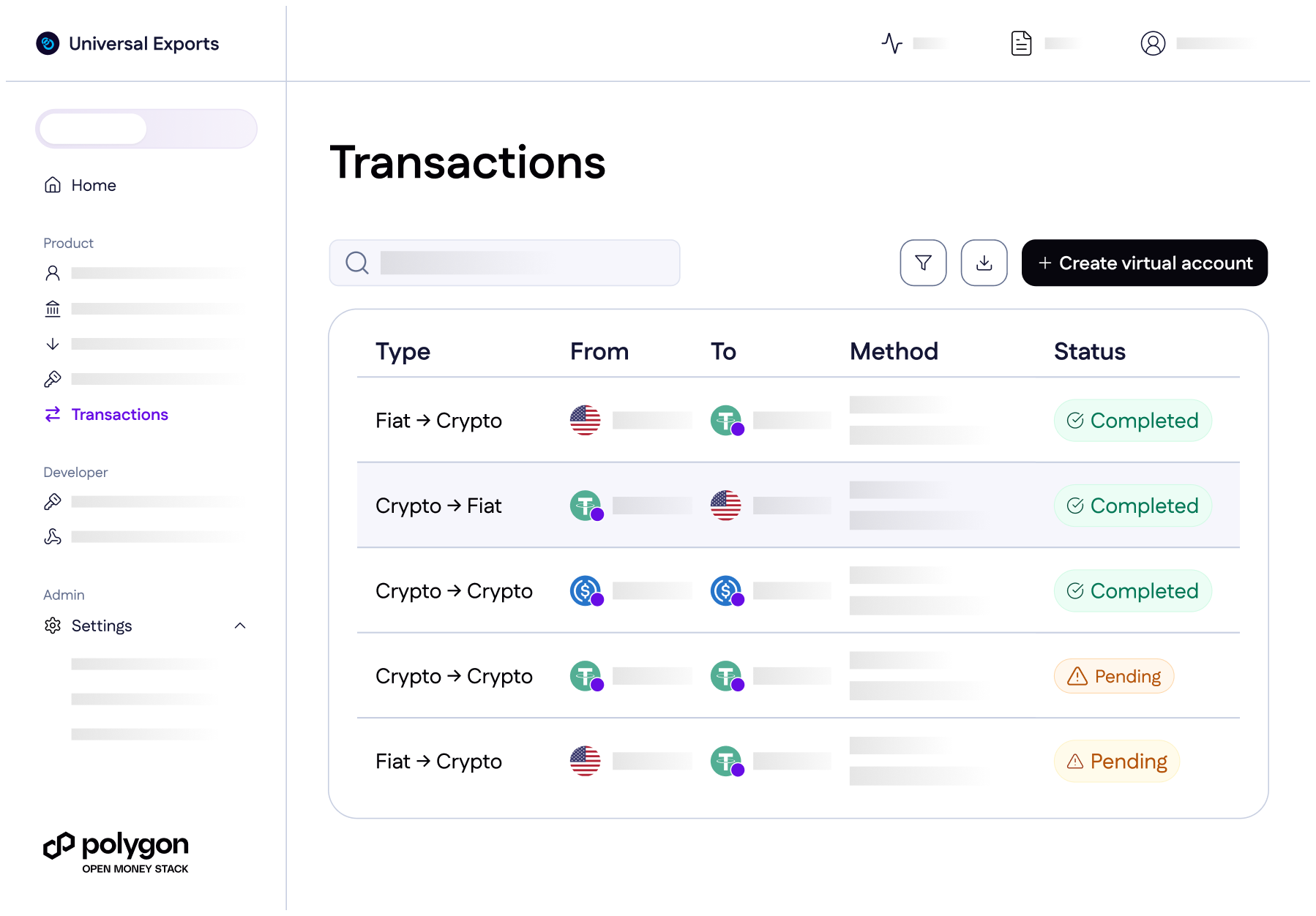
One orchestration layer for every money movement flow
Cross-border payments
Route payments across corridors without coordinating separate ramp, FX, and settlement providers.
Payroll & Payouts
Disburse to contractors, sellers, or partners in local currency via bank, cash, or crypto.
Marketplace settlement
Collect from buyers and pay out to sellers across borders with one ledger tracking the full cycle.
Remittances
Cut the cost of every corridor by settling on stablecoin rails instead of through correspondent banks.
Dollar accounts
Give your customers USD access through virtual accounts backed by stablecoins, no correspondent banking required.
Treasury operations
Hold, convert, and move funds across currencies without a separate vendor for each leg.
Cross-border payments
Route payments across corridors without coordinating separate ramp, FX, and settlement providers.
Payroll & Payouts
Disburse to contractors, sellers, or partners in local currency via bank, cash, or crypto.
Marketplace settlement
Collect from buyers and pay out to sellers across borders with one ledger tracking the full cycle.
Remittances
Cut the cost of every corridor by settling on stablecoin rails instead of through correspondent banks.
Dollar accounts
Give your customers USD access through virtual accounts backed by stablecoins, no correspondent banking required.
Treasury operations
Hold, convert, and move funds across currencies without a separate vendor for each leg.
'%3e%3cpath%20d='M2345.24%20883.735C2308.2%201733.98%201885.32%201800.15%201317.97%201800.15C750.616%201800.15%20290.688%201664.3%20290.688%20883.735C290.688%20263.278%20750.616%20290.872%201317.97%20290.872C1885.32%20290.872%202372.18%20265.487%202345.24%20883.735Z'%20fill='url(%23paint0_radial_12056_66301)'/%3e%3c/g%3e%3cdefs%3e%3cfilter%20id='filter0_f_12056_66301'%20x='9.15805e-05'%20y='9.15805e-05'%20width='2637'%20height='2090.83'%20filterUnits='userSpaceOnUse'%20color-interpolation-filters='sRGB'%3e%3cfeFlood%20flood-opacity='0'%20result='BackgroundImageFix'/%3e%3cfeBlend%20mode='normal'%20in='SourceGraphic'%20in2='BackgroundImageFix'%20result='shape'/%3e%3cfeGaussianBlur%20stdDeviation='145.3'%20result='effect1_foregroundBlur_12056_66301'/%3e%3c/filter%3e%3cradialGradient%20id='paint0_radial_12056_66301'%20cx='0'%20cy='0'%20r='1'%20gradientTransform='matrix(1027.81%20365.785%20-1042.34%20943.766%201318.5%201434.36)'%20gradientUnits='userSpaceOnUse'%3e%3cstop%20stop-color='%230037C6'/%3e%3cstop%20offset='0.3'%20stop-color='%23E271D7'/%3e%3cstop%20offset='0.5'%20stop-color='%23670DE5'/%3e%3cstop%20offset='1'%20stop-color='%23F2F1F5'%20stop-opacity='0'/%3e%3c/radialGradient%3e%3c/defs%3e%3c/svg%3e)
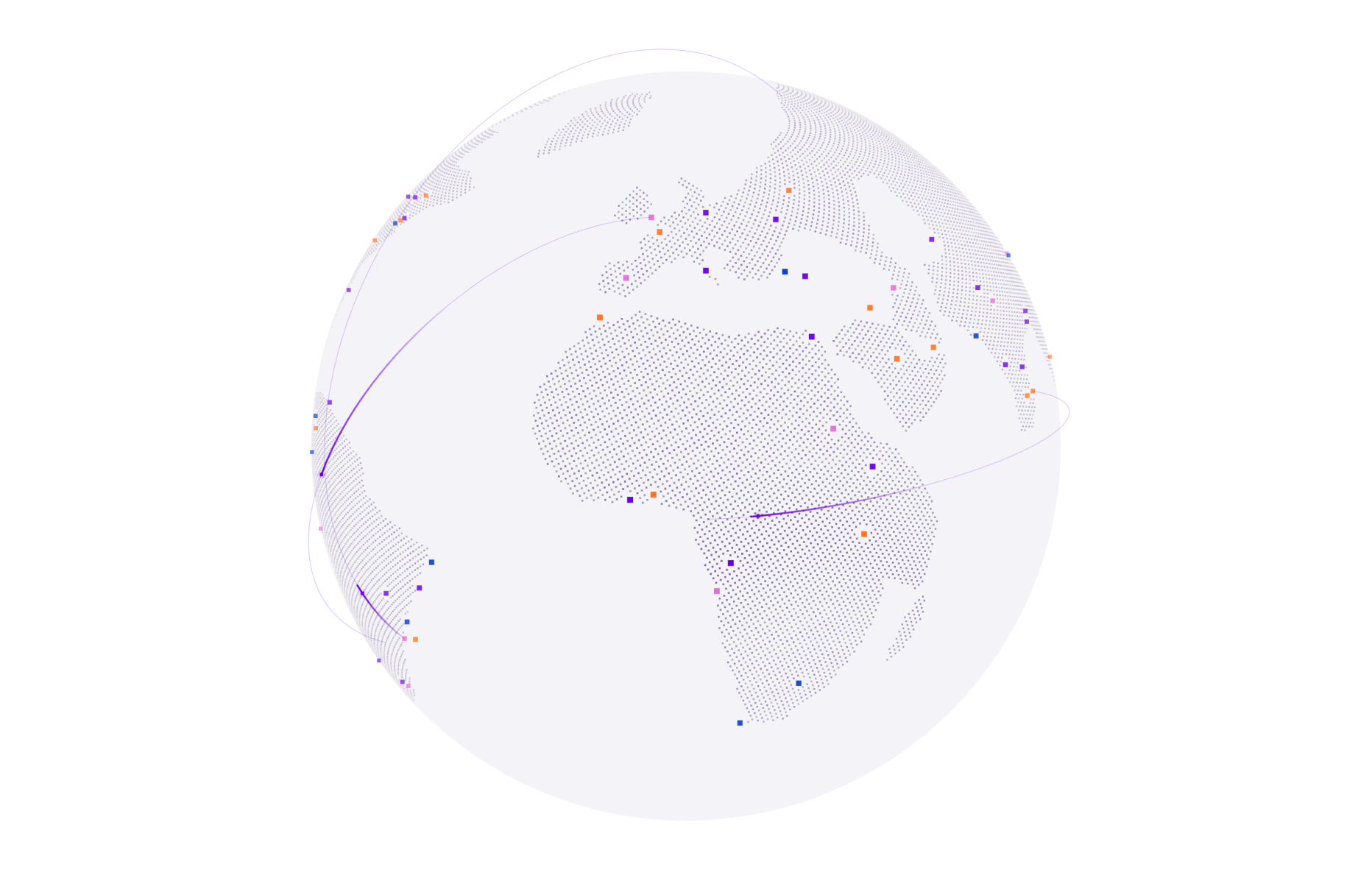
How a single transaction moves through OMS
- 1Money arrives
Funds arrive by bank transfer, cash code, or crypto deposit.
- 2Convert
Deposits can remain in a fiat wallet or convert into stablecoins.
- 3Hold
Funds remain in a fiat or stablecoin balance until they’re ready to move.
- 4Moves
OMS routes each transaction based on its source and destination assets.
- 5Off-ramp
Funds convert from stablecoins into local currency when needed.
- 6Local payout
The payout lands in the recipient’s account.
Move money
on your terms
Intent-based routing
Declare source and destination, and OMS finds the chain, conversion, and settlement path.
Intent-based routing
Declare source and destination, and OMS finds the chain, conversion, and settlement path.
Locked pricing
Lock the rate and fees at quote time so the price you show your user is the price that settles.

Locked pricing
Lock the rate and fees at quote time so the price you show your user is the price that settles.
Single reconciliation
Every leg logs to one ledger, one record per payment instead of one per vendor.
Single reconciliation
Every leg logs to one ledger, one record per payment instead of one per vendor.
Open infrastructure
Not locked into one chain, one wallet, or one ramp. Use what you need, swap what you don't.
Open infrastructure
Not locked into one chain, one wallet, or one ramp. Use what you need, swap what you don't.