
Deposit once. Pay a million times.
Move money as value is delivered, not after the fact. Fund a channel once, send signed payment updates as services are consumed, and settle the total on Polygon in batches. Real-time payments with instant finality, minimal fees, and settlement you can reconcile in one transaction.
Card rails can’t bill
by the second
Usage pricing means millions of payments worth fractions of a cent. A card fee is larger than most of them, and no network clears them one by one. So providers bill in arrears or sell prepaid credit. Either way, money sits idle and the bill stops matching the use.
Proof Aggregation
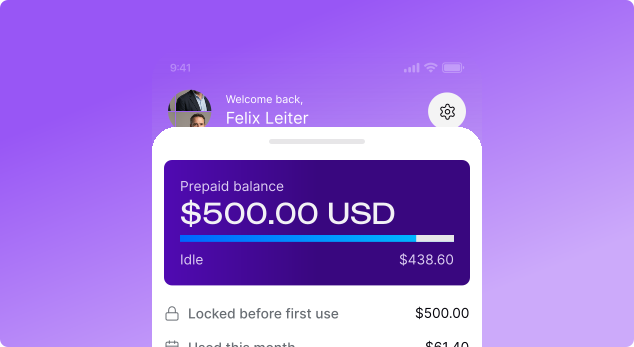
Deposit once on Polygon Chain. The deposit is your spending limit.
Unified Bridge
Each unit is a signed payment to a hub, confirmed in about 20 microseconds. No onchain transaction per payment.
Pessimistic Proof
Hubs post the totals to Polygon Chain in batches. Providers withdraw what they earned.
Anything metered can be paid as it’s used
Payments and fintech
Move small payments as they happen, without putting every payment onchain.
Streaming and media
Let viewers pay for the seconds they watch.
APIs and data
Charge for each request, lookup, or result.
Compute and inference
Bill model and GPU usage as it is consumed.
Connected devices
Let machines pay for the service, energy, or data they use.
AI agents
One task can buy data, tools, and inference from dozens of providers. The agent pays each one per call or per token, from a single deposit.
Usage billing your bank
can offer
Give business clients a way to pay as they use services, without extending new credit or building a new ledger.
- 1
Fund a client account
Clients can use Polygon Open Money Stack to move money into a Pay Channel before they start using a service.
- 2
Set the limit before spending begins
A channel can never spend more than its deposit, so the deposit is a hard credit limit.
- 3
Run a hub for your users
Operate a hub for your clients and verify every payment yourself.
- 4
Keep payment details private
Individual payments stay offchain. Clients can see their own balance and payment history, without putting it on public view.
Built for machine-scale volume
45 million payments per second, each confirmed in about 20 microseconds. Capacity scales linearly as you add hubs.