tl;dr
- Agglayer testnet just settled value between Ethereum and a chain that doesn’t run the EVM, in both directions, end-to-end
- For institutions, this is a proof point of Agglayer’s vision to reach liquidity anywhere
- Agglayer helps bring cross-chain unity to the Open Money Stack, enabling end-to-end stablecoin payments from fiat ramps to onchain settlement and back again
- The same Agglayer architecture that held during the $292M rsETH exploit now extends architecturally distant chains like Miden
- Combined with last week’s CDK privacy upgrade, institutions can build or operate on any chain that fits their requirements and still reach the rest of crypto through one bridge
Miden, a private, ZK-native blockchain incubated by Polygon Labs, recently settled value across Agglayer in both directions, becoming the first chain to clear the bridge without sharing Ethereum’s architecture.
Our Open Money Stack’s cross-chain bridge is now indifferent to how a connected chain computes transactions. Agglayer is chain agnostic.
Twitter/X
This is content from Twitter/X. It only loads after you allow social networking cookies.
https://twitter.com/0xMarcB/status/2053929167599857742
For institutions building onchain payment rails, the chain they use for their product is no longer constrained to where it settles.
Agglayer’s job is to let a stablecoin payment land on whatever chain serves the use case (Polygon for low-cost retail rails, a Polygon CDK validium for an institution that needs operator-level privacy, etc.) without the payer or recipient thinking about which chain they’re on.
One bridge, unified liquidity, and cryptographic guarantees, regardless of destination.
For two years, that destination set came with an asterisk: every chain Agglayer connected ran the EVM, architectures that all looked roughly like Ethereum’s. If a payment needed to land on a chain that worked differently, Agglayer couldn’t reach it end-to-end.
That asterisk is gone.
The same settlement layer that connects Polygon, Katana Network, Immutable, and every CDK blockchain, now connects a chain that computes transactions inside zero-knowledge proofs generated on the user’s device, where the network never sees the underlying data.
Whatever chain serves your use case, whether it’s a stablecoin payments rail, a tokenized deposit product, or a confidential asset platform, you will be able to connect to Agglayer and reach unified global crypto liquidity.
Why Miden was a difficult testcase
Miden, a Polygon Labs incubation, is an architecturally distant chain.
Three things make it different from every other chain currently connected to Agglayer:
It doesn’t run the EVM. Miden uses a ZK-native execution model. Smart contracts compile to a custom virtual machine designed around zero-knowledge proofs from the ground up.
Transactions are proven client-side. When a user sends value on Miden, their device generates the proof. The network verifies it but never sees the underlying transaction data. Counterparties, amounts, and balances are confidential by default at the protocol level, not by configuration, not by a privacy bolt-on, but because the network itself is structured around not having that information.
State is note-based, not account-based. Miden doesn’t have account balances in the Ethereum sense. It has notes, which are individual units of value with their own conditions. Bridging into Miden means creating notes the recipient can claim. Bridging out means consuming notes and producing a corresponding settlement note.
Connecting a chain with that architecture to a bridge designed around EVM accounts required Agglayer to do something it had never done before: settle across an execution boundary where neither side shares the other’s assumptions.
If Agglayer can do this, the question of which chains it can connect stops being about technical compatibility and starts being about which ones are next.
The Polygon CDK + Agglayer picture coming into focus
The Miden integration is the third proof point in a short sequence for what CDK and Agglayer does for institutional builders.
Earlier this spring, Agglayer processed roughly $200 million in cross-chain volume during the rsETH exploit without pausing, without an incident, while a single forged signature took more than twenty other bridges offline.
The architecture held, because Agglayer’s security model is ZK (pessimistic) proofs, not operator committees. There was no quorum to compromise, no RPC to poison, no committee to social-engineer at 3am on a weekend. The math-based security model is what every chain on Agglayer inherits from day one.
We also recently shipped a privacy upgrade for Polygon CDK so an institution can spin up its own private chain.
Transaction data stays inside infrastructure the institution controls. Settlement runs through Agglayer with the same ZK guarantees relied on during the rsETH incident.
Operator-level privacy, public-chain liquidity, math-based cross-chain security.
A bank standing up tokenized deposits, a payments company building stablecoin rails, an asset manager issuing a tokenized fund: each can now operate a chain that fits their compliance posture and still reach the rest of crypto.
Miden is the third coordinate.
It proves that the same security model and the same unified bridge extend to chains as architecturally distant from Ethereum as anything currently in production.
For institutions evaluating the stack, the picture is now coherent.
Launch any chain that fits your use case, whether it’s public, private CDK, or protocol-private like Miden. Connect to Agglayer. Leverage ZK-proven cross-chain security and unified liquidity. Institutions have options:
Confidential corporate payments. The counterparty, amount, or remittance reason can’t be public, but the settlement still needs to clear into a public stablecoin balance on another chain. Today this requires private off-ramping or wrapped representations. With Miden reachable through Agglayer, the private leg and the settlement leg are the same transaction.
Tokenized asset management. Ownership and rebalancing trades stay confidential between the fund and its custodian. Unit holders, oracles, and regulators get verifiable proof that the assets exist and behave as promised. Confidentiality lives on Miden. Settlement, distribution, and oracle integration happen on whatever chain serves them best, all reachable through the same bridge.
Cross-chain treasury operations. A company holds working capital across multiple chains and wants to rebalance without telegraphing positions to the rest of the market. The confidential leg routes through Miden. The settlement leg lands wherever liquidity sits.
None of these are theoretical. They’re the conversations we’ve been having with banks, custodians, and corporate treasuries for the last eighteen months. The blocker was always the same: privacy and connectivity were in tension, and no settlement layer could span the gap. Agglayer just did.
How the integration works under the hood
For readers who want the mechanics, here’s how value actually moves between an EVM chain and Miden through Agglayer. Skip this section if you’re not the kind of person who reads bridge specs for fun.
The proof system. Agglayer’s pessimistic proof is a zero-knowledge circuit that verifies the state transitions of every connected chain against the global accounting invariant: no chain can withdraw more than it deposited. The proof treats each connected chain as a black box that emits state commitments. For Miden, that meant building a new circuit that reads Miden’s note-based state instead of an EVM Merkle Patricia trie. The same proof framework that verifies a CDK chain now verifies a chain with a completely different state model.
The bridge primitive on Miden. Miden doesn’t have account balances. It has notes, which are individual unspent transaction output (UTXO)-like objects with their own spending conditions. The bridge uses two custom note types. On the inbound leg, AggKit (the toolkit that connects non-CDK chains to Agglayer) produces a claim note the recipient consumes to receive funds. On the outbound leg, the user produces a B2AGG note (bridge-to-Agglayer) that gets consumed locally and emits a nullifier the pessimistic proof picks up. The nullifier is what gives the L1 bridge contract permission to release escrowed ETH. No multi-sig. No external bridge operator. The nullifier is the authorization.
The offchain integration layer. Gateway built the connective tissue: a service that watches Miden state, formats the proofs and nullifiers AggKit needs, submits the L1 transactions, and recovers from edge cases like the settler nonce collision the smoke test surfaced. This is the part that makes Miden production-operable rather than a one-off demo. It’s hosted by Gateway in the same posture they run for other Agglayer-connected chains.
Client-side proving stays client-side. Nothing in the bridge integration changes Miden’s privacy model. Users still produce their transaction proofs locally. The network still never sees raw transaction data. The bridge only sees note nullifiers and the corresponding L1 escrow accounting, which are public by design (you can’t keep a bridge withdrawal completely private if the L1 side is releasing real ETH to a real address). What stays private is everything else the user did on Miden.
The combined result: a non-EVM chain with a fundamentally different state model and a fundamentally different privacy posture, settling into Agglayer with the same cryptographic guarantees as a CDK rollup. The Gateway team’s smoke test report has the full trace.
Live on testnet. Mainnet next.
The Miden integration is on Agglayer Bali, the staging deployment for the production release. The next milestones are mainnet bridging, additional asset types beyond ETH, and the production deployment of Gateway’s infrastructure stack at the SLAs institutional customers expect.
For builders, the testnet is live now. Developers building on Miden can use client-side proving for confidentiality and rely on Agglayer for cross-chain settlement today. Developers building on every other Agglayer chain now have a non-EVM destination they can compose with.
For institutions, the reach we can offer is different than it was a month ago.
Whatever onchain rail you’re building, whether it’s a tokenized deposit product on a private Polygon CDK blockchain, a stablecoin payments product on Polygon, or a confidential treasury workflow on Miden, Agglayer connects it to everything else.
Ready to get started? Book a call today.
Polygon Open Money Stack now supports TRON
Meet Polygon at Money20/20 USA
Monerium, Frax and Capa connect euro payments to onchain FX markets on Polygon
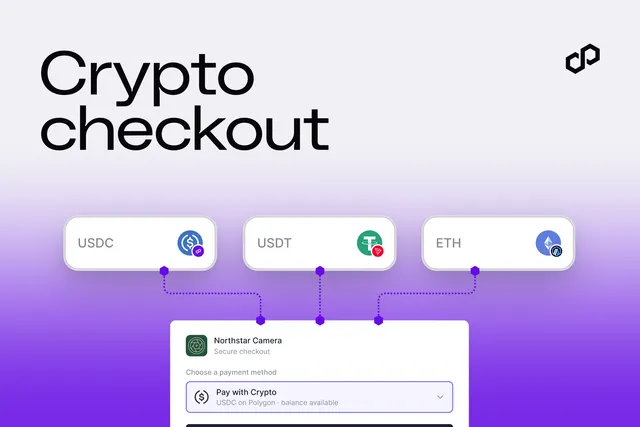
Introducing crypto checkout in Polygon Open Money Stack
Polygon passes $3 trillion in stablecoin transfer volume
Polygon Chain now supports 11 million payments per second
New to Polygon OMS: Recurring Stablecoin Subscriptions With One Customer Approval
Stable.com Adds Polygon for Direct-to-Bank Stablecoin Transfers
One API for Any Payment: Inside Polygon Open Money Stack