Stablecoin savings makes sense when the experience works like money already does.
Deposit. Save. Track. Withdraw.
For experienced crypto users, wallets, networks, stablecoins, gas fees, and transaction hashes are familiar parts of the journey. For mainstream users, the most useful financial products usually start with clear actions, simple interfaces, and predictable flows.
That gap, between how crypto infrastructure works and how mainstream users expect financial products to behave, is one of the biggest barriers to broader adoption. Closing it requires more than good UX. It requires a compliant, connected path between traditional payment rails and onchain settlement.
Coinstancy’s U.S. expansion is that path. The platform, which manages over $1 million in deposits, has integrated the Open Money Stack’s on-and-off-ramps (with services provided by Coinme, being acquired by Polygon Labs, subject to regulatory approval). Coinstancy now has access to a licensed and regulated enterprise crypto payments platform with access points at more than 50,000 cash locations across the U.S. to give users compliant ramps connecting traditional payment rails to USDC on Polygon.
The goal is simple: make onchain stablecoin savings feel closer to a payment app than a traditional crypto workflow.
The adoption opportunity for stablecoin savings
Stablecoins are one of the clearest use cases in crypto because they connect a familiar unit of account with blockchain-based settlement.
A user can understand the value of a digital dollar quickly. What matters next is the journey around it and its ease of use.
In many crypto product cases, a user still moves across several tools before reaching the actual product experience. They may create an account on an exchange, buy a stablecoin, choose a network, manage a wallet, send funds to an address, and later repeat a similar flow when withdrawing.
Each step makes sense to an experienced user. However, the full journey can still feel like heavy-lifting for someone who mainly wants a clear financial outcome in the most simple and efficient way possible.
For stablecoin savings to reach a broader audience, the experience should feel intuitive from the first action. Users should understand what they are doing, why it matters, and how their money moves.
This is how stablecoin savings products can close the UX gap for mainstream users.
What payments can teach onchain finance
A good payment experience lets users focus on the action they want to complete without bombarding them with unnecessary complexities that should otherwise be invisible.
Send money. Receive money. Pay someone. Fund an account. Withdraw funds.
The rails are essential, but they sit behind the product experience. Users engage with a clear interface while the system handles compliance, routing, settlement, liquidity, and transaction processing.
Onchain finance can follow the same direction.
A stablecoin savings product can be built around a familiar journey while still using blockchain infrastructure underneath. Users benefit from fast settlement, lower transaction costs, and transparent flows, while the front-end remains simple.
In Coinstancy’s architecture, three layers work together:
- Coinme provides the regulated U.S. access layer.
- Polygon provides the USDC settlement layer.
- Coinstancy provides the user-facing savings experience.
Each layer has a specific role. Together, they create one unified experience.
Why Polygon is the settlement layer for mainstream stablecoin savings
Polygon is where USDC settles every time a Coinstancy user deposits or withdraws. That makes it the foundation the entire product experience is built on.
To connect the settlement layer to everyday users, Coinstancy integrates the Coinme Widget, embedding fiat-to-crypto access directly inside the app and connecting users to Coinme’s regulated infrastructure across compliance, payments, custody, liquidity, KYC, and transaction processing. For Coinstancy, this means the on-ramp becomes part of the savings journey, with Polygon handling settlement at the end of every transaction.
Here’s how the flow works:
- A U.S. user enters the Coinstancy app and chooses to fund their savings account.
- The Coinme Widget provides the regulated fiat access layer.
- Funds are converted into USDC and settled on Polygon.
- Coinstancy routes the user into its stablecoin savings experience.
- When the user wants to withdraw, the same infrastructure helps connect onchain value back to a familiar off-ramp fiat flow.
The experience adapts to who is using it. Coinstancy supports multiple networks, but for users depositing or withdrawing directly in USDC, Polygon is the recommended settlement layer.
Crypto-native users get full network visibility and control. Mainstream users going through the Coinme Widget see a familiar fiat flow, with the blockchain handling everything underneath.
Two entry points. One product. And for users who want the best settlement experience, Polygon is the natural choice.
How fast, affordable settlement advances stablecoin savings
Settlement speed and transaction cost aren’t abstract technical metrics but the factors that determine whether a mainstream savings product is actually usable. A user who deposits $50 can’t absorb a $5 fee. A withdrawal that takes minutes breaks the payment-app feeling the product is built around.
This is where Polygon’s settlement layer creates direct product value. USDC settlement is fast and affordable at any transaction size. For a savings product serving mainstream users (where smaller deposits are the norm, not the exception) that efficiency is structural, not incidental. USDC on Polygon can save users several dollars per transaction compared with heavier settlement rails, and settlement is near-instant, so funding an account feels like using a payment app rather than waiting on a wire.
https://x.com/0xPolygon/status/2052120167736389721
Fast settlement improves the flow between funding an account and accessing the product. Lower transaction costs make the experience more efficient for users, especially when the product is designed to support flexible deposits and withdrawals. USDC on Polygon gives the system a digital dollar asset that can move efficiently across onchain infrastructure.
For users, the value is direct: faster access to the product, lower costs on every transaction, and a flow that feels familiar. The blockchain infrastructure earns its place through performance, not explanation.
This is exactly the kind of experience that has helped many fintech products succeed. The infrastructure is powerful because it improves the product, while the user journey remains simple.
Built on enterprise infrastructure. Designed for everyday users.
Onchain adoption is often framed as an education topic. Education matters, especially when users need to understand how funds move, what risks exist, and how the product works.
Product design is just as important.
A user-friendly savings product should make the main actions clear:
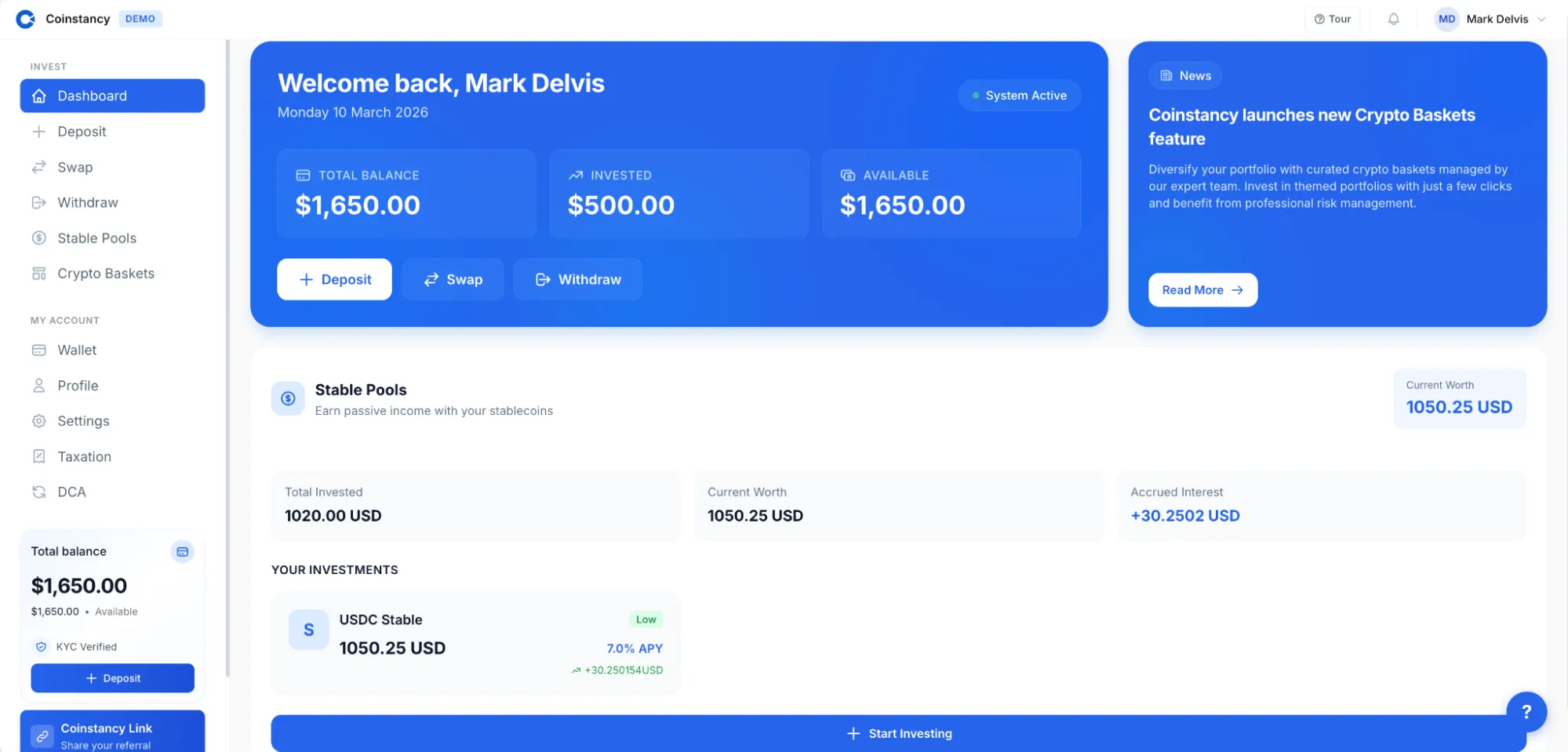
- Deposit funds.
- Access savings.
- Track balance and performance.
- Withdraw when needed.
- Understand the potential risks.
For Coinstancy, the objective is to bring this level of clarity to onchain stablecoin savings. The product gives users access to stablecoin-based strategies, while the infrastructure stack handles fiat access, USDC movement, and blockchain settlement.
This is about placing blockchain at the right level of the experience.
Users who want to understand the full architecture can explore how the system works. Users who mainly want a savings experience can start from a simpler path.
The result is a product where crypto infrastructure supports the user experience instead of defining every step of it.
Onchain trust starts with getting the fundamentals right
For mainstream users, simplicity and trust need to grow together. In onchain finance, trust comes from several layers working in the same direction.
The first layer is regulated access. For U.S. users, Coinme provides the regulated solution that makes Coinstancy’s offers accessible in the market.
The second layer is transparent settlement. Polygon enables USDC flows to move through blockchain infrastructure with speed, cost efficiency, and traceability. Through the Coinme integration, Coinstancy connects fiat access to USDC settlement on Polygon.
The third layer is product design. Coinstancy brings these components into a user-facing savings experience designed to feel direct, familiar, and accessible.
The fourth layer is risk management. Coinstancy adds a third-party protocol cover layer for defined technical events, helping users understand that protection is part of the product architecture. This layer is designed around specific risks such as certain smart contract code failures and severe economic events, with clearly defined coverage terms.
This layered model gives users a clearer way to understand how the product is built.
When infrastructure becomes a product advantage, adoption follows
The integration between Coinstancy, Coinme, and Polygon reflects a broader shift in how blockchain products can reach mainstream users.
The first phase of crypto adoption was built around self-directed users, people who learned to manage wallets, exchanges, networks, seed phrases, bridges, and transaction fees themselves. That model remains valuable, but it was never going to scale to the mainstream.
The next phase looks different. It brings blockchain infrastructure into products that feel familiar, where users choose onchain savings not because they understand the rails, but because the product is faster, more accessible, and more efficient than the alternative.
In that model, infrastructure becomes a product advantage, something that earns user trust through performance. That is what the layered approach between regulated fiat access, efficient onchain settlement, and a clean user-facing experience is designed to deliver.
“The next phase of onchain adoption will be won by making the infrastructure reliable, compliant, and invisible enough so that users can simply move from dollars to onchain savings in a few clicks.” — Armand Bouchard, CEO of Coinstancy
Polygon is built for exactly that.
Stablecoin savings is no longer a crypto product. It’s a financial one.
The gap between how blockchain works and how mainstream users think about money is closing. Not because users are learning more about crypto, but because products are getting better at making the complexity disappear.
When regulated access, cost-efficient settlement, and a simple user experience work together, the user journey becomes the whole story. Deposit. Save. Track. Withdraw. The infrastructure behind it becomes invisible as needed.
That is what Coinstancy and Polygon have built together. A product that earns user trust through performance, and a settlement layer that is ready for the mainstream because it was designed for it.
Disclaimer: The information provided in this blog post is for general informational purposes only. The views and opinions expressed are those of the authors and do not necessarily reflect the official position of Polygon Labs. Any third-party information referenced, including details about Coinstancy and Coinme, has been provided by those parties and has not been independently verified by Polygon Labs. Polygon Labs makes no representations as to the accuracy, completeness, or suitability of any information contained herein and shall not be liable for any errors, omissions, or losses arising from reliance on this content. Nothing in this post constitutes financial, investment, legal, or tax advice. Readers should conduct their own research and consult qualified professionals before making any decisions related to digital assets or financial products.
Polygon Open Money Stack now supports TRON
Meet Polygon at Money20/20 USA
Monerium, Frax and Capa connect euro payments to onchain FX markets on Polygon
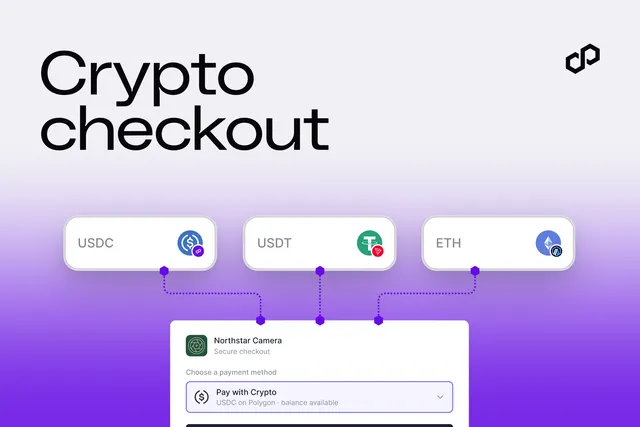
Introducing crypto checkout in Polygon Open Money Stack
Polygon passes $3 trillion in stablecoin transfer volume
Polygon Chain now supports 11 million payments per second
New to Polygon OMS: Recurring Stablecoin Subscriptions With One Customer Approval
Stable.com Adds Polygon for Direct-to-Bank Stablecoin Transfers
One API for Any Payment: Inside Polygon Open Money Stack