- The Open Money Stack routes anywhere in the world, securely across blockchains, with ramps, wallets, and settlement in one API
- Most cross-chain blockchain solutions only move onchain tokens; a payments stack moves money end-to-end, from offchain ramps to onchain settlement and back again
- The pieces ship as one stack, but also work à la carte
- Take OMS as a whole, or take Agglayer, Trails, or CDK on their own
Your customer wants to move money, not pick a blockchain.
This sounds obvious, but it’s not how the crypto industry has been built. Every institution or fintech building a global product on blockchain rails has had to make the same bad choice: pick one chain and shrink your reach, or pick many chains and inherit the complexity of bridges, liquidity routing, custody splits, reconciliation gaps, offramping, and compliance edge cases for each one.
Both options ask the customer to think about chains, making foundational architecture visible. This isn’t what we think a payments solution should act like. We think customers want to send money to their supplier in Mexico, pay out a creator in Nigeria, settle a treasury position in Singapore, and see a single line in their dashboard when it is done.
We designed the Open Money Stack from a fundamental principle of unity: A secure cross-chain architecture, woven in as a fundamental characteristic.
One API, one vertically integrated stack, and one experience across crypto to tap unified crypto liquidity.
One API, every chain
Twitter/X
This is content from Twitter/X. It only loads after you allow social networking cookies.
https://twitter.com/0xPolygon/status/2053859817496928416
OMS routes payments across chains automatically. Your users sign once. Your treasury reconciles to one ledger. The chain that settles the transaction is an implementation detail.
The result is the experience customers actually want: pay in, hold, route, pay out, all from a single integration, with the route underneath chosen for cost and finality rather than by a product manager.
The hard part is making cross-chain payments safe to ship at production scale.
Cross-chain security is a design choice, not a configuration
Twitter/X
This is content from Twitter/X. It only loads after you allow social networking cookies.
https://twitter.com/0xPolygon/status/2049233442936693248
Agglayer was designed around a single security idea: a cross-chain transaction moves only after the math behind it checks out.
The mechanism is the pessimistic proof. It enforces one rule across every connected chain: a chain cannot withdraw more than it has deposited. Balance conservation, nullifier uniqueness, and root consistency are all verified by proof before settlement.
The result is a security model that does not depend on intermediaries or social-economic security.
In most cross-chain designs, security is delegated to a signer set, an oracle committee, or a verifier list each application configures separately. Agglayer depends, instead, on cryptographic proof.
The accounting either balances or the transaction does not land.
For the product you are building, that changes what you have to underwrite. The bridge stops being a third-party vendor your risk team has to evaluate, but becomes a property of the chain you settle on.
Cross-chain security is no longer a separate procurement, a separate audit, or a separate point of failure.
It is part of what you get when you build on the Open Money Stack.
Vertically integrated, open
The old pattern in payments infrastructure is well known. A platform sells you the full stack and locks you into every piece of it. Switching one layer means switching all of them.
OMS is built differently. Use the whole stack or use part of it. Plug your existing wallet, your existing compliance partner, your existing ledger into the layers you do not want to replace. Secure cross-chain routing still works the same way underneath.
You get the integration without the lock-in. That is what “open” means in the Open Money Stack.
Twitter/X
This is content from Twitter/X. It only loads after you allow social networking cookies.
https://twitter.com/0xPolygon/status/2051665299301425616
What this looks like for the product you are building
If you run a cross-border fintech, your users can hold a balance in a stablecoin, receive payouts from a payer on a different chain, and cash out in their local currency, in one flow.
If you run a PSP, your merchants can accept payment in any supported asset on any supported chain and settle in whichever stablecoin and chain serves their treasury, without you running a bridge.
If you run a neobank, your customers can move dollars between accounts that physically live on different chains and never see the word “chain” in your app.
In every case the chain is doing what a chain should do: settling value. The rest of the stack is doing the work the customer actually pays for.
Book a call to talk about what the OMS can do for you today.
Polygon Open Money Stack now supports TRON
Meet Polygon at Money20/20 USA
Monerium, Frax and Capa connect euro payments to onchain FX markets on Polygon
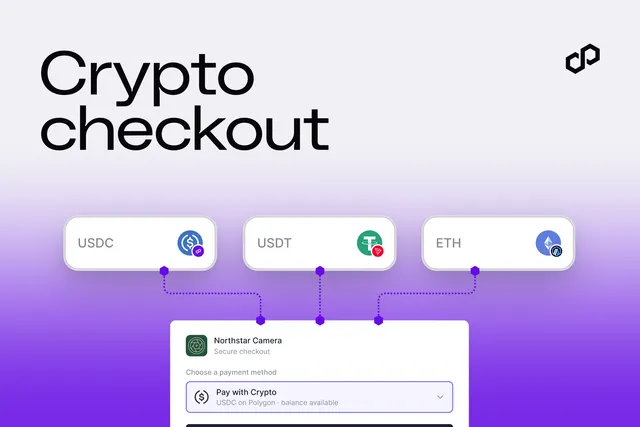
Introducing crypto checkout in Polygon Open Money Stack
Polygon passes $3 trillion in stablecoin transfer volume
Polygon Chain now supports 11 million payments per second
New to Polygon OMS: Recurring Stablecoin Subscriptions With One Customer Approval
Stable.com Adds Polygon for Direct-to-Bank Stablecoin Transfers
One API for Any Payment: Inside Polygon Open Money Stack