tl;dr
- Your institution can launch its own private blockchain with Polygon CDK, configured around your data residency and confidentiality requirements
- Transaction data is designed to stay inside infrastructure you operate. Only a cryptographic fingerprint and a zero-knowledge proof settle to Ethereum
- Every RPC call, contract, and function can be gated through your enterprise identity system
- Reach fiat onramps, wallets, and Agglayer cross-chain liquidity from day one
Today, we’re announcing a privacy upgrade to Polygon CDK that lets your institution build your own private blockchain without losing access to global liquidity. Institutions can now design and build compliant, private blockchains.
The new upgrade to Polygon CDK brings a validium configuration, powered by Succinct, designed to keep transaction data inside the infrastructure your institution operates. Ethereum cryptographically verifies the chain’s correctness. No trusted operator in the settlement path, no third party with privileged visibility into the chain. As part of the Open Money Stack, CDK offers your institution custom configurations with wallets, fiat on/off-ramps, and cross-chain orchestration.
Privacy is a property of the chain itself, and the chain remains connected to the open liquidity around it. That provides value for institutions: own the execution environment, satisfy data residency and confidentiality requirements, and still participate in a broader onchain economy.
Private data, public verification
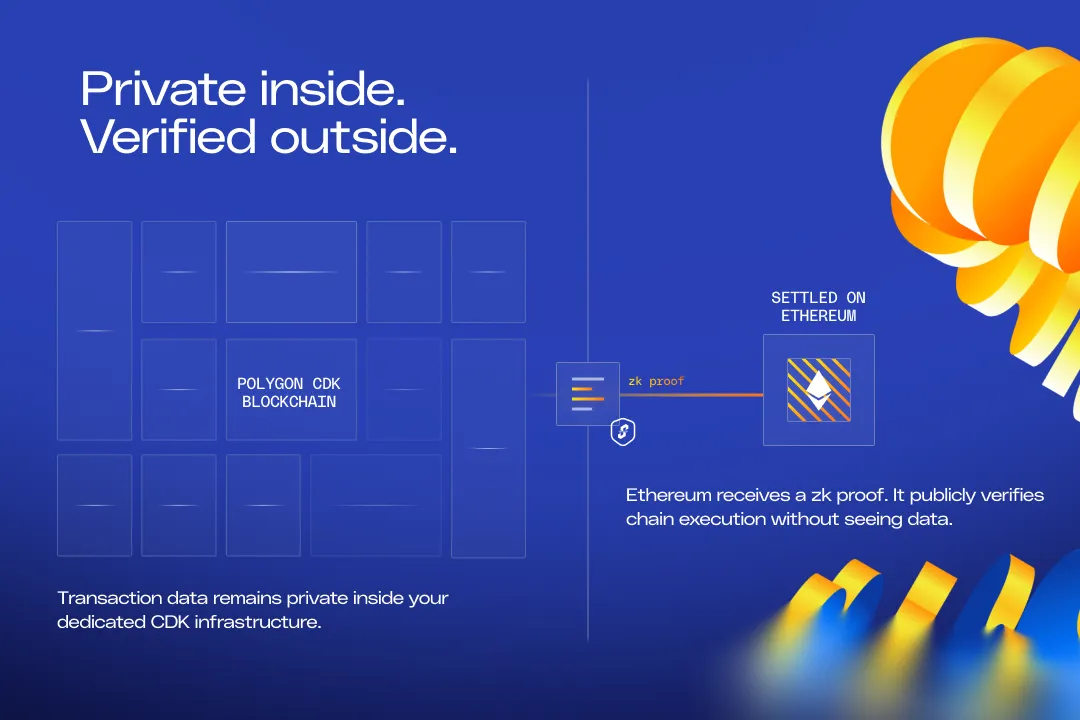
With the latest privacy configuration for Polygon CDK, raw transaction data is not published to a public network. Batch data remains in an institution-operated data availability environment. Ethereum receives only a cryptographic commitment to each batch, together with a zero-knowledge proof that verifies the chain’s execution.
This means Ethereum can confirm that the chain is operating correctly without seeing the transactions themselves.
The proving system is Succinct’s SP1 Hypercube, which is already running in production on Katana Network and generating proofs daily. The settlement model is based on validity proofs rather than a trusted third-party operator with privileged visibility into institutional transaction data.
The entire configuration of the blockchain is composable.
Role-based access controls are layered on top of the private chain environment. RPC endpoints and block explorers can be gated through enterprise identity systems such as Okta or Azure AD. Policies can be enforced at the contract and function level. Counterparties can be limited to the transactions they participate in. Auditors can receive scoped read access, regulators can be given selective disclosure and chain operators retain full visibility into their own network, in each case in compliance with all applicable laws and regulations.
Even operational metadata, including block contents, transaction counts, and gas usage, does not need to be publicly exposed.
Your institution can configure deployments around your compliance, privacy, and residency requirements based on where the infrastructure physically operates.
Stack at a glance. OP Stack in OP-Succinct validium mode. Succinct SP1 Hypercube proving. AltDA as the institution-operated data availability layer. Implementation partners like Conduit and Gateway for rollup-as-a-service; institution-operated sequencers also supported. Agglayer for cross-chain liquidity and state.
Privacy is a spectrum
Privacy on CDK is not an on-off switch. It is a spectrum, and CDK is designed to provide institutions with capabilities to compose the levels they need. We’ve built the framework with collaborators across each layer so institutions get production-grade primitives at every level, not a research roadmap.
Permissioned access. Standard CDK chain with role-based RPC, a private block explorer, and enterprise SSO through Gateway. Sovereign and identity-gated, but transaction data is designed to stay visible to authorized users. For institutions whose primary requirement is access control, not data confidentiality.
Confidential chain (validium). A private validium where transaction data is designed to stay inside the institution’s own infrastructure and only a cryptographic fingerprint settles to Ethereum. The CDK validium is powered by Succinct for institutions whose data residency, counterparty confidentiality, and regulatory posture demand the full set.
Confidential compute (TEE). Trusted execution environments for workloads where parts of computation must stay sealed even from the chain operator. Useful for institutional DeFi primitives like dark-pool matching, encrypted RFQ, and sealed-bid auctions.
Confidential tokens (FHE). Fully homomorphic encryption on permissioned token rails. Balances and transfer values are designed to stay encrypted onchain while the asset itself remains compliance-bound. The precedent is T-REX Ledger, backed by Tokeny and Apex Group, with Zama on ERC-3643 institutional tokens, which plans to make use of this functionality.
Confidential user transactions (client-side ZK). Shielded pools at the wallet layer, with senders, receivers, and amounts unlinkable onchain and selective disclosure to auditors through viewing keys. For institutional payroll, treasury, and counterparty payments where the parties see the details and the public does not. Polygon wallet integrates this layer through Hinkal.
Twitter/X
This is content from Twitter/X. It only loads after you allow social networking cookies.
https://twitter.com/0xPolygon/status/2051356952148738201
An institution can start at one level and progressively compose more, with no migration. That matters because we understand institutional privacy requirements are rarely static. They change with the product mix, the regulatory regime, and the counterparty set. A chain that can only be one of public or private forces a decision before the business has enough information to make it.
Liquidity stays open
Privacy that cuts your institution off from the rest of the onchain economy creates a different problem.
Application-layer privacy approaches are designed to address it by living on top of an existing public chain, while keeping liquidity on whatever chain the application was deployed to, and designed to prohibit shielded assets from moving out of that chain without breaking the privacy envelope.
CDK is designed to work the other way: privacy is a property of the chain, and so is the liquidity model. Every CDK chain ships natively connected to Agglayer, the cross-chain aggregation layer that unifies liquidity and state across connected chains.
Agglayer is built for heterogeneous networks. Miden, a zkVM blockchain, recently connected in testnet. A private CDK chain reaches OP Stack chains, cdk-erigon chains, and non-EVM networks like Miden through the same ZK-proven settlement layer.
So when a regional bank launches stablecoin payment rails for its corporate clients on a private CDK chain, those clients are not trapped inside a single network. They settle with counterparties on other chains, tap stablecoin liquidity that lives elsewhere, and access the full stack of onramps and offramps already integrated into the Open Money Stack.
The chain is private, but the economy around it is not.
Own your own rails with the Open Money Stack
Twitter/X
This is content from Twitter/X. It only loads after you allow social networking cookies.
https://twitter.com/0xPolygon/status/2041172380454887924
A private CDK chain is built for institutions that are already past the question of whether to come onchain and are now asking how to do it without compromising on privacy, compliance, or ownership.
The following types of institutions may benefit from the Open Money Stack, subject in each case to applicable laws and regulations:
- Banks launching tokenized deposit products
- Payments companies standing up stablecoin corridors
- Asset managers issuing tokenized funds
- Regional banks offering stablecoin rails to corporate clients
- Crypto-native teams that need high throughput with enterprise SLAs
If your team is evaluating private chain architectures for tokenized deposits, settlement, or stablecoin rails, we can walk you through the operating model.
Stop renting, start owning. Book a call today.
Disclaimer
This post is for general informational purposes only. It does not constitute legal, financial, tax, regulatory, or investment advice, and should not be relied upon as such. Nothing in this post constitutes a solicitation, offer, or recommendation to buy, sell, or use any product or service. Users are responsible for ensuring their use of any Polygon product complies with all applicable laws and regulations in their jurisdiction. Polygon Labs makes no representation that any particular Polygon CDK configuration will satisfy the legal or regulatory requirements of any specific jurisdiction, and iInstitutions should obtain independent legal advice regarding applicable compliance requirements.
The features and uses (which are provided solely for illustrative purposes) described in this post are subject to applicable law and may not be available in all jurisdictions. Polygon reserves the right, in its sole discretion, to modify, suspend, limit, or discontinue Polygon CDK or any component of the Open Money Stack, in whole or in part, at any time and without prior notice.
Polygon CDK validium configuration’s proving system is provided by Succinct. Agglayer and cross-chain infrastructure involve third-party components. Polygon Labs makes no representations or warranties regarding the technology, uptime, compliance posture, or performance of any third-party service, including Succinct. Use of Polygon CDK’s validium configuration is subject to Polygon’s Terms of Use (available at polygon.technology/terms-of-use) and any applicable Succinct or other third-party terms and conditions.
Statements in this post regarding future products, features, or capabilities (including TEE and FHE integrations) are forward-looking and subject to change without notice.
Blockchain and smart contract technology involves inherent risks. Polygon shall not be liable for any loss or damage arising from use of, or reliance on, Polygon CDK, the Open Money Stack, or the information in this post.
Introducing Polygon CDK Besu: Launch a Hyperledger Besu chain connected to other chains and their liquidity
Polygon Open Money Stack is now a U.S.-regulated payments platform with completion of Coinme acquisition
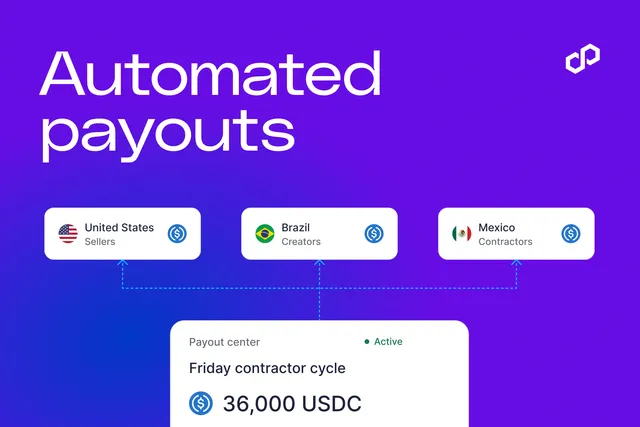
New to Polygon OMS: Automated stablecoin payout runs with rules your team sets
Polygon Open Money Stack now supports TRON
Meet Polygon at Money20/20 USA
Monerium, Frax and Capa connect euro payments to onchain FX markets on Polygon
Introducing crypto checkout in Polygon Open Money Stack
Polygon passes $3 trillion in stablecoin transfer volume
Polygon Chain now supports 11 million payments per second