A critical aspect of any blockchain ecosystem is the ability of a blockchain community to decide how the protocol is managed. Facilitating and socially coordinating upgrades to a blockchain network based on community feedback is what the Polygon Improvement Proposal (PIP) framework aims to accomplish.
The PIP framework provides a mechanism for the developer community to inform, propose, and gather technical feedback on new features. As a transparent and versioned repository, it enhances accountability, inclusion and self-governance by creating a historical record of all feature proposals, including their revision history and implementation progress.
For Polygon PoS, there is no single locus of control and all decisions are made by distributed consensus. An agreement among the parties providing the stake validating the network is the only manner of enacting change. What PIPs add to the mix is a social coordination component to facilitate good decision making by that community consensus pool.
The blockchain space has a rich history of developing mechanisms for this coordination, starting with the first Bitcoin Improvement Proposal more than a decade ago that laid out the BIP framework. The Ethereum community borrowed heavily from that experience in creating its own Ethereum Improvement Proposal framework, which since has been used to enact major protocol changes including introduction of the non-fungible token standard, fee burning and the upgrade to Proof-of-Stake.
The PIP framework is modeled after the BIP and EIP approaches and builds on that rich heritage of learning. Here is all you need to know to get started.
PIPs 101
PIPs describe standards and design specifications decided by the community for the Polygon network, including core protocol specifications, such as Heimdall and Bor chains of the Polygon PoS, client APIs, contract standards, and more. A PIP is a design document providing information to the Polygon community, or describing a new feature of the Polygon network or network processes.
Here’s a high-level summary:
- Anyone within the Polygon community has the ability to create a PIP.
- A PIP provides a concise technical specification as well as the motivation behind the proposal.
- The PIP author is responsible for reaching consensus within the community and documenting alternative opinions.
- Most PIP authors are application or protocol developers as a well-formed PIP requires a high degree of technical detail.
The recent Delhi hardfork of the Polygon PoS aimed at reducing severity of gas spikes and addressed chain reorgs. PIP-4 and a framework for evaluating validator performance are additional examples of PIPs in action. But PIPs can come in a number of flavors:
- Core: Changes that are not strictly necessary for reaching consensus but may still be pertinent to core components, such as Heimdall and Bor improvements.
- Contracts: Upgrades to the core contracts deployed on Ethereum.
- Interface: Improvements to client API/RPC specifications and standards, as well as some language-level standards like method names and contract ABIs.
- Informational: Recommendations, information, or general thoughts on an issue posted to the broader community. An informational PIP does not require consensus of the validating stake, but it may be adopted by the larger ecosystem, for example, as a new token standard.
How to PIP
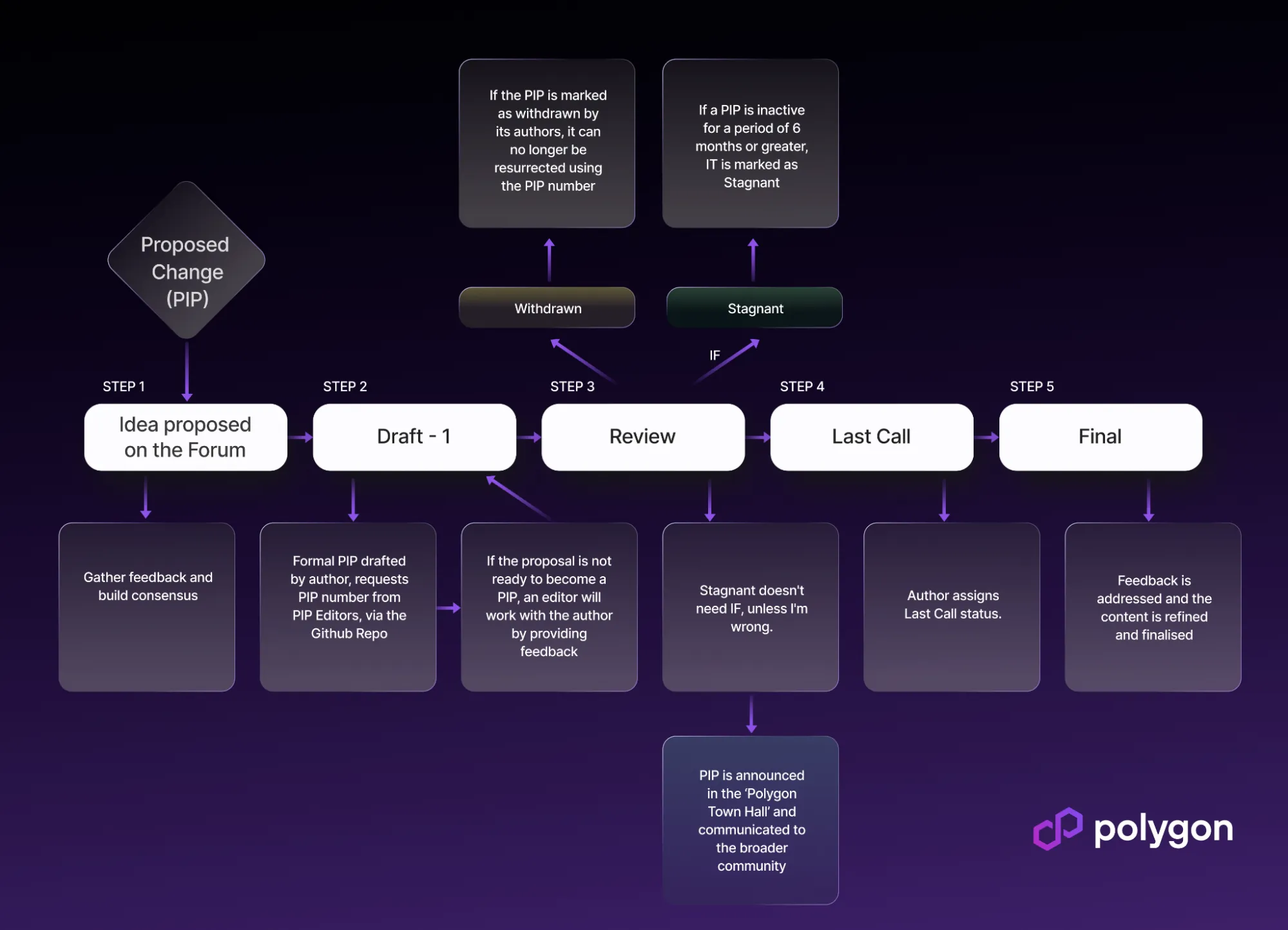
Step 1 - Publish your proposal on the Polygon Community Forum to engage with the community and gather their feedback. Authors should generally provide all relevant information here when drafting a PIP.
Step 2 - Create a pull request so that a PIP editor can either assign a number and status to your proposal or suggest changes to it. Your proposal is now officially ready for peer review.
Step 3 - PIPs are then peer reviewed and discussed in Polygon Builder Sessions, where the proposal is communicated to the larger community.
Step 4 - The ‘Last Call’ status will be assigned by editors to collect feedback over the following 14 days.
Step 5 - After all feedback has been taken into account, the final step lays the groundwork for the developer team to start prioritizing and implementing the PIP.
If the PIP author withdraws the proposal, it cannot be resubmitted under the same PIP number and will be considered as a new proposal if the idea is pursued at a later date.
The goal of PIPs is to facilitate community involvement in shaping the future of the Polygon PoS protocol by providing a forum for members to offer suggestions and vote on proposed changes, as well as to establish and promote new standards and recognize outstanding contributions from members of the community.
Head over to forum.polygon.technology to sign up and start participating in community discussions.Have further questions? Visit the FAQ page to read more. Tune into our blog and check out our social channels for the latest on the Polygon network ecosystem.
Together, we can build an equitable future for all through mass adoption of Web3!
Website | Twitter | Developer Twitter | Telegram | Reddit | Discord | Instagram | Facebook | LinkedIn
Introducing Polygon CDK Besu: Launch a Hyperledger Besu chain connected to other chains and their liquidity

Polygon Open Money Stack is now a U.S.-regulated payments platform with completion of Coinme acquisition
New to Polygon OMS: Automated stablecoin payout runs with rules your team sets
Polygon Open Money Stack now supports TRON
Meet Polygon at Money20/20 USA
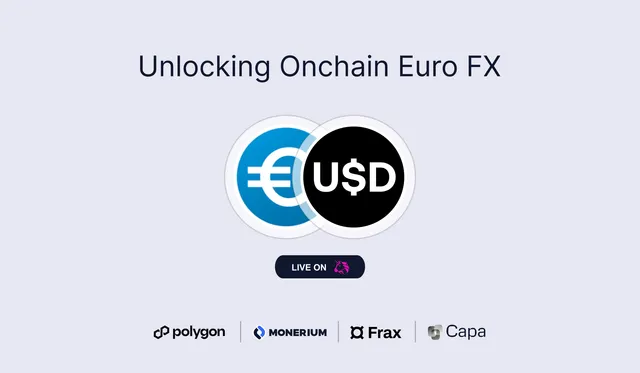
Monerium, Frax and Capa connect euro payments to onchain FX markets on Polygon
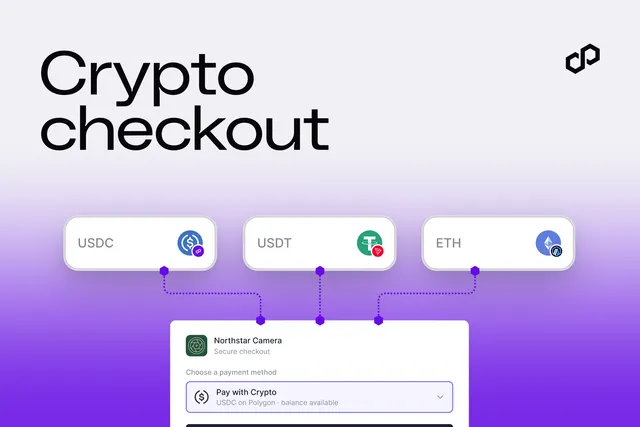
Introducing crypto checkout in Polygon Open Money Stack
Polygon passes $3 trillion in stablecoin transfer volume
Polygon Chain now supports 11 million payments per second