This article was written by Hugo Finkelstein, CEO at Riseworks.io.
Global payroll hasn’t changed much since the 1970s.
SWIFT wires. Correspondent banks. Three-to-five business day delays. Fees that quietly eat 3-7% of every transfer before a contractor ever sees the money.
The workforce has changed completely, but the payment infrastructure hasn’t.
That’s the gap Rise is closing together with Polygon.
The Market Is Moving Fast
What started as a payment method for crypto-native DAOs is now a $33 trillion annual transaction layer used by one in four companies worldwide. Over 225 businesses integrated stablecoins for payroll and operational payments in 2025 alone, and B2B stablecoin payment volumes surged from under $100 million monthly in early 2023 to over $6 billion by mid-2025.
- 25% of global businesses now use cryptocurrency for payroll.
- 63% prefer USDC for its regulatory clarity and institutional backing.
- And 75% of Gen Z workers want crypto salary options.
The demand is there. The regulation is catching up.
The GENIUS Act, signed into law in July 2025, established the first US federal framework for payment stablecoins, removing the single biggest compliance barrier to enterprise adoption.
And MiCA now provides uniform crypto market rules across the EU.
What companies need now isn’t a reason to adopt stablecoin payroll. They need the right chain and the right platform to run it on.
That’s exactly what we’ve built at Rise.
Why Polygon Is the Right Chain for Payroll
Not every blockchain is built for payroll. Payroll demands consistent throughput, fees that don’t erode margins, enterprise-grade stablecoin support, and finality fast enough that workers actually trust the system.
Most chains fail at least one of these requirements. Polygon clears all of them.
Speed that matches expectations
Polygon’s average transaction confirmation time is 2.1 seconds, versus Ethereum’s 12.4 seconds. Contractors get paid when the schedule says, not when a bank decides to process it. That predictability is the foundation of any payroll system workers can rely on.
Fees that don’t eat into wages
- The average transaction cost on Polygon sits at just $0.002, compared to Ethereum’s $1.58.
- Over 83% of transactions on Polygon cost less than $0.01, compared to just 5% on Ethereum mainnet.
The clear leader in payments volume
From February to June 2025, Polygon saw a 67% rise in micropayments volume, outpacing Solana, Ethereum, Base, Arbitrum, Optimism, Avalanche, and Gnosis.
In addition, Polygon is the number one chain for USDC transactions with a total stablecoin supply over $3.47B, with payment processor volumes on Polygon showing an impressive growth of 409% in 2025.
Polygon leads in peer-to-peer USDC micropayments with 3.4 million transactions, which is an 82% year-to-date increase and holds more than 50% market share in micropayment volume.
That’s not a coincidence. Polygon has been purpose-built around the speed and fee requirements that payments, including payroll, demand.
Native USDC with no bridging complexity
USDC leads crypto payouts with a 68% share across the market. Polygon hosts it natively, issued directly by Circle, meaning employers fund payroll in a fully-reserved, dollar-backed stablecoin with clean accounting and transparent compliance on every transaction. No wrapped assets. No bridge risk.
Cross-chain flexibility via CCTP
Circle’s Cross-Chain Transfer Protocol (CCTP) lets treasury teams move USDC between Polygon, Ethereum, and other supported chains without custodial bridges. For companies managing multi-chain treasuries, Polygon is already central to that routing infrastructure.
EVM compatibility
Finance and engineering teams don’t need to relearn anything. MetaMask, Ledger, Safe, and existing treasury workflows all run natively on Polygon. Adoption doesn’t require retraining or rebuilding from scratch.
Ecosystem reach for workers
Once paid, contractors aren’t just holding funds in a wallet. Our ecosystem gives them immediate access to DeFi, savings, global spending apps, and off-ramps including Revolut, turning payroll into the entry point of a real financial toolkit.
Why Rise Is the Right Platform for Payroll on Polygon
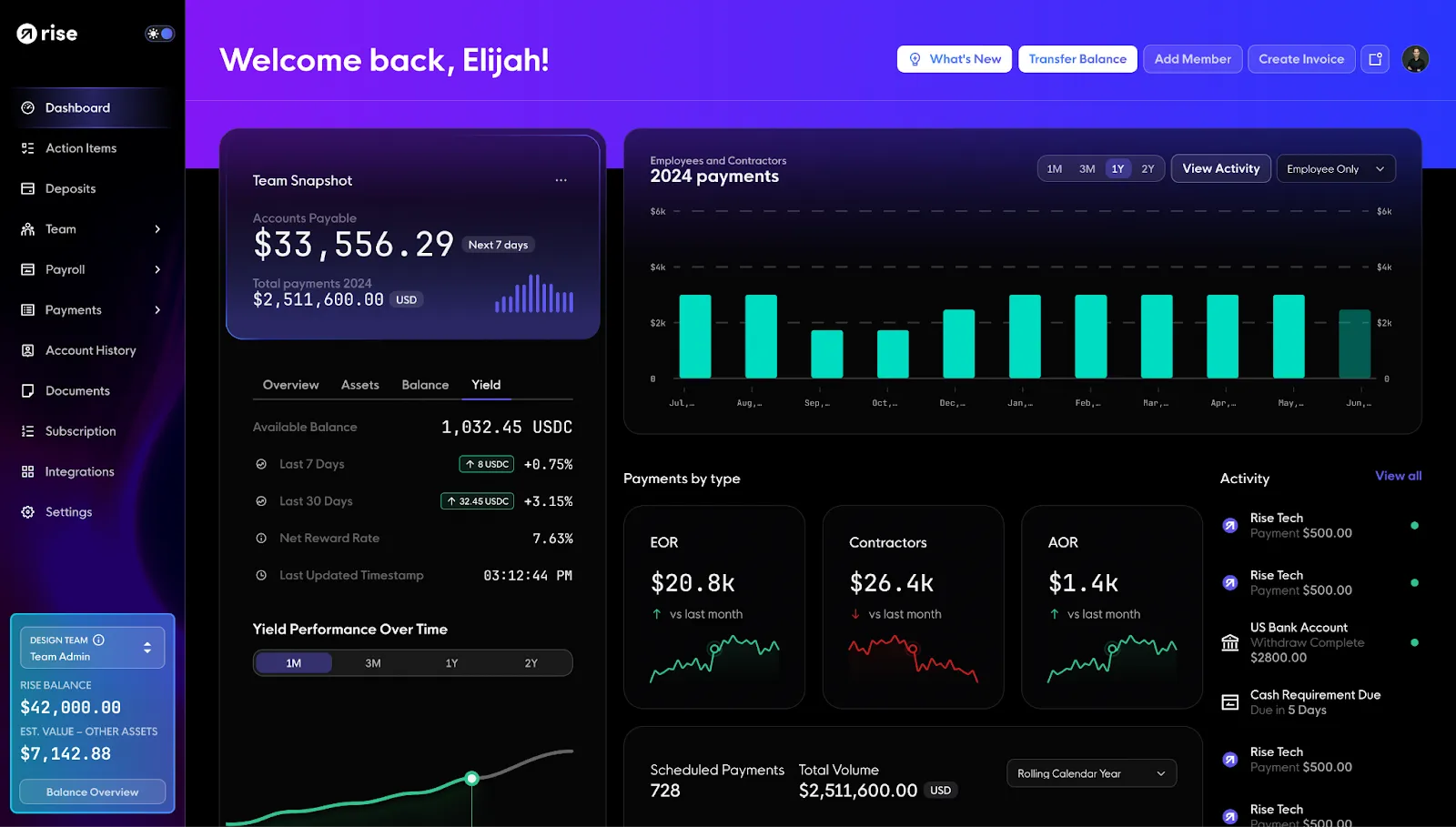
Polygon provides the rails. Rise provides everything built on top of them, the compliance engine, onboarding infrastructure, hybrid treasury controls, and multi-currency payout layer that turns a blockchain into an actual payroll system.
Rise is rated the best overall stablecoin payroll platform in 2026, offering native hybrid fiat-crypto payroll, worker-controlled withdrawals, and end-to-end compliance across 190+ countries from a single dashboard. Where competitors have retrofitted stablecoin support onto legacy systems through third-party partnerships, Rise was built from day one with stablecoin payroll as a core feature, not an add-on.
Here’s how the full flow works on Polygon:
Onboarding that’s compliant by default.
Rise handles contractor invitations, KYC, identity verification, classification, automated professional agreements, and tax documentation. Every contractor receives a Rise ID, an onchain identity layer that lets them set Polygon USDC as their preferred withdrawal method from the start.
Flexible treasury funding.
Companies fund payroll via USD bank transfer or directly in USDC/USDT. Deposit stablecoins on Polygon for near-zero-fee instant settlement, or fund in fiat and let Rise handle conversion. Either way, Rise allocates balances automatically across the global workforce.
Automated payment schedules.
Weekly, bi-weekly, monthly, milestone-based, or custom, Rise automates the schedule and handles compliance by region. No manual wallet-to-wallet transfers. No spreadsheets. One dashboard.
Worker-controlled withdrawals.
Contractors choose their own payout method every cycle, stablecoins, local fiat in 90+ currencies, or 100+ other crypto assets. Funds on Polygon arrive in under two seconds and with Polygon’s Revolut integration, off-ramping to a local wallet is as frictionless as it gets.
The result: a contractor in Manila and a contractor in Berlin both get paid on time, in their preferred currency, with full compliance documentation handled automatically, all from a single employer dashboard.
Where This Is Headed
Polygon’s infrastructure is strong today. It’s about to get significantly stronger.
Polygon’s speed opens the door for daily payouts, real-time performance bonuses, and on-demand compensation models that traditional payroll systems will never be able to match.
Stablecoin circulation is projected to exceed $1 trillion by late 2026, driven by institutional adoption.
Nearly 1 in 5 Fortune 500 executives now view onchain initiatives as a key part of company strategy, with the number planning to use or explore stablecoins increasing more than 3x year over year.
As enterprise treasury operations standardize on Polygon, payroll is a natural next step. Polygon has processed $2.3 trillion in cumulative value at 99.99% uptime which is a reliability track record that finance teams require before building critical infrastructure on any chain.
Rise is built to scale with every improvement we ship. No rebuilds. No migrations. Just better payroll, automatically.
The Bottom Line
Polygon is the chain that wins on the metrics that matter for payroll: speed, fees, USDC liquidity, payments volume, and EVM compatibility.
Rise is the platform that wraps our infrastructure in the compliance, automation, and flexibility that global teams actually need.
Together, we replace a process that takes 3–5 days and costs 3–7% with one that takes two seconds and costs fractions of a cent.
That’s not just a better payroll product. It’s a different category entirely.
Cross-border payroll shouldn’t take a week. Rise fixes that.

Polygon Open Money Stack now supports TRON

Meet Polygon at Money20/20 USA

Monerium, Frax and Capa connect euro payments to onchain FX markets on Polygon
Introducing crypto checkout in Polygon Open Money Stack
Polygon passes $3 trillion in stablecoin transfer volume
Polygon Chain now supports 11 million payments per second
New to Polygon OMS: Recurring Stablecoin Subscriptions With One Customer Approval
Stable.com Adds Polygon for Direct-to-Bank Stablecoin Transfers

One API for Any Payment: Inside Polygon Open Money Stack