
The Polygon AI Platform Team is spread: Yasin’s in Australia, Niko was in Denmark for a few days, Daryl ships at midnight, I get up at 5 am, and the rest of the team is equally spread. There is no globally convenient time slot available.
- Status updates are still necessary though as a way to keep everyone on the team in sync.
- Manual status updates are unreliable because people forget what they did.
- Naive automation is unreliable if it only looks at one system.
The real problem is that status truth is split across Github, Slack, and Jira, and reconciling it every day isn’t anyone’s job.
Enter Claude Tag.
We added Claude Tag to our team channel and asked it to check in with each team member at the end of their day. If it’s correct, the team member confirms it and continues on.
Status update complete.
Claude Tag looks for relevant work like PRs, commits, and tickets closed to pre-populate your status update. This saves the mental context switching from “what did I do today?” to just identifying the items missing from that list. Team members can reply to Claude and their changes get written back live. At the end of the day (Pacific Time), Claude posts a summary of everyone’s activity in one post, for everyone to see.
The part where it was wrong:
Yasin called out Claude Tag’s first draft for missing three of his tickets because it only pulled tickets linked to open PRs, not the full Jira queue. We updated Claude Tag’s instructions to pull the status from actual system activity: merges, PR states, ticket activity. Now Claude Tag presents a status update from all our data sources and asks “does this cover it, any blockers?”
The part it picked up on its own:
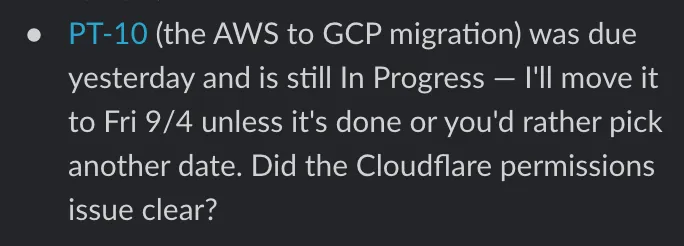
In one update, Claude Tag noticed Daryl had an overdue ticket that was still In Progress. Claude Tag offered to either move the due date to Friday or mark it done. Daryl’s reply “Yup, move it to 9/4” triggered Claude Tag to update the due date in Jira.
In another message, Daryl had been blocked on Cloudflare permissions previously. Claude Tag followed up to make sure the blocker was cleared. When team members are blocked, I get tagged directly to clear the blocker.
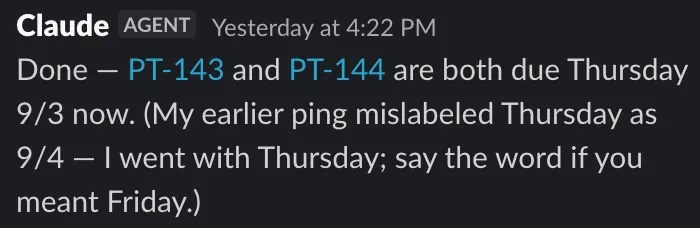
Claude Tag also corrects itself when wrong. In one exchange, it had the date wrong. In the follow-up message it admitted it, made a best-effort guess at the correct answer, and called out what it had done.
Watching its own bill
Anthropic rolled out $25k in credits for using Claude Tag. We wanted to use every penny. We had Claude Tag watching its own bill and tracking the credit countdown as we switched models to consume the credits and avoid overspending.
Using Claude Tag as an active member of the team
We’ve found it extremely useful to have Claude Tag interact with Jira on our behalf. Instead of leaving Slack to create a ticket in Jira, we now just @Claude make a ticket for this. This has saved time and cut down on context-switching. Claude Tag now triages tickets for us, too. If a ticket has been sitting in our queue, unclaimed for > 48 hours, Claude Tag picks it up and attempts to resolve the issue. This is a new process, so we’re still tracking how well it’s going to work.
What this actually changes
We didn’t have a Scrum Master on the team, and we were suffering as a result. Using Claude Tag, status updates became a byproduct of the work instead of a tax on it, and silence became visible instead of invisible. Claude Tag is now a full-time member of the team. His emoji game is strong, too — a requirement if you’re going to succeed on my team. It routinely responds with 👀 or 👍 to acknowledge messages, but grabs relevant emoji when appropriate, such as the beach with umbrella emoji when told to “hit the beach”. During his performance review at the end of the year, I’m going to challenge him to step up with memes and gifs.

Oh, Marketing said I need a call-to-action at the end of the post:
Buy POL. Stake POL.
Why we moved software development into Slack
An agent on your laptop is yours. An agent in the channel is the team's. How Polygon's non-engineers ship code without opening an IDE, and what it took to get there.

Why we moved software development into Slack
An agent on your laptop is yours. An agent in the channel is the team's. How Polygon's non-engineers ship code without opening an IDE, and what it took to get there.
Oct 825 minChaos engineering for Polygon PoS
“Chaos Engineering is the discipline of experimenting on a distributed system in order to build confidence in the system’s capability to withstand turbulent conditions in production.” — Rosenthal & Jones

Chaos engineering for Polygon PoS
“Chaos Engineering is the discipline of experimenting on a distributed system in order to build confidence in the system’s capability to withstand turbulent conditions in production.” — Rosenthal & Jones
Sep 1714 minEveryone at Polygon builds their own agents now. And the best thing we did to help them was get out of the way
We built our colleagues’ agents one at a time until the upkeep quietly became the job. So we stopped building them and handed everyone the platform instead — 12 agents running, 11 in the works, 605 runs last month.

Everyone at Polygon builds their own agents now. And the best thing we did to help them was get out of the way
We built our colleagues’ agents one at a time until the upkeep quietly became the job. So we stopped building them and handed everyone the platform instead — 12 agents running, 11 in the works, 605 runs last month.
Sep 176 min