.BcyISvV5.png)
$2.4 trillion is more than the GDP of Brazil. It’s larger than the entire market cap of the S&P 500 healthcare sector. It’s roughly what the United States federal government collects in individual income tax in a year.
That’s the stablecoin transfer volume settled on Polygon. It happened predictably, without incident, while most of the market was looking at something else.
But the first trillion took years.
The pace of the second one is the story worth telling.
2025 was an inflection point for growth
In February 2026, Polygon’s stablecoin supply hit an all-time high of $3.4 billion, nearly doubling from $1.64 billion at the start of 2025. Total transfer volume on the network reached $2.4 trillion. Monthly stablecoin volume crossed $298 billion.
It’s growth that compounded.
Twitter/X
This is content from Twitter/X. It only loads after you allow social networking cookies.
https://twitter.com/0xPolygon/status/2027399757799498053
The stablecoin driving most of this growth is USDC, the regulated, dollar-backed token that enterprise payment flows run on. USDC supply on Polygon nearly doubled year over year, from $777 million to $1.43 billion. By February 2026, Polygon had become the #1 network for USDC transactions globally, processing over 12 million per day. The next closest L2 was below 3 million.
Twitter/X
This is content from Twitter/X. It only loads after you allow social networking cookies.
https://twitter.com/0xPolygon/status/2022420373569237229
Then came a milestone that caught the wider market’s attention: In mid-February, Polygon flipped Ethereum in daily transaction fees, with Polygon generating over $313,000 in daily revenue compared to Ethereum’s $264,000. Ethereum has been the dominant settlement network since the beginning of the stablecoin era. Surpassing it in fee revenue, driven entirely by real usage, is not a small thing.
Twitter/X
This is content from Twitter/X. It only loads after you allow social networking cookies.
https://twitter.com/tokenterminal/status/2023497470991642658
Twitter/X
This is content from Twitter/X. It only loads after you allow social networking cookies.
https://twitter.com/growthepie_eth/status/2023386554870165857
In a single week in February, Polygon recorded 27.5 million USDC transactions (surpassing Solana’s 22 million), 102.8 million USDC transfers (46% global market share, 2.6x the next largest chain), and the highest organic x402 transfer volume of any network at $1.2 million.
Twitter/X
This is content from Twitter/X. It only loads after you allow social networking cookies.
https://twitter.com/petertherock/status/2023304145646620693
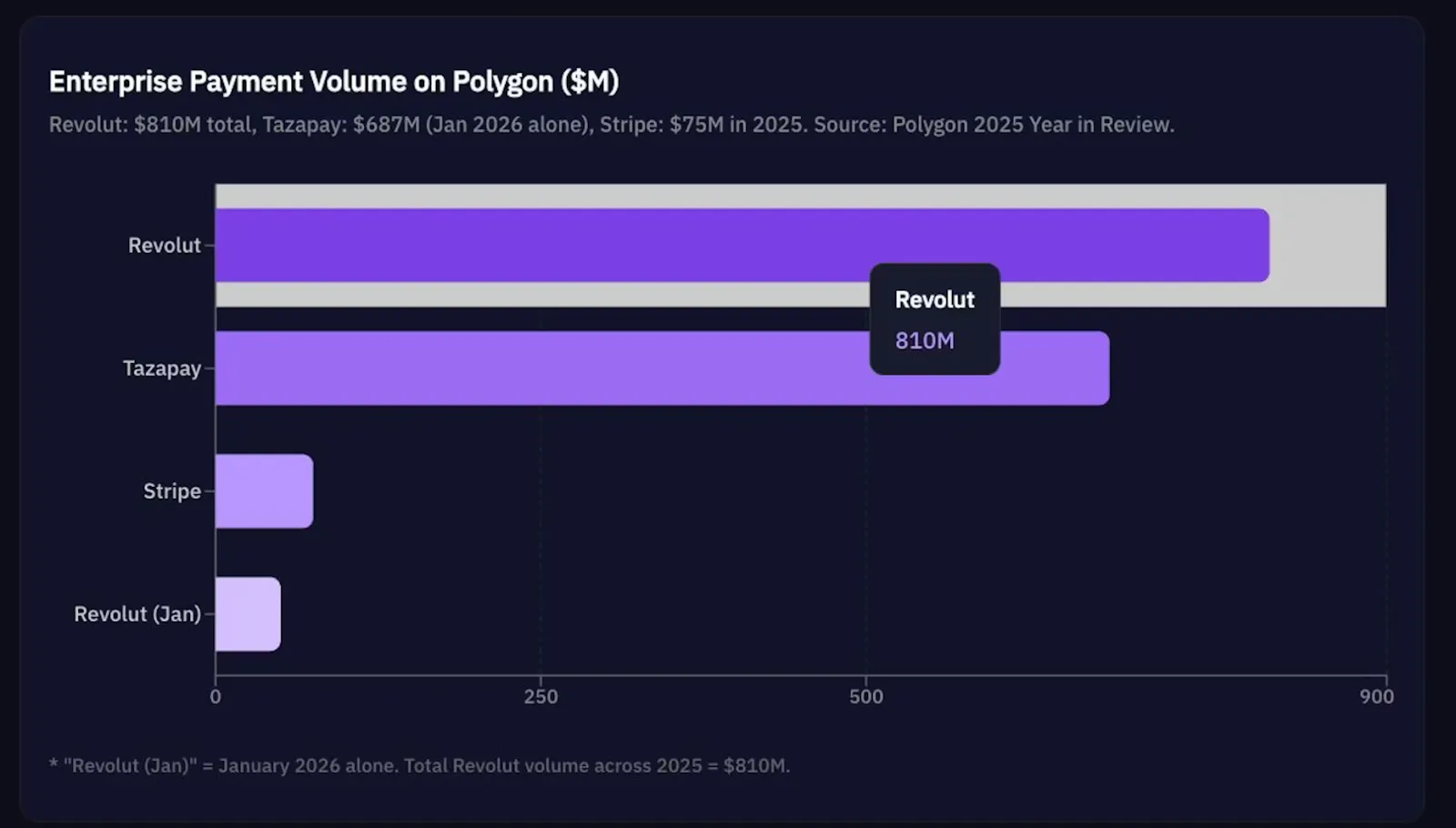
What makes this meaningful for enterprise teams evaluating infrastructure is who’s behind the numbers. Revolut moved $810 million through Polygon in 2025. Tazapay, a B2B cross-border payments platform operating in 173 countries, processed $687 million on Polygon in January 2026 alone. Stripe processed over $75 million in payments on the network. Flutterwave extended stablecoin payments across 30 countries in Africa.
And the infrastructure is scaling ahead of demand. Polygon’s gas limit increased to 110 million in February 2026, bringing maximum throughput to over 2,600 transactions per second. At that rate, the network can handle approximately 224 million transactions per day, at an average cost of $0.002 per transaction. The capacity ceiling is rising faster than the usage.
Twitter/X
This is content from Twitter/X. It only loads after you allow social networking cookies.
https://twitter.com/0xPolygon/status/2026349229913063742
Institutions are coming on board
The payments companies building on Polygon’s network include Revolut, Stripe, Paxos, Tazapay, Avenia Pay, and more. These are companies with compliance teams, vendor risk management processes, and technical due diligence cycles that last months. When an institution at that scale puts live payment volume on a network, they’ve done the work.
6.4 billion total transactions. 159 million unique wallet addresses. $3.4 billion in stablecoin supply. These are the numbers behind a network that’s been operating in production for nearly six years, processing more value each quarter than the one before.
Upgrading how the world moves money
Money is fragmented, slow, and inefficient. While the internet moves at the speed of light, money is stuck in line at the bank. Legacy financial systems were built for a different world. Polygon was founded to change that.
After six years and trillions processed, the settlement rail has proven itself. Revolut, Stripe and Paxos are all live on it. But even with this initial wave of enterprises recognizing the potential, there’s still a real bottleneck: getting them and their users onboarded is harder than it should be.
Wallets, compliance, fiat conversion, orchestration, each piece exists, but they were built separately by different teams with different standards. And critically, enterprises aren’t starting from zero. They have existing payment systems, treasury workflows, and compliance stacks already in place. Any new infrastructure has to plug into what’s already stood up, not ask them to rip and replace.
That’s why we’re building the Open Money Stack: a single integration for stablecoin payments that works with existing systems. Low fees, 24/7 global settlement, and infrastructure built to scale. It’s the product layer being built on top of the same network that has processed $2.4 trillion in stablecoin volume. Our new website reflects this focus: Polygon is upgrading how the world moves money.
Twitter/X
This is content from Twitter/X. It only loads after you allow social networking cookies.
https://twitter.com/0xPolygon/status/2029970604989075779
Build with us
Learn more about what we’re building at polygon.technology, or talk to our team about how your organization can move money on the infrastructure behind $2.4 trillion in settled transactions.

Introducing Polygon CDK Besu: Launch a Hyperledger Besu chain connected to other chains and their liquidity

Polygon Open Money Stack is now a U.S.-regulated payments platform with completion of Coinme acquisition
New to Polygon OMS: Automated stablecoin payout runs with rules your team sets

Polygon Open Money Stack now supports TRON

Meet Polygon at Money20/20 USA

Monerium, Frax and Capa connect euro payments to onchain FX markets on Polygon
Introducing crypto checkout in Polygon Open Money Stack
Polygon passes $3 trillion in stablecoin transfer volume

Polygon Chain now supports 11 million payments per second