A customer opens your app to send money, pay for a service or use a stablecoin balance. They expect a familiar payment experience, with their money protected every time they use it.
That expectation is harder to meet as threats grow. TRM Labs counted a record 207 crypto hacks in the first half of 2026, and infrastructure and operational compromises, about 15% of incidents, caused roughly 76% of the losses. Outages are a second risk: when AWS went down in October 2025, services including Coinbase and MetaMask were disrupted for hours, even though the blockchains underneath kept running.
Building that experience means protecting more than the moment someone signs in. The keys that approve payments need protection. Apps need clear spending boundaries. Users need a way to recover access when something goes wrong.
Polygon Open Money Stack brings wallet security into everyday payments, combining protected private keys, independent control over key access and spending limits enforced by the blockchain. With non-custodial wallets, users control their funds. No one, including Polygon, can move their money without their authorization.
Protecting every payment starts with the keys
A private key is the secret used to approve a wallet’s transactions. Whether someone is making one payment or authorizing a series of them, that key needs to stay protected.
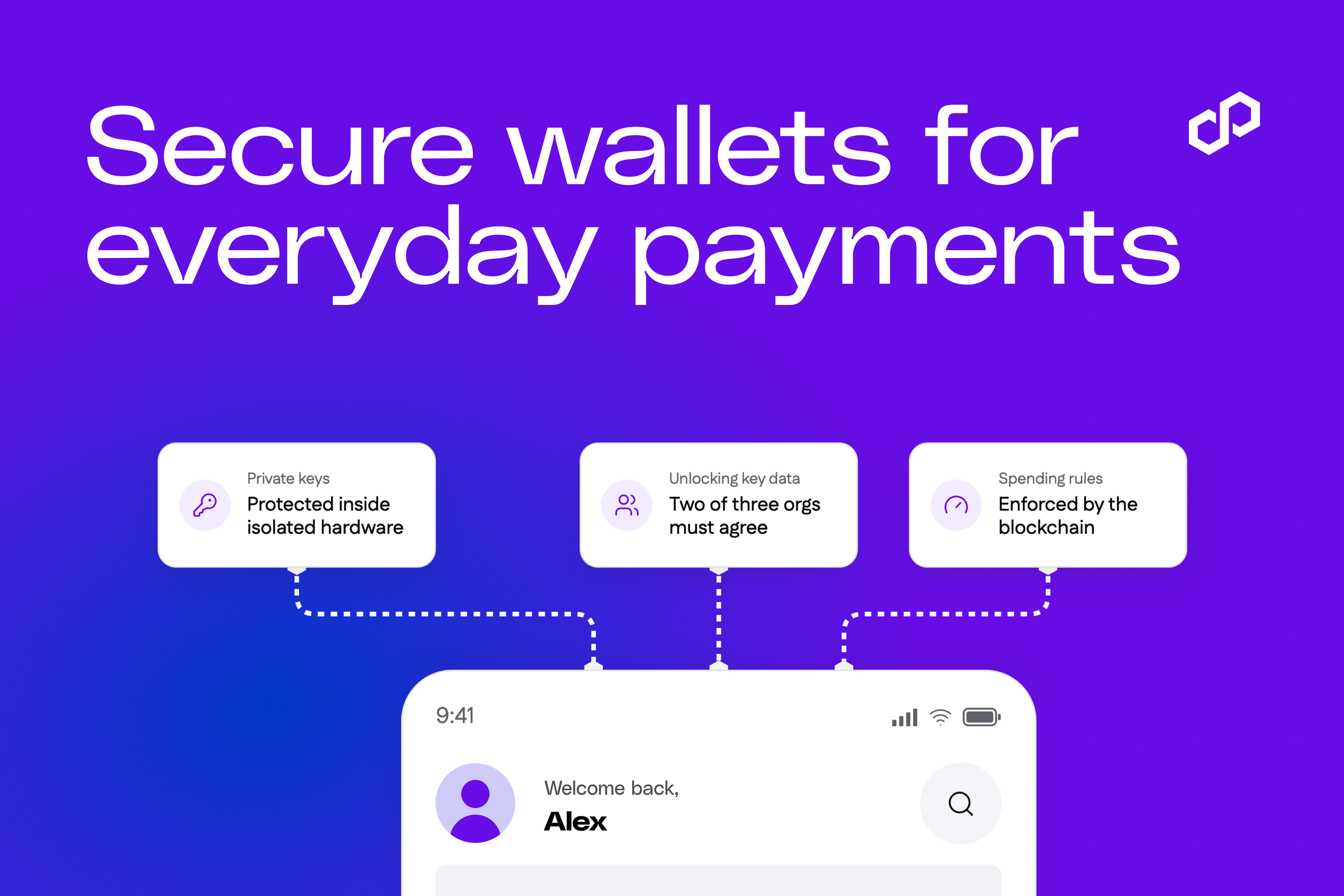
Private keys are generated and used inside AWS Nitro Enclaves, a protected computing environment isolated from the surrounding servers. Even Polygon’s own server administrators cannot look inside that environment to read the keys.
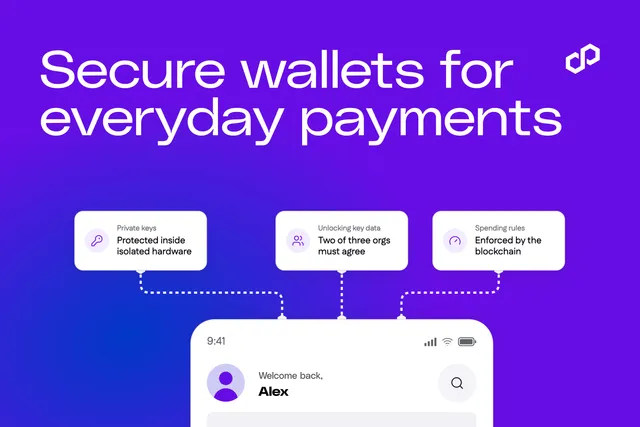
There is a separate check on access. Unlocking the protected key data requires agreement from at least two of three independent organizations: Polygon, Quantstamp and CoinCover. No single organization can unlock it alone.
These protections work together: the keys stay inside an isolated environment, and no single organization controls access to the protected key data. Unlocking that data does not give the organizations permission to spend a user’s money.
Most wallet infrastructure providers run key operations inside secure enclaves, so isolated hardware alone does not set a design apart. What does is Polygon’s key council: access to the protected key data requires agreement from at least two of three independent organizations (Polygon, Quantstamp and CoinCover), so no single party, including the provider, can unlock it.
Security businesses can verify
Businesses putting wallets into a payment product need evidence behind the security claims. The wallet contracts have been audited by Quantstamp, ConsenSys Diligence and Code4rena, adding independent scrutiny to the rules that control how funds move.
Every response from the wallet service also includes cryptographic proof of the code that produced it. That makes the code behind the response verifiable.
Repeat payments with clear spending limits
Everyday payments often involve repeat actions, such as paying for a subscription or letting an app complete a purchase. Users need a convenient way to authorize those actions while keeping control over how much can be spent and for how long.
With Smart Sessions in the Open Money Stack wallet, users can approve specific actions, set a spending cap and choose when permission expires. The blockchain enforces those limits whenever that permission is used.
For example, a user could authorize an AI agent to pay for a particular service within an agreed budget and time window. The agent can act within that permission, without receiving the user’s private key. A transaction outside the approved rules is rejected by the wallet’s contract.
That lets apps carry out approved payments without asking the user to approve each transaction again. The spending boundaries are built into the wallet, so they do not depend only on the app remembering to check them.
Businesses can add another check with Guard, an optional transaction screening service. It can check transactions against policies, assess potential threats and block known risky addresses. Teams can use it to block interactions with unknown contracts or flag large transfers.
A way back in without relying on Polygon
A wallet used for everyday payments also needs a recovery path. Losing access to an app should not leave a user dependent on its provider to get back to their funds.
Users can link multiple sign in methods. For non-custodial wallets on networks such as Ethereum and Polygon, they can also recover using a 24 word recovery phrase through a tool that works without Polygon’s involvement. This recovery path includes a 30 day safety delay and requires the underlying blockchain to remain live.
That gives users a route back to their wallet even if the operator is unavailable.
Secure wallets built into the payment flow
Key protection, independent checks, spending controls and recovery all support the same job: helping people use their money with confidence. The payment experience can stay familiar, too. Apps can sponsor network fees, or let users pay those fees in stablecoins, so making a payment does not require buying a separate token first.
Polygon Open Money Stack connects these wallets to money entering and leaving the system and routing through one integration. Businesses can build the payment experience around the people using it, with wallet protections supporting how their money is held and spent.
Polygon Open Money Stack is built for secure, everyday payments: keys stay protected, spending follows the permissions users approve, and users have a way to recover access without relying on Polygon.
Building a product that moves money? Talk to a payments specialist.
Disclaimer
This post is for general informational purposes only and does not constitute legal, financial, tax, regulatory, or investment advice. Nothing contained herein should be construed as a solicitation, offer, or recommendation to buy, sell, or engage with any product or service, nor should it be relied upon as the basis for any decision.
Users and institutions are solely responsible for ensuring that their access to and use of any Polygon product or service complies with all applicable laws, rules, and regulations in their respective jurisdictions. Polygon Labs makes no representation or warranty that any particular program configuration, feature, or use case will satisfy the legal or regulatory requirements of any specific jurisdiction. Users and institutions are strongly encouraged to seek independent legal counsel regarding their specific compliance obligations before engaging with any Polygon product or service.
The features, use cases, and illustrative examples described in this post are subject to applicable law and may not be available in all jurisdictions. All statements regarding future products, features, functionalities, or capabilities are forward-looking in nature and subject to change without notice. Such statements should not be relied upon as representations of future performance or availability.
Polygon Labs reserves the right, in its sole discretion and without prior notice, to modify, suspend, limit, restrict, or discontinue the program or any component of the Open Money Stack (“OMS”), in whole or in part, at any time. Use of OMS is subject to OMS terms and conditions. Polygon Labs further reserves the right to restrict or terminate access to any code, feature, or support for any user or in any jurisdiction where required by applicable legal or regulatory obligations.
Blockchain technology, smart contracts, and decentralized protocols involve inherent and significant risks, including but not limited to technical vulnerabilities, regulatory uncertainty, and potential loss of funds. To the fullest extent permitted by applicable law, Polygon Labs shall not be liable for any damage of any kind arising from or in connection with the use of, or reliance upon, the program, the Open Money Stack, or any information contained in this post.
Inside Polygon Open Money Stack: Secure wallets for everyday payments
Bennu is live on Polygon Open Money Stack to give global professionals a private home for their money
Polygon Agglayer v1.0 is now the fastest ZK-verified interop layer in production, settling in minutes
Nuvera is live on Polygon Open Money Stack for cross-border stablecoin settlement
Web3 user onboarding: how to simplify it for your app
SoFiUSD lands on Polygon Chain, bringing America's first bank-issued stablecoin to everyday use

Polygon Trails partners with Foresight to bring 1-click fund flows to prediction markets
Scalable payment infrastructure: scaling payment apps without sacrificing UX
MPC wallets: what they protect, and what a payments product still needs