
tl;dr
- Proven performance at scale matters more than cost or integration speed when evaluating payment infrastructure
- Ask about exception rates on live transactions, audited uptime, and true all-in cost including FX and correspondent charges
- Compliance architecture (built in, not bolted on) is the criterion procurement teams underweight until it’s too late
- This framework is designed to be used in a live procurement process, not just read
For every $100 million in cross-border volume, mid-market enterprises leave $1.5 to $6 million on the table.
This isn’t because they picked a bad provider; it’s because they evaluated infrastructure using criteria from the 1900s that doesn’t reflect how money can actually move now.
Wire fee? SLA? Corridor coverage? These considerations were designed around a system where sequential, multi-day settlement across intermediary banks is a given. Within this system, every provider is working the same levers: slightly tighter FX spreads, slightly fewer intermediaries, slightly faster reconciliation. The ceiling is built into the architecture.
Fintechs and banks are adopting blockchain-based settlement to get under that ceiling.
But ripping out payment infrastructure or layering new rails alongside what you already run is a real operational lift. Integration timelines stretch. Compliance requirements multiply across jurisdictions. And the wrong infrastructure choice locks you into a stack that may not scale with your volume or your corridors.
You will live with whatever decision you make for a long time.
Deciding what separates one blockchain-based solution from another, what’s real from what’s positioning, can be hard.
Below, we lay out how criteria we use to evaluate stablecoin-based infrastructure that actually makes a difference in real-world payment processing.
We’re releasing the following criteria so enterprises can think through criteria required to figure out how to evaluate what framework makes most sense for their solutions.
Criterion 1: Proven Volume at Scale
This is the first gate. Any provider can process onchain payments in a controlled or testnet environment.
What you need to know is how much live production volume can actually be handled. Not projections, not sandbox results, not annualized run rates from a three-month pilot.
Ask: What is your total processed transaction volume in live production over the past 24 months? What are your ten largest single-day volumes? At peak, what’s the transaction throughput?
The answer that signals credibility: Specific numbers, verifiable from public data or independent audits, at a scale that matches or exceeds your anticipated volume. A provider with $2 trillion in processed volume has been stress-tested in ways that a provider with $200 million hasn’t.
The answer that should give you pause: Vague references to “significant volume,” market sizing data substituted for production data, or a pivot to future projections when you ask about current throughput.
Volume matters because it’s the precondition for the next criterion: uptime under real load.
Criterion 2: Audited Uptime
99.9% uptime sounds like a high bar for payment processing. It’s not. That allows 8.77 hours of downtime per year. For enterprise-grade payment infrastructure, particularly anything handling 24/7 settlement, the standard is 99.99%, which limits annual downtime to about 52 minutes.
The distinction matters because payment downtime isn’t recoverable the way a content delivery outage is.
If a payment doesn’t process during a settlement window, you deal with counterparty exposure, failed supplier relationships, and potential contract penalties. Downtime compounds into cost, which is why uptime serves as an operational metric as well as a financial one.
Ask: What was the actual uptime of a system in the last 12 months? How is downtime defined in the SLA (service-level agreement)? Does it include scheduled maintenance?
The answer that signals credibility: Third-party verified uptime data, clear SLA definitions that exclude only explicit maintenance windows with advance notice, and a transparent incident history that shows how outages were handled when they did occur.
The answer that should give you pause: Uptime figures based on internal monitoring only, SLA definitions that allow the provider to calculate downtime on their own terms, or no incident history (meaning they’re either new or not disclosing it).
Uptime proves reliability. But reliability means nothing if the infrastructure can’t keep you compliant as you scale.
Criterion 3: Compliance Architecture
“We’re fully compliant” is something every payment provider says.
What varies enormously is whether compliance is built into the product architecture or applied as a layer on top of it. That architectural decision determines whether your compliance obligations scale with your volume or compound against it.
Compliance-as-architecture means automated KYC/KYB (know-your-customer and know-your-business verification) at onboarding, real-time transaction screening against OFAC (the US Office of Foreign Assets Control) and global sanctions lists, AML (anti-money laundering) monitoring that flags suspicious patterns rather than requiring manual review, analytics integration for stablecoin-based rails, and audit trails that satisfy regulatory reporting requirements without additional tooling.
Compliance-as-a-layer means a compliance team, third-party integrations that require separate contracts, and a workflow that slows down every time regulators update their requirements.
The difference shows up at scale: architecture handles ten times the volume with the same team; a layer requires ten times the headcount.
Ask: How is KYC/KYB handled? Is it integrated in the API, or do we need to bring our own identity provider? What happens when a transaction triggers an AML alert, and who handles the remediation? Are your compliance workflows audited by a third party?
The licensing question: For any provider handling fiat conversion (on-ramps and off-ramps, meaning the conversion points between traditional currency and stablecoins), ask specifically what money transmission licenses they hold and in which jurisdictions. For US operations, 48-state licensing coverage represents meaningful infrastructure investment. A provider with partial licensing creates corridors where you can’t operate.
Compliance keeps you operating. But even compliant infrastructure can erode your margins if you’re not looking at the full cost.
Criterion 4: All-In Cost, Not Headline Rate
Payment infrastructure pricing is structurally hard to compare.
The headline number, whether it’s a flat transaction fee or a percentage, is usually not where most of the cost lives. FX markup alone can run 0.5 to 2%, and it’s often embedded in the quoted exchange rate rather than broken out.
Correspondent banks deduct their own fees from the payment while it’s in transit. Settlement can take hours or days, which means your capital is locked up earning nothing. And when a payment fails, the reversal goes back through the same chain of intermediaries, accumulating fees in both directions.
The only comparison that actually means anything is all-in cost per dollar moved, calculated against your real transaction mix at your real volume. Getting to that number requires the kind of transparency most providers aren’t structured to offer.
Ask: What is the all-in cost for a $500,000 cross-border transfer from the US to Singapore, including FX conversion, any correspondent fees, and settlement fees? Is there a volume discount structure? What happens to pricing if we scale to 10x our initial volume?
The cost advantage to benchmark: For a mid-market enterprise on legacy rails paying 1.5 to 6% all-in, stablecoin-based infrastructure can bring that number well under 1% when you compare the full cost stack honestly, including ramps, FX, and compliance. On $100 million in annual cross-border volume, that’s somewhere between $1 million and $5 million back on the balance sheet every year. The exact number depends on your corridors, your volume, and how much of your current cost is hidden in the rate. Which is exactly why the comparison matters.
Cost determines ROI. But cost savings only materialize if you can actually integrate the infrastructure into your stack.
Criterion 5: Integration Reality, Not Integration Promise
Every provider tells you their API is simple to integrate. The real question is: simple compared to what, for which use case, by which team? Integration complexity lives in the edge cases: multi-currency handling, reconciliation formats, error handling, webhook reliability, sandbox environment fidelity.
Ask: Can we speak with an enterprise customer who integrated six months or more ago, after they were past their launch sprint? What does your sandbox environment cover, and does it accurately simulate the failure modes we’d encounter in production? What’s the average integration timeline for a company of our size and technical stack?
One-API principle: The cleanest architectures let you access the full payments stack (on-ramps, settlement, off-ramps, wallet infrastructure) through a single integration point. Every additional API contract is an additional maintenance burden, an additional failure vector, and an additional negotiation when pricing changes.
Integration complexity is measurable. But the best proxy for whether an integration works in production is whether other enterprises are running it in production today.
Criterion 6: Partner Proof, Not Logo Proof
Logo slides are not evidence. Here’s what real evidence is: what those companies are actually using the infrastructure for, at what volume, and with what results
Ask: Of listed partners, which ones can you connect with as references? What are they using the infrastructure for, specifically? Is it exploratory, pilot-scale, or production at meaningful volume?
The difference between a partnership announcement and a production integration is the difference between a press release and a due diligence process conducted by an organization with material risk at stake. The former tells you about a marketing team. The latter tells you about the infrastructure.
How We Built the Open Money Stack Against This Framework
We built the Open Money Stack to pass exactly this kind of evaluation. Here’s how we answer our own questions.
Proven volume: $2.4+ trillion in processed stablecoin volume, publicly verifiable onchain.
Uptime: The Polygon Chain processes 24/7 settlement across global corridors. Our infrastructure is built for the 99.99% standard this framework demands.
Compliance architecture: We partnered with Coinme, which we are acquiring, and is regulated in 48-state states, to cover fiat conversion across the U.S., with expanding international reach, too. Compliance is built into the Open Money Stack’s architecture.
All-in cost: Stablecoin-based settlement through our stack delivers well below 1% all-in, compared to the 3 to 7% enterprises typically pay on traditional cross-border rails.
Integration: One API (forthcoming) covers on-ramps, settlement, off-ramps, and wallet infrastructure. We designed the stack so your team deals with one solution, not five.
Partner proof: Mastercard, Revolut, Stripe, BlackRock, Visa, Polymarket, Flutterwave, Apollo, and more are using our infrastructure.
Start Your Infrastructure Evaluation
Explore the Open Money Stack, or talk to our team to get specific answers to the questions in this framework.

Polygon Open Money Stack now supports TRON

Meet Polygon at Money20/20 USA
Monerium, Frax and Capa connect euro payments to onchain FX markets on Polygon
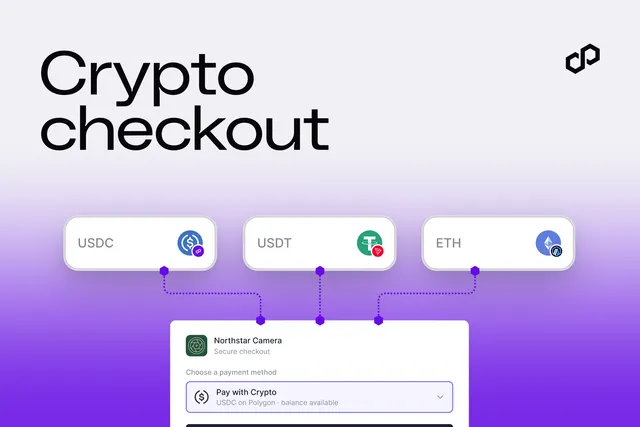
Introducing crypto checkout in Polygon Open Money Stack
Polygon passes $3 trillion in stablecoin transfer volume
Polygon Chain now supports 11 million payments per second
New to Polygon OMS: Recurring Stablecoin Subscriptions With One Customer Approval
Stable.com Adds Polygon for Direct-to-Bank Stablecoin Transfers
One API for Any Payment: Inside Polygon Open Money Stack