Something quiet has happened while the payments industry is debating the future of money: businesses in Latin America have started using it differently.
Not because they read a whitepaper, but because sending $10,000 through a correspondent banking chain and watching $150–500 disappear into fees and FX spreads, then waiting up to 24 hours — or longer on slower corridors — to find out if it arrived.
The SWIFT network was built for another era. Fees, float, opacity: none of it is designed for fintechs processing thousands of small-value cross-border transfers, daily. It’s designed for a world where international payments are rare, large, and handled by institutions with the balance sheet to absorb the friction.
That world is gone. Stablecoin settlement rails are being adopted by institutions with no particular interest in crypto. LATAM is where the shift is most visible. Institutions in the region are adopting stablecoins because the economics are materially better, the settlement is faster, and the capital requirements are lower. This piece breaks down the real numbers on both sides.
The True Cost of Traditional Rails
Ask a CFO what it costs to send an international wire and they’ll quote you a number between $25 and $50. That’s the fee their bank charges to initiate the transfer and on a typical cross-border payment, it’s the smallest cost on the list.
The rest is spread across line items that never appear on the same invoice.
Transaction fees. US banks charge $25–50 to send an international wire, with Chase running $40 online in USD and Wells Fargo at $25 digital. The receiving bank charges another $10-20 on the other end. For a $1,000 transfer, that’s 3–7% before anything else.
FX spread. Banks don’t use the mid-market rate, which makes sense from a revenue perspective. They apply a markup of 2–5% above it; Wells Fargo discloses this explicitly in its fee schedule: “The exchange rate Wells Fargo provides to you may be different from exchange rates you see elsewhere.” On a $50,000 transfer at a 2.7% markup, that’s $1,350 in conversion cost which isn’t disclosed on any fee schedule, rather invisible until the funds arrive short.
Intermediary deductions. SWIFT transfers route through correspondent banks between sender and receiver. Each one can deduct a fee mid-transfer — Wise estimates $15–50 per correspondent bank — without either party knowing in advance. These “lifting fees” reduce the amount received without explanation. The sending bank cannot guarantee the total because it doesn’t control what downstream correspondents will charge.
Capital lockup. Wire transfers can take up 24 hours to settle via SWFIT GPI and longer on slower or non-GPI corrders. During that period, funds are debited from the sender but not credited to the recipient. For a company running $10 million per month in cross-border payments, that means roughly $333,000 is in transit at any given time, unavailable for operations, earning nothing. At a 5% cost of capital, that idle float costs roughly $75,000–125,000 annually, just from settlement delay.
Then there’s the prefunding requirement. To process same-day payments across currency pairs, institutions must maintain pre-funded nostro accounts in each market. JPMorgan alone likely holds $15–25 billion in nostro balances globally. For smaller institutions and fintechs, that capital requirement is a direct barrier to operating in new corridors.
The combined cost of traditional rails on key LATAM corridors runs 2–7% of transaction value, with 2–5 day settlement and continuous capital locked in prefunded accounts.
What Stablecoin Rails Actually Cost
Stablecoin settlement on Polygon compresses each of those four cost categories.
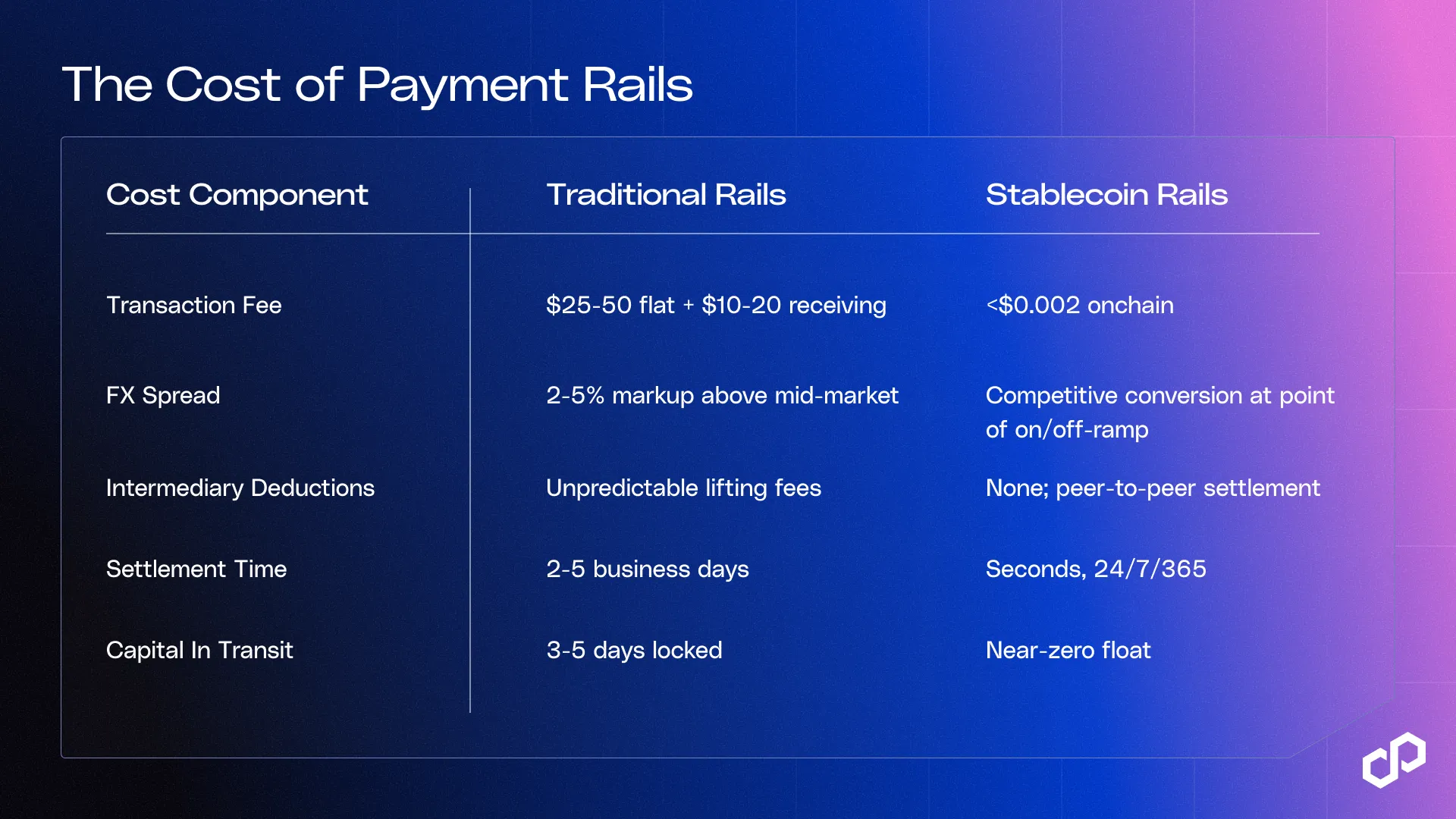
Across B2B implementations, the total reduction for adopting stablecoins consistently lands in the 30–50% range when all cost components are included: transaction fees, FX spread, float, and intermediary deductions. EY’s 2025 stablecoin survey found 41% of current users reporting cost savings of at least 10% in B2B cross-border payments, with midsize firms reporting 10–20% savings. BVNK’s Stablecoin Utility Report 2026, surveying 4,600 users across 15 countries, found stablecoin transfers cost an average 40% less than traditional remittance channels.
Onchain fees are not the whole picture; on/off-ramp fees and FX conversion at the fiat legs still apply. The savings come primarily from eliminating intermediary deductions, reducing float costs, and removing the prefunding capital requirement.
The Case for Stablecoin Is a Foregone Conclusion
Stablecoin rails change the economics of cross-border payments in four distinct categories. And institutions that have run the numbers are acting on all four. Adoption is following operational arguments on their own merits. Below, we cover how banks, remittance platforms, PSPs, and corporate treasuries are utilizing this technology in the real world.
Why Banks Are Moving in This Direction
Settlement efficiency. The clearest signal is coming from the region itself: LATAM.
BTG Pactual, Latin America’s largest investment bank, issued BTG Dol, bank-issued dollar-backed stablecoin, explicitly to eliminate the cost and friction of cross-border dollarization for Brazilian clients. Nubank, serving 127 million customers across Brazil, Mexico, and Colombia, embedded USDC into its platform as a core financial product; by mid-2025, one in four new Nubank Cripto investors chose USDC as their first holding. Itaú Unibanco, Brazil’s largest bank, integrated crypto and participated in the Central Bank of Brazil’s Lift Challenge for DLT-based cross-border payments. Most recently, Grupo Braza, Brazil’s largest foreign exchange bank, expanded BBRL, its fully-backed, BCB-regulated Brazilian real stablecoin, to Polygon, connecting BRL liquidity directly to global payment infrastructure. Brazil’s Central Bank has reported that over 90% of the country’s crypto transaction volume is stablecoin-denominated and the primary use case is cross-border payments and treasury.
Counterparty risk reduction. Traditional wire transfers have a multi-day window where funds are in transit and either party can face operational failure. Stablecoin settlement is atomic: the transaction either completes or it doesn’t. Nothing is in limbo.
Capital efficiency. Eliminating multi-day settlement frees working capital that previously sat idle in transit. For institutions processing large volumes, this is a meaningful improvement in return on capital.
Treasury optimization. Stablecoin balances can earn yield while waiting for deployment. Rather than idle nostro accounts earning minimal returns, treasury teams can hold dollar-denominated stablecoins in interest-bearing positions and redeploy instantly when payment is needed.
The savings are measurable and significant.
Mizuho research reports that remittance fees via stablecoin rails in the US–Mexico corridor are now under 1%, a huge cost-savings against the 5–7% average on traditional channels. Fireblocks’ 2025 survey found that 71% of Latin American institutions are already using stablecoins for cross-border payments, the highest regional adoption rate globally. EY’s 2025 stablecoin survey found that 80% of non-users are actively exploring adoption.
For Remittance Platforms
Mexico received $64.7 billion in remittances in 2024, an all-time record that saw a drop in 2025. The US–Mexico corridor alone accounts for the majority of that, and it’s where the stablecoin model has already proven itself at scale. Bitso processed $6.5 billion in US–Mexico crypto remittances in 2024, roughly 10% of the entire corridor, with competitive FX and same-day settlement. Felix Pago has processed over $1 billion through a USDC-to-SPEI model that settles via WhatsApp, at fees well below Western Union’s.
Platforms still running remittance volume through traditional correspondent rails on these corridors are competing against stablecoin cost structure. New blockchain-based rails are not only viable on US→MX, US→BR, or US→AR, but are seeing increasing volume for operators who’ve already made the switch.
Brazil is the largest crypto market in Latin America, with $318.8 billion in crypto inflows through mid-2025 and over 90% of flows moving through stablecoins. The infrastructure for remittance settlement into PIX is live. The regulatory framework, BCB Resolutions 519–521, effective February 2026, is defined. What’s left is execution.
For PSPs and Embedded Payment Infrastructure
If your product is the cross-border payment layer, then the rail you settle on is a direct input to your margin. Your settlement speeds and your ability to launch new corridors without standing up new banking relationships are all constrained by legacy systems. This is true if you’re building a remittance API, an embedded payments platform, or you’re a PSP managing multi-country settlement.
The fragmentation problem is structural.
PIX in Brazil, SPEI in Mexico, Transferencias 3.0 in Argentina, Bre-B in Colombia: none interoperate natively. Every new corridor means a new integration, a new compliance relationship, a new prefunding requirement.
Companies like Conduit and BlindPay are already building on stablecoin settlement precisely because it collapses that stack; the cross-border leg settles on a single standard, and local-currency conversion happens at the fiat edge via licensed on/off-ramp providers.
A platform that settles in USDC on Polygon can reach any corridor where a licensed ramp exists, without a new correspondent banking relationship for each one. Conduit hit $10 billion in annualized cross-border volume in 2024, growing 16x in a single year, with Latin America as its primary market.
For PSPs managing high-frequency, lower-value flows, the per-transaction economics are the point: sub-cent settlement costs versus $25–50 wire fees mean the unit economics of serving SMB cross-border volume change entirely.
For B2B Treasury and Corporate Payments
Many finance teams fear the float number. On $10 million per month in cross-border payments, 2–5 day settlement means roughly $333,000 is in transit at any given time. At a 5% cost of capital, that’s $75,000–125,000 a year in idle money, all before you count the 2–5% FX spread or the $25–50 wire fee on each transaction.
For corporates running supplier payments, intercompany settlement, or multi-entity treasury across LATAM, that’s the baseline cost of operating on traditional rails.
Stablecoin settlement eliminates the float. Funds move in seconds, 24/7, without weekend cutoffs or holiday delays that compound settlement timelines on LATAM corridors.
Dollar-based wallets and neo-treasury providers operating in high-inflation markets are already holding stablecoin balances as a treasury position. The settlement infrastructure is identical to what cross-border payment flows need, which means if you’re already in stablecoins for treasury, the operational lift to add B2B settlement on top is smaller than you’d expect.
The Regulatory Moment
For LATAM operators, regulatory clarity on stablecoins arrived in 2025 and 2026.
Brazil: BCB Resolutions 519–521 (effective February 2026) classify stablecoin transactions as foreign exchange operations, bringing them under the same framework as traditional remittances. Compliance requirements are now defined. VASPs require BCB authorization with R$10.8–37.2M in minimum capital, depending on activity type.
Mexico: The Ley Fintech (2018) established the foundational framework for regulated payment institutions. B2B stablecoin operators function under Mexico’s AML regime as non-financial entities — which is workable today, and regulatory modernization for stablecoins is actively underway.
United States: The GENIUS Act, signed July 18, 2025, established the first federal framework for payment stablecoins — 1:1 reserves, monthly attestations, and AML compliance requirements. This materially de-risks USD stablecoin infrastructure for LATAM operators whose flows originate in the US.
The consistent signal: stablecoin infrastructure is becoming regulated financial infrastructure. Operators who are building on compliant rails are ahead of competitors still evaluating their options.
The Decision
The traditional rail cost structure in LATAM cross-border payments is stuck in the past. Correspondent banking fees are sticky, FX spreads remain wide in emerging market corridors, and the capital requirements for prefunding don’t shrink.
And the stablecoin alternative is already here. Visa, Mastercard, Stripe, and JPMorgan are running live stablecoin settlement infrastructure today. Conduit crossed $10B in annualized volume in 2024. Bitso Business is processing stablecoin settlement for over 1,900 clients. This is institutional validation at scale.
For LATAM payment operators, the numbers are well-documented: 30–50% reduction in end-to-end transaction costs depending on corridor and volume, near-zero settlement float, 24/7 availability, and the elimination of the prefunding capital that currently sits idle across every corridor you operate.
The infrastructure to do this on Polygon is available now.
Reclaim cross-border costs with Polygon.
Talk to our team about migrating your LATAM payment operations to stablecoin rails. We work directly with PSPs, fintechs, neobanks, and treasury teams on architecture, compliance, and implementation and can help you change your legacy (rails) in weeks, not months.
Get in touch with Polygon’s enterprise team →
Polygon Open Money Stack is now a U.S.-regulated payments platform with completion of Coinme acquisition
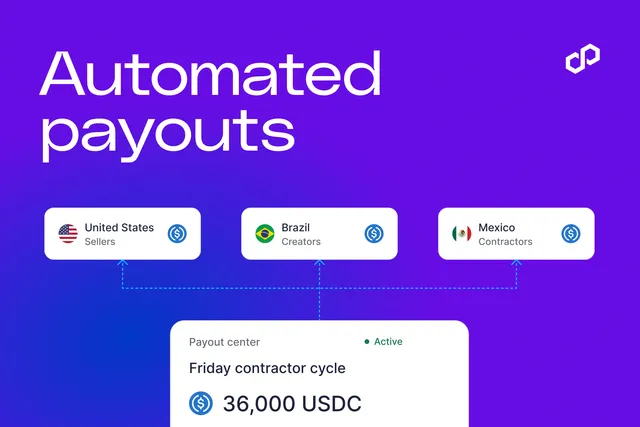
New to Polygon OMS: Automated stablecoin payout runs with rules your team sets

Polygon Open Money Stack now supports TRON
Meet Polygon at Money20/20 USA
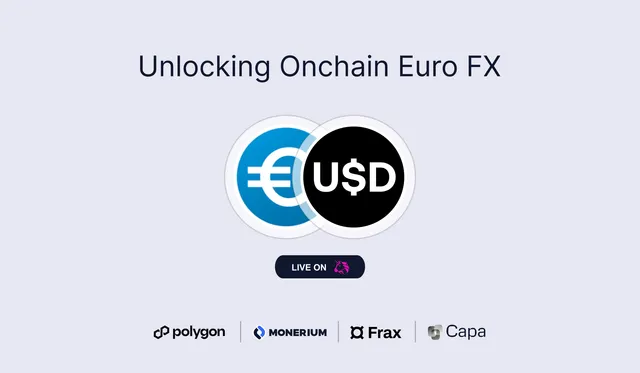
Monerium, Frax and Capa connect euro payments to onchain FX markets on Polygon
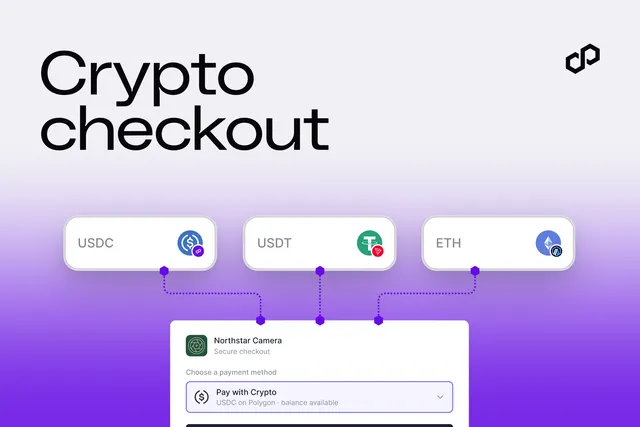
Introducing crypto checkout in Polygon Open Money Stack
Polygon passes $3 trillion in stablecoin transfer volume
Polygon Chain now supports 11 million payments per second
New to Polygon OMS: Recurring Stablecoin Subscriptions With One Customer Approval