Today, Mastercard introduced Agent Pay for Machines (AP4M), a new service that allows machine-driven transactions to be permissioned, orchestrated, and settled at machine speed across its global payments network.
More than 30 companies are among the first participants and supporters. Polygon is one of them, alongside Adyen, Ant International, Checkout.com, Cloudflare, Coinbase, Getnet by Santander, Global Payments, Solana, and Stripe.
We think this launch matters because of what it says about where payments are heading.
Agentic commerce already runs on the Polygon network. As of June 2026, 95% of all x402 transactions (the open protocol that lets AI agents pay for resources over HTTP) settle through Polygon, more than 15.5 million agent payments to date. The economics hold up: finality in about five seconds, fees in fractions of a cent, and our intent-powered orchestration layer of the Open Money Stack finding the best route from a single instruction.
AI agents are becoming full economic actors, participating in ways that are essential to their own prosperity: buying compute, data, hosting, and services on behalf of the businesses that deploy them.
One human request can now fan out into a chain of transactions executed automatically across providers.
Payments are changing for the better
Agent payments look substantially different from human checkouts.
They are continuous instead of one-off, initiated by software and not people, and often are only fractions of a cent. A logistics agent might pay for freight, reserve loading-bay access, and settle warehouse fees as a shipment moves. That’s dozens of small transactions where a person would have made one.
Existing payment infrastructure was designed for people clicking buy.
Machine-driven commerce needs something different: transactions that are credentialed, permissioned, and settled reliably at volumes and values today’s systems were never built for.
AP4M is Mastercard’s answer. It builds on the Agent Pay program Mastercard introduced in 2025 and rests on four capabilities:
- credentialing, so every agent can be recognized and trusted across ecosystems;
- permissioning, so spending rules are enforced programmatically;
- transacting, so verified participants can connect across providers; and
- settling, with guaranteed multi-rail settlement across cards, accounts, and stablecoins.
Where the Polygon network fits
That last rail is where we come in.
Stablecoin settlement is what the Polygon network does at scale today: transactions reach finality in about five seconds and cost fractions of a cent, which is the economic profile machine-driven payments require. A payment model built on very high volumes and very small values only works when the settlement layer doesn’t eat the margin.
We built the Open Money Stack (our end-to-end platform for global stablecoin payments) so businesses can move money on those rails without assembling the infrastructure themselves. Agent-driven commerce is a natural extension of that work, and supporting AP4M connects it to one of the largest payment networks in the world.
“Polygon Labs is building the infrastructure for programmable payments and agent-driven commerce at global scale, with the Open Money Stack helping make digital financial services more accessible and interoperable,” said Aishwary Gupta, global head of business at Polygon. “Mastercard’s exploration of machine payments underscores how blockchain and traditional payment networks can work together to unlock new consumer and business experiences while accelerating the evolution of the digital payments ecosystem.”
What happens next
Mastercard and its partners are now validating priority use cases, establishing common rules, and working to accelerate adoption across industries. We expect agentic payments to develop the way most payment infrastructure does: quietly, in the background, until one day the volume is impossible to ignore.
The direction is what counts. Card networks, PSPs, and blockchain networks are building toward the same future, one where software transacts on its own and settlement has to keep up. We’re glad to be building it together.
Read Mastercard’s full announcement here.
If you’re building agentic payments on the Polygon network, talk to us.
Disclaimer
This post is for general informational purposes only. It does not constitute legal, financial, tax, regulatory, or investment advice, and should not be relied upon as such. Nothing in this post constitutes a solicitation, offer, or recommendation to buy, sell, or use any product or service. Users and businesses are responsible for ensuring their use of Open Money Stack and any related Polygon products complies with all applicable laws and regulations in their jurisdiction. Use of Open Money Stack is subject to Polygon’s Terms of Use and, for OMS-specific services, the Open Money Stack Terms and Conditions, available at polygon.technology/terms-of-use. Any applicable third-party terms and conditions also apply.
Open Money Stack is currently in technical preview with limited early access. Features, functionality, and availability are subject to change. Access may be modified, suspended, or discontinued at any time. Polygon reserves the right, in its sole discretion, to modify, suspend, limit, or discontinue the Open Money Stack or any component thereof, in whole or in part, at any time and without prior notice.
Mastercard Agent Pay for Machines is a product and service of Mastercard International Incorporated and its affiliates, not Polygon Labs. Polygon Labs is one of multiple initial participants and supporters of the program. Participation does not constitute, and should not be construed as, an endorsement, certification, approval, or preferential status by Mastercard, and Polygon Labs makes no representations or warranties regarding Agent Pay for Machines, its features, availability, performance, supported jurisdictions, or compliance posture. Use of Mastercard products and services is subject to Mastercard’s terms and policies.
Transaction data referenced in this post, including x402 transaction share and counts, is drawn from publicly available third-party analytics (Dune Analytics) as of June 2026, reflects activity measured at the facilitator level, and is subject to change. Polygon Labs does not guarantee the accuracy or completeness of third-party data.
Statements in this post regarding future products, features, or capabilities are forward-looking and subject to change without notice. They do not constitute commitments, guarantees, or representations as to timeline or availability.
Polygon shall not be liable for any loss or damage arising from use of, or reliance on, Open Money Stack or the information in this post.
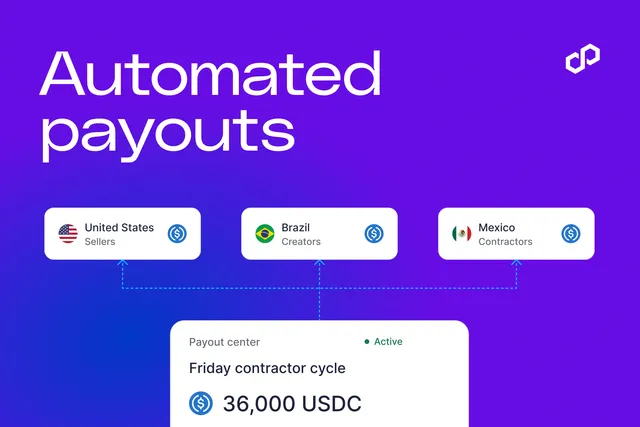
New to Polygon OMS: Automated stablecoin payout runs with rules your team sets

Polygon Open Money Stack now supports TRON
Meet Polygon at Money20/20 USA

Monerium, Frax and Capa connect euro payments to onchain FX markets on Polygon
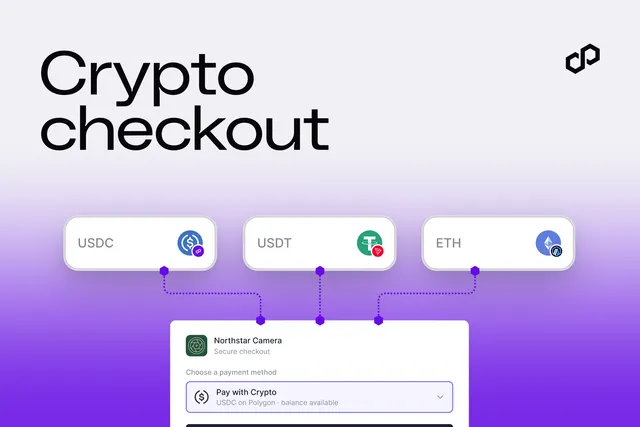
Introducing crypto checkout in Polygon Open Money Stack
Polygon passes $3 trillion in stablecoin transfer volume
Polygon Chain now supports 11 million payments per second
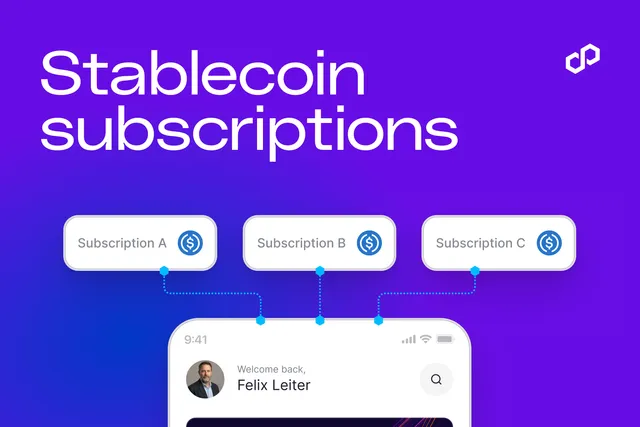
New to Polygon OMS: Recurring Stablecoin Subscriptions With One Customer Approval
Stable.com Adds Polygon for Direct-to-Bank Stablecoin Transfers