Six years of receipts
Every few months, another chain announces a payments strategy. New entrants raise rounds, publish roadmaps, launch testnets. The category is getting crowded with promises.
We have something more tangible: receipts.
$2.6 trillion in stablecoin value has moved through Polygon. $3.8 billion in stablecoins sit on the network today. Stablecoin volume grew 264% year-over-year in 2025. And institutions driving that volume are doubling down on stablecoins.
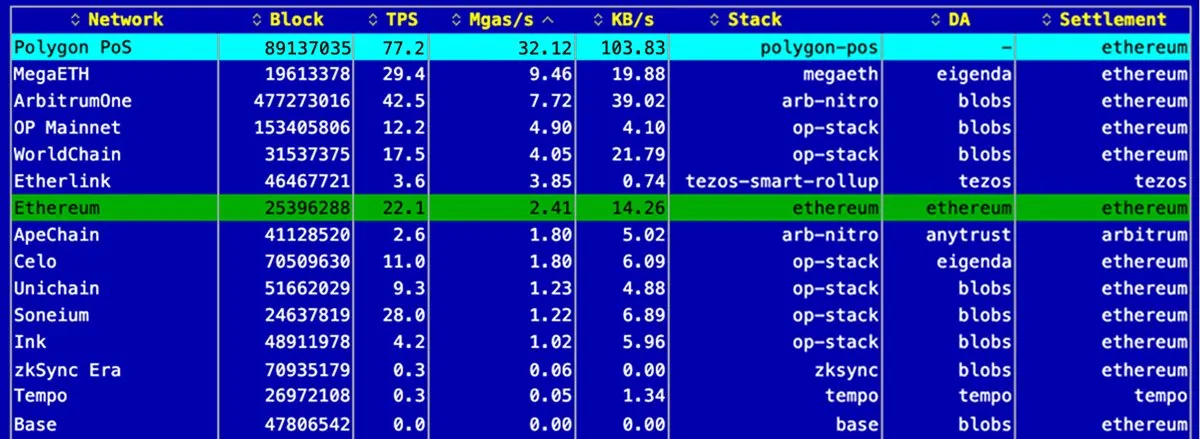
Source: https://rollup.wtf/
Stripe routes stablecoin payments through Polygon rails, with global USDC payments live for merchants across 150+ countries.
Mastercard settles merchant payouts on Polygon at nights, weekends, and holidays, when traditional rails sit idle, and chose Polygon as part of the ecosystem powering its new Agent Pay product.
Shift4, one of the world’s largest independent payment processors, settles in stablecoin on Polygon for hundreds of thousands of merchants worldwide.
Revolut processed over $1.2 billion in stablecoin volume on Polygon, with fees 437x cheaper than Ethereum and 4x cheaper than Solana.
Paxos settled $1.3 billion in stablecoin payments on Polygon for total gas fees under $700.
Cash App lets users send and receive stablecoins on Polygon.
Polymarket has processed over $65 billion in stablecoin volume on Polygon.
BlackRock runs BUIDL, its tokenized money market fund, on Polygon.
Twitter/X
This is content from Twitter/X. It only loads after you allow social networking cookies.
https://twitter.com/0xPolygon/status/2038968865921863709
What we built for them, and what’s shipping next
These businesses chose Polygon because it works in production. They’ve been moving real volume on infrastructure proven across six years. And we keep optimizing it to match what enterprises need as more financial volume moves onchain.
A year ago, Polygon Chain was running at roughly 1,000 TPS with two-minute finality. Today, it handles up to 5,000 payments per second, confirms transactions in about 5 seconds, and hasn’t seen a single reorg in 6 months. Each upgrade builds on the last.
Here’s what’s already live, what ships next, and why it matters for businesses moving real money.
Live on Polygon Chain
5,000 payments per second
Polygon Chain now handles 5,000 payments per second after a recent upgrade raised the gas limit to 160M at 1.5-second blocks. That’s the speed of a card network, for a fraction of a cent per transaction. The Gigagas roadmap targets 100,000 TPS next.
Twitter/X
This is content from Twitter/X. It only loads after you allow social networking cookies.
https://twitter.com/0xPolygon/status/2069852795725926406
Near-instant finality, zero reorgs.
Polygon Chain confirms transactions in about 5 seconds, often faster than a Venmo confirmation. Since the Rio upgrade in October 2025, the chain has seen near-instant finality, better reliability and and end to reorgs. Once a transaction confirms, it stays final. That’s what lets a fintech show its user “paid” the moment they tap, without rolling it back two minutes later.
Smooth, predictable fees
Headroom from the 160M gas limit means it takes far more volume before blocks fill. When fees do move, they move gradually, not in sudden spikes. Apps price against stable fees the way they price against card networks.
Automated payment flows
Recurring settlements, conditional releases, programmable escrow built at the protocol level. The Lisovo upgrade earmarked up to $1M of fee revenue to make programmable transactions cheaper. The first protocol-level subsidy for programmable commerce on any live chain.
Private mempool
On most chains, every payment is visible before it confirms. High-value transfers get front-run. Institutions absorb costs they never agreed to. Payments on Polygon will be shielded from front-running and sandwich attacks until they’re finalized. What gets submitted is what settles.
Dedicated blockspace
A $100M institutional settlement shouldn’t compete for block inclusion with every other transaction on the network. We’re reserving blockspace for payment transactions: guaranteed inclusion, predictable execution, regardless of what else the network is processing. Payment rails get their own lane.
Confidential payments
Supplier payments, payroll, institutional transfers: these can’t be public. A company paying a vendor doesn’t want the amount visible to competitors. An institution moving assets doesn’t want strategy legible on a block explorer. We’re building native transaction privacy into the protocol: amounts, senders, and receivers shielded by default, with the auditability compliance requires.
Together, these give enterprises something more than hype: a settlement layer where finality, fee predictability, throughput, and programmability are guarantees, not best-effort promises that break under load.
Agents pay on Polygon
The next generation of payment users isn’t human. Agents don’t carry credit cards or sign up for bank accounts. They need rails that move at machine speed, cost fractions of a cent, and settle programmatically. That’s Polygon.
In late January 2026, Polygon overtook Base in daily x402 transactions and held the lead for eight consecutive days, per Artemis. We’re a founding member of the x402 Foundation alongside Coinbase, AWS, Google, Stripe, Mastercard, and Visa. We host our own x402 facilitator as core infrastructure.
Twitter/X
This is content from Twitter/X. It only loads after you allow social networking cookies.
https://x.com/0xPolygon/status/2031515266111385683
- We doubled down. The Lisovo upgrade earmarked up to $1M from protocol fee revenue specifically to make x402 transactions cheaper, so service providers run agentic flows at microtransaction margins.
- The Polygon Agent CLI gives any developer an agent-ready stack out of the box: smart wallets, embedded onramps, swaps, crosschain bridging, x402 APIs, onchain identity, all in a single install.
- Mastercard chose Polygon as a founding partner for Agent Pay for Machines. Deloitte estimates agentic commerce could influence $17.5 trillion in global trade by 2030. The rails carrying it need to look more like APIs than ACH. That’s already what Polygon looks like.
The Open Money Stack
To move money end-to-end, a business needs fiat ramps connected to the banking system, compliance tooling that covers KYC, AML, and sanctions without custom builds per jurisdiction, wallets anyone can use, and stablecoin interoperability that ties it all together.
Without those layers, even the best settlement chain requires five vendors and months of integration before a business can send its first dollar.
We built the Open Money Stack to close that gap. One integration. Payins, payouts, stablecoin orchestration, embedded wallets, compliance, and yield. Not a bundle of partners to manage, one API and one SLA. Not a crypto-native product that needs translation for a finance team.
Twitter/X
This is content from Twitter/X. It only loads after you allow social networking cookies.
https://x.com/0xPolygon/status/2062548856890658837
The payments chain is what makes this possible. We built the chain first, and we’re optimizing for enterprise-grade production.
What comes next
Confidential payments for enterprises that can’t have transaction data on a public ledger. 100,000 TPS through the Gigagas roadmap. Cross-chain liquidity through Agglayer (the cross-chain aggregation layer that unifies liquidity and state across connected chains). And the Open Money Stack as a single integration point for businesses that want to move money without building the plumbing themselves.
The institutions building onchain continuously choose Polygon for its reliability and payments focus.
Every upgrade since is about making it better to move money, at the next order of magnitude.
Twitter/X
This is content from Twitter/X. It only loads after you allow social networking cookies.
https://twitter.com/0xPolygon/status/2069438824216731672

Polygon Open Money Stack now supports TRON

Meet Polygon at Money20/20 USA

Monerium, Frax and Capa connect euro payments to onchain FX markets on Polygon
Introducing crypto checkout in Polygon Open Money Stack
Polygon passes $3 trillion in stablecoin transfer volume
Polygon Chain now supports 11 million payments per second
New to Polygon OMS: Recurring Stablecoin Subscriptions With One Customer Approval
Stable.com Adds Polygon for Direct-to-Bank Stablecoin Transfers

One API for Any Payment: Inside Polygon Open Money Stack