tl;dr
- In 2025, only 2% of U.S. adults used crypto to buy something or make a payment, against 9% who bought or held it as an investment (Federal Reserve), even as adjusted stablecoin volume topped $300 billion in a single month in 2026 (Allium).
- Fragmented balances, failed checkouts, and technical steps (gas, slippage, bridging, approvals) are the main barriers.
- Stablecoins stay locked in silos when a payer’s chain or token does not match the merchant’s.
- The fix is to put wallets, routing, checkout, and fiat ramps behind one integration, so the user never sees the plumbing.
For all its hype, crypto still struggles with one of its most basic promises: paying for things easily. In 2026, adjusted stablecoin volume has topped $300 billion in a single month, yet only a fraction of holders use their assets for everyday transactions. The reasons are less about willingness and more about friction. Figures below come from 2023 to 2026 sources, with dates noted.
Most people do not care how crypto payments work, only that they do. If a checkout page is confusing, if the fee is unclear, or if the wallet connection fails, users close the tab and move on.
Crypto has normalized these roadblocks, while mainstream users expect instant, reliable, universal payments. Until that gap closes, adoption stalls.
Here are the barriers holding back mass adoption of crypto payments.
1. The triple fragmentation problem
The industry has made real progress scaling blockchains and improving wallets. That progress has also fragmented liquidity, buying power, and user experience. In the Federal Reserve’s 2025 survey, 9% of U.S. adults bought or held crypto as an investment, but only 2% used it to buy something or make a payment.
Value is spread across many chains, tokens, and wallets:
- A wallet may support only one chain at a time.
- Tokens often need to be swapped or bridged before they can be used.
- Users hold funds across multiple accounts, each one a set of steps away.
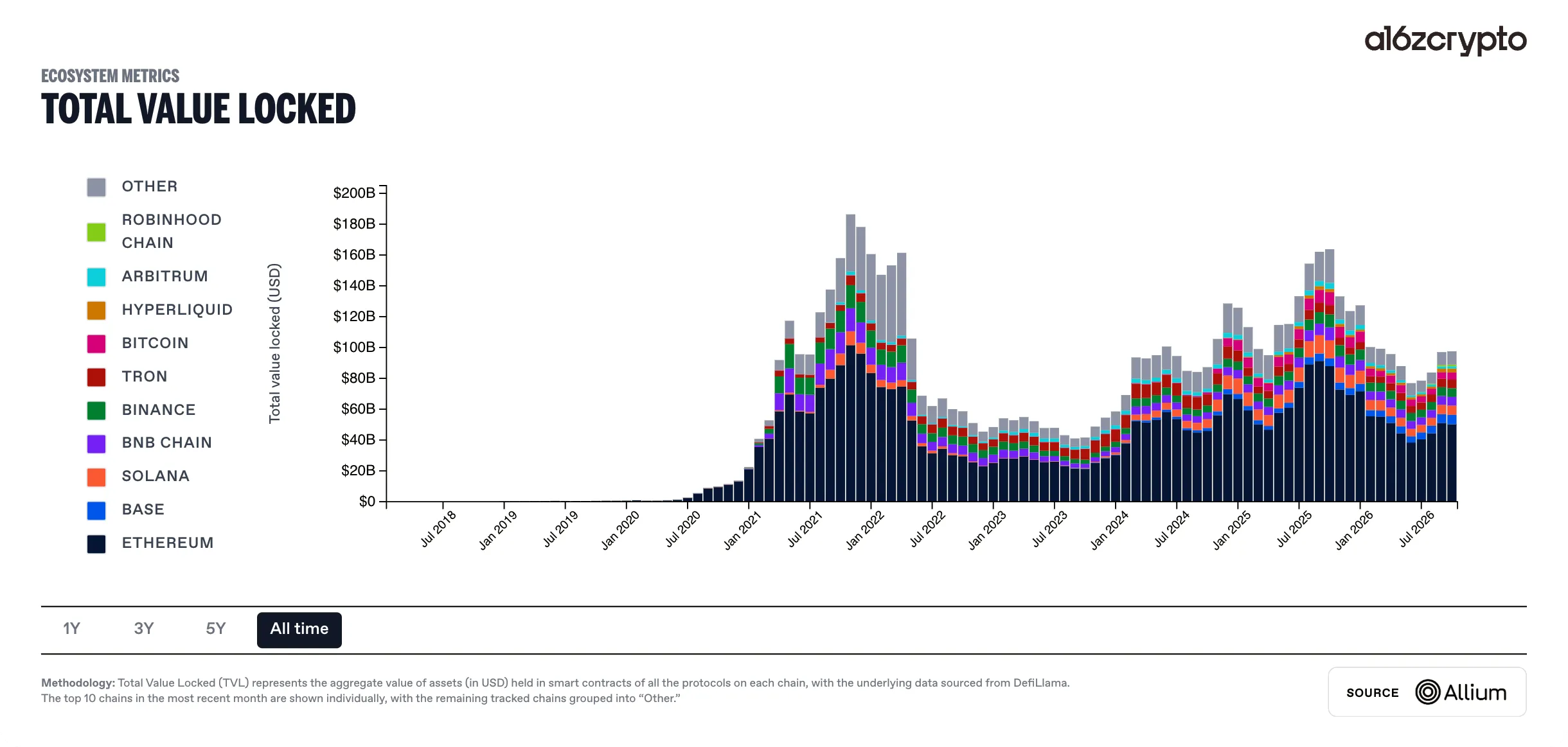
Source: a16z crypto State of Crypto, Allium (underlying data from DefiLlama)
Total value locked tracks assets in smart contracts rather than wallet balances, but it shows how thinly liquidity spreads across networks. Ethereum is the largest single chain, while Base, Solana, BNB Chain, Tron, and many others each hold a share.
This makes even simple actions unnecessarily complex.
Getting USDC into a savings product to earn yield, or simply paying a merchant, often means bridging, swapping, approvals, and gas, in that order. Start from a different chain and the process becomes slow and arduous, which shows up as lower conversion, abandonment, and frustration.
What should be as simple as buying a T-shirt instead feels like a technical project that requires knowing about liquidity routing, bridging, and approvals.
2. Failed checkouts and abandoned transactions
Crypto checkouts are fragile. A token mismatch, an underfunded fee, or a misconfigured chain is enough to break a payment. A 2023 report from Cointelegraph Research and Onramper found that fiat-to-crypto transactions failed up to 50% of the time, and that abandonment during the purchase flow could climb as high as 90%.
Every failed transaction is a broken promise. Users lose patience, businesses lose trust, and developers lose revenue. Abandoned carts are already a big problem in online commerce. In crypto, abandoned transactions multiply because of the extra friction at checkout.
3. Complexity of payments
Crypto users face a steep learning curve before they can make a first payment. They are expected to understand:
- Gas fees: unpredictable and often confusing.
- Slippage: the risk of losing value when swapping tokens.
- Bridging: moving funds across chains.
- Approvals: granting permission before every transaction.
This level of complexity may suit experienced DeFi users, but it alienates mainstream audiences. For payments to become truly universal, they need to be as simple as tapping a card or a phone.
4. Stablecoins with limited utility
Stablecoins are the bridge between blockchain and real-world commerce. By design they offer price stability, which makes them ideal for payments, and their use is growing: Allium’s adjusted stablecoin volume data, published by Visa Onchain Analytics, shows monthly volume topping $300 billion in 2026, well above 2024 levels.
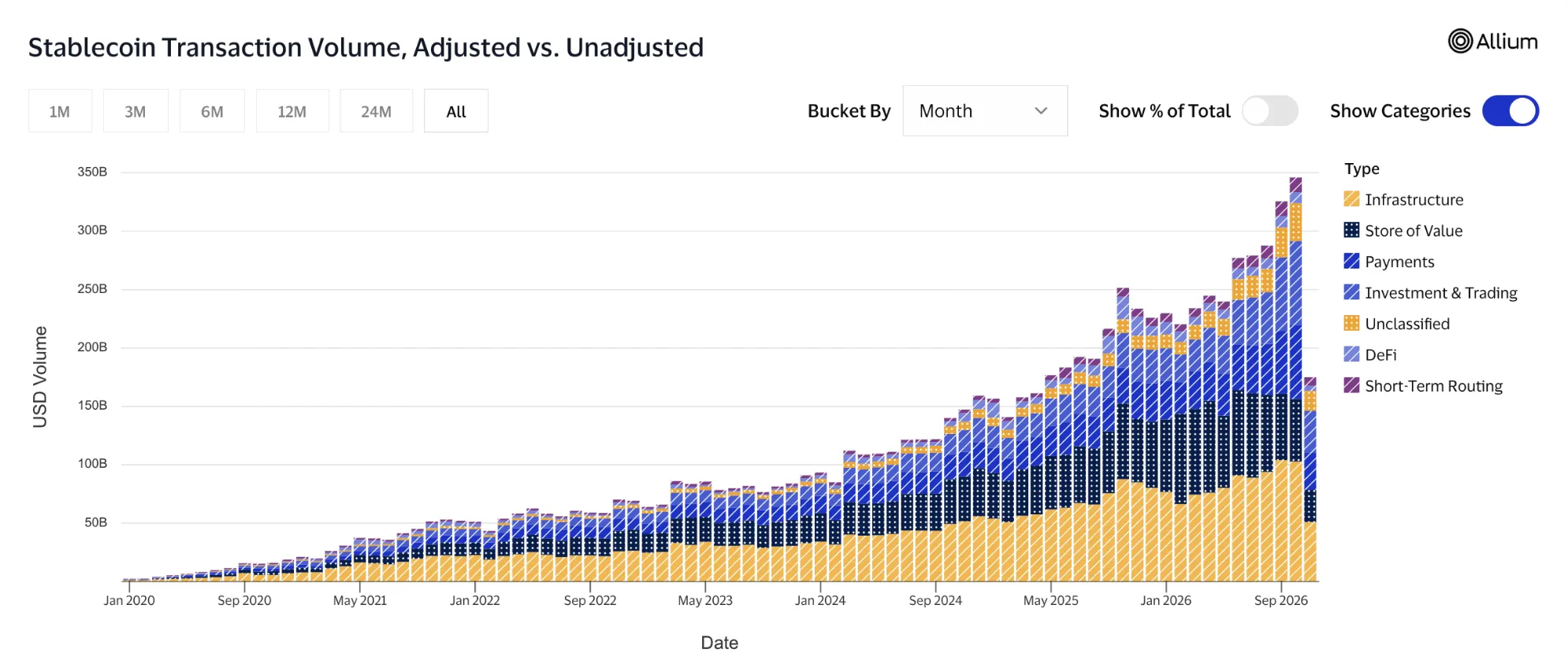
Source: Allium, via Visa Onchain Analytics
The chart splits that volume by use, and payments is one category among several, next to infrastructure, store of value, and investment and trading. Growth in total volume does not mean growth in everyday spending.
In practice, fragmentation undermines their utility. A user might hold USDC on Ethereum while a merchant only accepts USDT on Polygon. Without cross-chain liquidity and chain abstraction, stablecoins stay locked in silos, which limits what they are good for at checkout.
From potential to usability
Crypto payments are stuck in limbo, and the problem is the experience. The gap between the 9% of adults who buy or hold crypto as an investment and the 2% who spend it is a friction gap, not a lack of supply.
Fragmentation, failed checkouts, and complexity keep blockchain from delivering on its promise as internet-native money. Mass adoption comes when payments just work: when a user can pay with any supported token, from any wallet, on any supported chain, without thinking about gas, bridges, or approvals.
Until then, crypto remains money people hold, but not money people use.
What it takes to fix it
Each barrier above is a layer that payment businesses have had to stitch together themselves: a wallet from one provider, a bridge from another, an on-ramp from a third, and a checkout built on top. We built the Polygon Open Money Stack to put those layers behind one integration.
Users sign in with email or a social login and hold a stablecoin balance inside your product, so they never see a seed phrase or a gas prompt.
Polygon Trails routes swaps and bridges behind a single confirmation, so a customer holding USDC on one supported chain can pay a merchant on another without doing any of it by hand. How intent-based payment routing works explains the model.
Crypto checkout in the Open Money Stack accepts whatever the customer holds and handles fees for them, to cut the failed payments described above. Uquid uses it for 1-click crypto checkout across 178 million products.
On- and off-ramps, virtual accounts, and settlement come from the same API, so stablecoins stop being a silo and start being money.
The structural side of this problem, the one platforms and issuers face rather than users, is covered in Stablecoin infrastructure is fragmented: the structural barriers to scaling crypto payments. For a practical path from a card-based product to stablecoin settlement, read Stablecoin payments for enterprise: a practical guide.
Explore the Open Money Stack, or talk to a payments specialist about the checkout or wallet flow you want to build.

Nuvera is live on Polygon Open Money Stack for cross-border stablecoin settlement

Web3 user onboarding: how to simplify it for your app

SoFiUSD lands on Polygon Chain, bringing America's first bank-issued stablecoin to everyday use

Polygon Trails partners with Foresight to bring 1-click fund flows to prediction markets

Scalable payment infrastructure: scaling payment apps without sacrificing UX
MPC wallets: what they protect, and what a payments product still needs

Polygon Trails partners with Katana to solve DeFi fragmentation with 1-click liquidity and real yield
Stablecoin infrastructure is fragmented: the structural barriers to scaling crypto payments
What is an embedded wallet? How embedded wallets work