tl;dr
- Stablecoins are digital dollars. They behave like money, not crypto. For enterprise finance teams, that distinction shapes everything about how to evaluate them.
- Cross-border B2B settlement is the dominant enterprise use case, with 77% of corporates naming it their top reason to adopt stablecoins (EY-Parthenon, 2025).
- Actual stablecoin payment volume (real commerce, not trading or bot activity) reached approximately $390 billion in 2025 (McKinsey/Artemis Analytics), more than doubling the prior year. Still early, but no longer a pilot category.
- Success depends on whether the infrastructure you build with can handle the volume, compliance, and operational demands of enterprise payments at scale.
Here’s a transaction that happens every day at companies with international supplier networks. A buyer in Chicago owes $2 million to a supplier in Singapore. The wire goes out on Tuesday, and when it arrives through a labyrinth of correspondent banks, it comes in minus $47 in wire fees, minus a 3.2% FX markup not itemized, minus whatever the chain of correspondent banks took for themselves. Total cost: depending on the sender, it could be up to $64,000. Nobody flags it because that’s just what cross-border payments cost.
Except it isn’t. Not anymore.
This guide is for CFOs, VPs of Payments, and Treasury Heads who are getting asked, or asking themselves, whether stablecoin payments belong in the enterprise toolkit. A practical walkthrough of what stablecoins actually do in a payments context, how enterprise settlement works, and what the adoption curve looks like right now.
What a stablecoin is (and isn’t)
Here’s the payments explanation: a stablecoin is a digital representation of a fiat currency, almost always the US dollar, that lives on a payment network and settles instantly, around the clock, at a fraction of the cost of traditional rails.
USDT and USDC, the two dominant stablecoins, together hold ~87% of the total stablecoin market. Both are pegged 1:1 to the dollar. USDC is fully backed by cash and short-term Treasuries with monthly attestations; USDT claims similar backing but operates under less regulatory oversight
When a business sends USDC, it’s sending dollars. The recipient gets dollars. The difference from a wire is what happens in between, which is nearly nothing. No correspondent bank chain, no intermediary fees, no cut-off times.
That’s what makes stablecoins interesting for enterprise payments. The infrastructure behavior, not the asset class.
A reference guide to major stablecoins
Not all stablecoins are interchangeable.
They differ by issuer, backing mechanism, regulatory status, and the corridors where they’re actually liquid. The table below covers the major options an enterprise payments team is likely to encounter, from the dollar-backed market leaders to non-USD instruments designed for specific cross-border corridors.
| Ticker | Issuer | Proof of Stability |
|---|---|---|
| USDC USD | Circle | Monthly reserve attestations by Deloitte; backed 1:1 by cash and short-term US Treasuries. Regulated under US state money transmission laws. |
| USDT USD | Tether Limited | Quarterly attestations by BDO Italia; backed by mix of T-bills, cash, and other assets. Largest stablecoin by market cap and daily volume. |
| PYUSD USD | Paxos (for PayPal) | Monthly attestations by WithumSmith+Brown; backed by USD deposits and US T-bills. Issued under NYDFS oversight. |
| RLUSD USD | Ripple / Standard Custody | Monthly reserve attestations; backed by USD deposits and US government T-bills. Approved by NYDFS. |
| EURC EUR | Circle | Monthly reserve attestations; backed 1:1 by euro cash equivalents held in regulated EU financial institutions. MiCA-compliant. |
| XSGD SGD | StraitsX | Regulated by the Monetary Authority of Singapore (MAS); backed 1:1 by SGD held in segregated bank accounts with audited reserves. |
| JPYC JPY | JPYC Inc. | Backed 1:1 by JPY held in Japanese bank accounts; operates under Japan’s Funds Settlement Act with annual audits. |
| AUDF AUD | Novatti Group | Backed 1:1 by AUD held in trust; issuer is ASX-listed. Operates under Australian financial services licensing. |
| BRLA/BRL1 BRL | Avenia; Bitso, Foxbit, Cainvest & Mercado Bitcoin | Both backed 1:1 by BRL under Brazil’s Central Bank (BACEN) regulations. BRLA powers cross-border Pix-SPEI payments; BRL1 designed for interoperability. |
| MXNe MXN | Etherfuse | Backed 1:1 by MXN; designed for cross-border payments, merchant systems, and financial apps. Operates under Mexican financial services regulation. |
| USDS/DAI DeFi | Sky (formerly MakerDAO) | Overcollateralized at 150%+ by on-chain crypto assets; collateral ratios and reserves are publicly auditable on-chain in real time. |
USD-backed stablecoins dominate enterprise payment flows by volume. Non-USD instruments are worth evaluating for specific high-value corridors (XSGD for Singapore, BRLA/BRL1 for Brazil, MXNe for US-Mexico) where settling in local currency eliminates the off-ramp FX step entirely.
How enterprise settlement actually works
The practical flow for a business using stablecoin payments looks like this: fiat goes in, converts to a stablecoin at the sending end, moves across the settlement network, and converts back to local currency at the receiving end.
The middle leg, the actual movement, happens in seconds. The friction lives at the entry and exit points, where you need licensed on- and off-ramp providers who can handle fiat conversion, KYC/KYB, and local currency delivery.
This pattern, sometimes called the stablecoin sandwich, has become the de facto standard for cross-border B2B flows. It’s what Stripe, Visa, and Mastercard are all building around, and what allows a payment to settle in seconds where it previously settled in days.
On an adjusted basis that filters out trading, bot activity, and internal rebalancing, stablecoins processed roughly $9 trillion in the 12 months through September 2025, up 87% year over year (a16z State of Crypto 2025, using Artemis Analytics data). But context matters: McKinsey and Artemis Analytics estimate that actual end-user payment activity, covering B2B transfers, payroll, remittances, and capital markets settlement, accounts for approximately $390 billion of that annually (McKinsey, February 2026). That number doubled from 2024. It’s growing fast, but it’s important to be precise about what we’re measuring.
Among current enterprise users, the savings are concrete: 41% report cost reductions of at least 10%, primarily in cross-border B2B payments (EY-Parthenon Stablecoin Survey). On a $50 million annual cross-border payments program, 10% is $5 million.
The use cases that are actually scaling
Cross-border supplier payments. The leading enterprise use case, named by 77% of corporates in EY-Parthenon’s 2025 survey. A supplier in Vietnam or Brazil doesn’t care which rail carries their payment. They care whether it arrives, in full, without hidden deductions, and without banking hours.
Treasury management. Organizations holding stablecoin balances gain something correspondent banking doesn’t offer: a dollar-denominated instrument that moves 24/7/365. Treasury teams can hold USDC, deploy it for payments outside of banking hours, and bring it back without the overnight float drag that traditional banking imposes.
Payroll in emerging markets. For companies with distributed teams in high-inflation or banking-constrained markets, stablecoins give workers access to dollar-denominated wages without the multi-day delay and correspondent bank markup of a wire. Some platforms are now processing payroll at $47 average transaction size, a completely different pattern from traditional $250-minimum remittances.
B2B marketplace settlement. Platforms handling high-volume payouts to international suppliers or sellers increasingly route through stablecoins because the margin degradation from FX and correspondent fees at scale is simply too large to ignore.
The regulatory barrier is more defined; the question of infrastructure remains
If you’ve been waiting for regulatory clarity before taking stablecoins seriously, the wait is over. The GENIUS Act, signed into law in 2025, established the first federal framework for USD-denominated stablecoins in the United States. The EU’s MiCA regulation is fully applicable. Hong Kong has enacted its Stablecoin Bill. As recently as mid-2025, 73% of organizations cited regulatory uncertainty as their top barrier to adoption (EY-Parthenon).
That barrier has largely dissolved.
Which means the determining factor has shifted. Enterprise-grade stablecoin payment infrastructure needs automated KYC/KYB, real-time transaction screening, AML monitoring, and analytics integration. These are prerequisites for any regulated industry.
The question to ask any infrastructure provider: is compliance built into the product architecture, or bolted on as an afterthought? The answer tells you more about long-term viability than any feature comparison.
What proven infrastructure looks like at this scale
Choosing infrastructure for enterprise stablecoin payments is a consequential decision. The volume moving through these networks is growing fast, and the gap between infrastructure that works in a demo and infrastructure that works at scale is where most enterprise implementations break down.
The question enterprise teams should be asking is not whether stablecoins work. They do. The question is whether the payment network you’re considering has been proven at the volumes and transaction types that match your business, not in a sandbox, not in a pilot, but in live production.
Polygon’s network has processed over $2.4 trillion in stablecoin transfer volume. Partners including Mastercard, Revolut, Stripe, and Apollo via Securitize have built on this infrastructure because the track record at scale is what enterprise procurement requires.
The Open Money Stack, Polygon’s suite for enterprise payments, connects fiat on- and off-ramps (with regulated infrastructure via Coinme across 48 U.S. states), a programmable settlement layer, and wallet infrastructure through a single API. Your team integrates once and gets access to the full payments stack, without rebuilding compliance, liquidity management, or cross-chain routing from scratch.
The depth of the stablecoin ecosystem on Polygon is itself a proof point. When Paxos settled $1.3 billion in stablecoin volume on Polygon, the total gas cost across all 82,000+ transactions was less than $700. That’s not a per-transaction figure, that’s the total on $1.3 billion.
Beyond USD-denominated flows, Polygon hosts more than 35 native stablecoins covering local currencies across LATAM, APAC, Africa, and Europe. As of late 2025, Polygon captured over 61% of monthly DEX volume for non-USD stablecoins across those regions. In September 2025 alone, non-USD stablecoin activity on Polygon generated $72.97 million in transfer volume across more than 83,000 transfers. For enterprises moving money into markets where dollar-denominated settlement creates off-ramp friction, that breadth of local-currency liquidity is operationally significant.
The full list of stablecoins active on Polygon is available at polygon.technology/stablecoins/list.
What the numbers describe, cumulatively, is infrastructure that has been tested across currencies, corridors, transaction sizes, and partner types at a scale that most enterprise payment networks have never approached. That’s what $2.4 trillion looks like in practice.
Ready to Evaluate Stablecoin Infrastructure for Your Business?
Explore the Open Money Stack, or talk to our team about the specific requirements for your payments program.
Monerium, Frax and Capa connect euro payments to onchain FX markets on Polygon
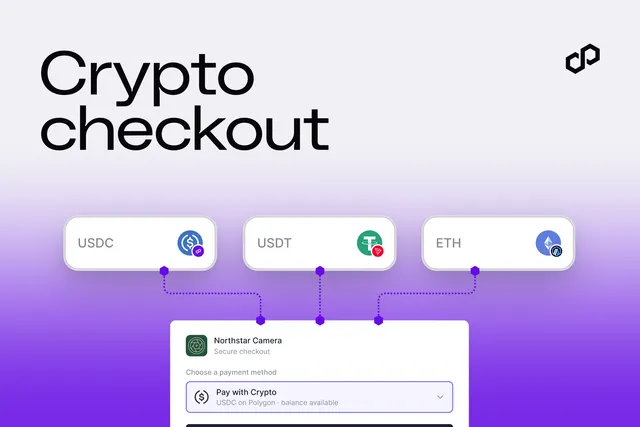
Introducing crypto checkout in Polygon Open Money Stack
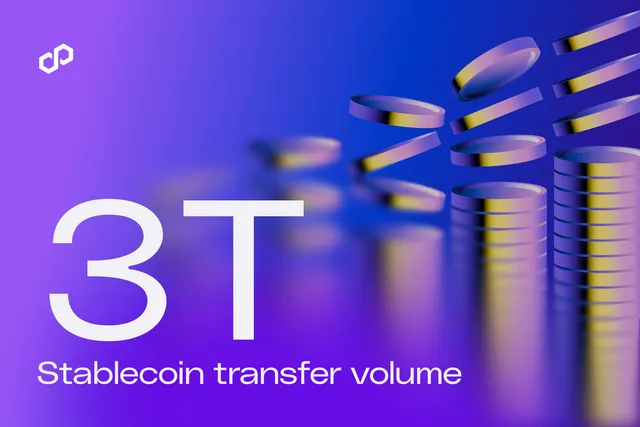
Polygon passes $3 trillion in stablecoin transfer volume
Polygon Chain now supports 11 million payments per second
New to Polygon OMS: Recurring Stablecoin Subscriptions With One Customer Approval
Stable.com Adds Polygon for Direct-to-Bank Stablecoin Transfers
One API for Any Payment: Inside Polygon Open Money Stack

Polygon completes SOC 2 Type 1 examination for Open Money Stack

Revolut Launches EURR, a Euro-Backed Stablecoin, on Polygon