tl;dr
- Apex Group (servicing $3.5T+ in assets) has committed to $100 billion in tokenized assets on T-REX ledger by June 2027, adopting the Polygon CDK chain as its default multi-chain orchestration infrastructure
- T-REX Ledger is a dedicated RWA chain we’re helping design and launch, with backing from T-REX Network and Tokeny (owned by Apex Group), using Polygon CDK
- It’s connected to global crypto liquidity through Agglayer, the cross-chain aggregation layer that unifies liquidity and state across connected chains
- The new chain will be the standard reference chain for tokenized assets that relies on a standard for tokenization: ERC-3643
When Apex Group committed to $100 billion in tokenized assets on T-REX Ledger as its multichain orchestration layer by June 2027, the number made headlines. But the architecture decision underneath it is what should get the industry’s attention.
Together with T-REX Network and Tokeny, we’re building T-REX Ledger: a purpose-built blockchain using our chain as a service model in Polygon CDK, designed around specific compliance requirements, privacy needs, and distribution.
T-REX Network brings ERC-3643, the de facto token standard for permissioned securities, used by 140+ institutions. Apex Group, with $3.5 trillion in assets under administration, will serve as the onchain transfer agent. We bring the chain infrastructure, ZK security, and native connectivity to global crypto liquidity through Agglayer.
- If your institution is evaluating blockchain, reach out to chat with us today.
Here’s why serious institutional deployments are increasingly turning to Polygon CDK.
Bespoke chain design for any use case
Every CDK chain starts with a design consultation.
We work with the institution and our implementation partners to architect around specific regulatory environments, privacy requirements, data residency constraints, and counterparty structure.
Custom compliance frameworks, custom gas tokens, configurable block times, built-in KYC.
With Polygon CDK, we’re offering chain as a service, where the architecture decisions are made collaboratively, along a spectrum of options in conjunction with implementation partners like Gateway, Conduit, Succinct, and others.
For T-REX Ledger, the starting point was specific: a blockchain built around the only token standard designed for regulated securities.
It started with the token standard
Most tokenized assets today use ERC-20, the default fungible token standard on Ethereum. ERC-20 was built for open, permissionless transfer. But it’s a regulatory liability for assets, which require the issuer to know who holds them at all times. Transfer restrictions, investor eligibility, KYC, jurisdictional limits: these are legal requirements.
ERC-20 has no mechanism for any of them. Compliance is laid on at the application layer.
ERC-3643, the standard T-REX Ledger is built on, embeds compliance directly at the token level.
Identity verification, transfer restrictions, and investor eligibility checks are enforced in the smart contract itself. Every transfer is validated before it executes. If the recipient isn’t verified, the transaction reverts.
$32 billion in assets have already been tokenized under the standard across 140+ institutions, including DTCC, Deloitte, ABN AMRO, and Fireblocks. And the SEC has taken notice: Chairman Atkins specifically referenced ERC-3643 in his “Project Crypto” framework as the kind of compliance-embedded standard that tokenized securities should adhere to.
But a compliance-native token standard only works on compliance-native infrastructure.
Running it on a public chain where every transaction is visible, where there’s no protocol-level privacy, and where the institution doesn’t control the compliance environment, defeats the purpose. The standard enforces the rules. The chain has to enforce the environment.
The public chain problem
Public blockchains are extraordinarily useful. They’re also a terrible fit for regulated financial institutions operating at scale.
The core issue is control. When an institution deploys tokenized assets on a public chain, it inherits that chain’s privacy model (typically none), that chain’s compliance framework (also none), and that chain’s fee structure, governance, and upgrade timeline.
The institution is a tenant, not an owner.
Financial institutions need protocol-level KYC and AML rules, maintain audit trails that satisfy regulators in every jurisdiction where it operates, and do all of this without breaking the asset’s ability to move across chains and access liquidity.
No existing public chain offers all of that. Most don’t offer any of it.
The permissioned chain problem
The instinct, historically, has been to go the other direction: build a permissioned ledger, like Hyperledger. Private, controlled, compliant.
But permissioned chains have a different fatal flaw: they’re walled gardens. An asset issued on a private consortium ledger can only move within that consortium. It can’t access DeFi liquidity. It can’t be distributed to investors on other chains. It can’t participate in the broader onchain economy that makes tokenization valuable in the first place.
This is the silo problem that blockchain was supposed to solve. Permissioned chains just recreated it.
The third option: sovereign chains with access to global crypto liquidity
What we’re building with T-REX Ledger, and what we built with Polygon CDK, is a third path: A sovereign blockchain that the institution controls, with the privacy and compliance of a permissioned chain, but natively connected to global liquidity via Agglayer.
Here’s what that looks like in practice.
ZK security, not trust-based security
Polygon CDK chains are secured by zero-knowledge validity proofs posted to Ethereum. That means anyone can verify the chain’s state against Ethereum’s roots, permissionlessly, without relying on the chain’s operator. The raw transaction data never touches L1.
With ZK validity proofs, the math either checks out or it doesn’t. Succinct provides the prover infrastructure that generates these proofs, making them fast, verifiable, and independently auditable. Settlement finality is cryptographic, not social-economic as in an optimistic framework. And it’s fast: sub-1-hour finality (with plans to get even faster) and no 7-day challenge windows.
That finality difference has real operational consequences. An institution settling tokenized bonds doesn’t want to wait a week to confirm that a transfer is irreversible. It wants the same certainty it gets from a central securities depository, but faster.
Privacy that’s configurable, not binary
Most blockchain privacy models are all or nothing. Public chains are fully transparent. Private chains are fully opaque. Neither works for regulated institutions that need to be selectively transparent: private to the market, visible to regulators, auditable by counterparties with the right permissions.
We designed Polygon CDK’s privacy architecture to be configurable along a spectrum. Institutions work with implementation partners, Gateway and Conduit, to design a privacy model that fits their specific regulatory environment. That can include: private data availability, private RPC and mempool, private block explorer, role-based access controls for auditors and regulators, ZK validity proofs that verify correctness without exposing transaction details, and fully homomorphic encryption through Zama for cases where even the chain operator shouldn’t see the data.
The point is that privacy is a set of levers that the institution controls.
Global crypto liquidity, not a walled garden
This is the piece that makes CDK chains fundamentally different from permissioned alternatives.
Every chain built on Polygon CDK is natively connected to Agglayer. That means the institution’s private, sovereign chain has one-click access to global crypto liquidity across every chain connected to the network. No token wrapping. No third-party bridges. Configurable origin privacy so the institution controls what information travels with the transaction.
For Apex Group, this is what makes the $100 billion commitment feasible. Tokenized assets issued on T-REX Ledger can be distributed to investors wherever they are, on whichever chain they prefer, without fragmenting the compliance record. T-REX Ledger remains the single source of truth for eligibility and ownership. Agglayer handles movement.
We’re also building fiat gateways natively into the stack: stable sandwich flows from ACH, SEPA, PIX, and UPI through stablecoins to destination chains and mobile wallets. The goal is end-to-end: an institution shouldn’t need to stitch together six vendors to move money from a bank account to an investor’s onchain wallet.
20,000 TPS
Performance matters, but it’s table stakes at this point. What matters more is the cost structure.
Polygon CDK chains on Gateway and Conduit infrastructure deliver up to 20,000 transactions per second, comparable to Visa, at under $0.003 per transaction. Fully managed 24/7 with enterprise SLA. Multi-cloud deployment across AWS, Azure, GCP, or on-prem. Sequencer failover, sandbox environments, Prometheus/Grafana/Datadog monitoring.
The infrastructure cost is important because it determines whether tokenization math works at scale. If transaction costs are measured in dollars, only high-value assets justify the overhead. At fractions of a cent, the institution can tokenize everything from a $500M bond tranche to a $10K fund subscription and have the economics work.
Full EVM compatibility, zero lock-in
Polygon CDK is 100% EVM-compatible. Solidity contracts, existing Ethereum liquidity and tooling, standard developer workflows, all work out of the box. That gives institutions access to the largest developer and biggest DeFi ecosystems in crypto, eliminating replatforming risk.
This is a direct contrast to trust-based alternatives that require proprietary smart contract languages with a fraction of Solidity’s developer base. It’s also different from platforms that require commercial license agreements, impose token governance requirements, or take fees from activity on the institution’s chain.
We designed CDK to be non-rent-seeking. No fees to connect to Agglayer. The institution owns the chain and captures the value from activity on it. Custom gas tokens or fully gasless via paymaster. The institution’s chain is the institution’s business.
What Apex Group’s commitment says
The $100 billion target is a signal about where institutional blockchain infrastructure is heading.
The institutions entering this market want compliance that’s built in, not bolted on. Privacy they can configure, not just toggle. Connectivity to the broader crypto ecosystem without giving up sovereignty. And an architecture where the economics of tokenization work at every asset size.
That’s what chain-as-a-service with Polygon CDK delivers. And it’s why Apex Group, servicing $3.5+ trillion, committed $100 billion in assets to be tokenized on T-REX Ledger as its multichain orchestration layer.
If your institution is evaluating blockchain infrastructure, we’d like to have that conversation. Talk to us
T-REX Ledger is a compliance-focused blockchain backed by T-REX Network, Tokeny, and Polygon Labs using Polygon CDK, connected through Agglayer. Read the full announcement.
Polygon Open Money Stack now supports TRON
Meet Polygon at Money20/20 USA
Monerium, Frax and Capa connect euro payments to onchain FX markets on Polygon
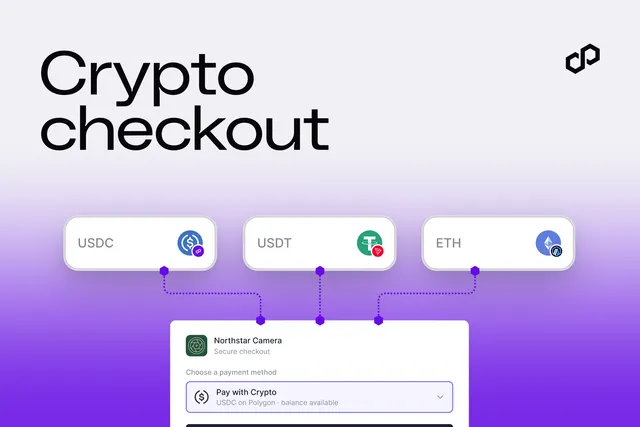
Introducing crypto checkout in Polygon Open Money Stack
Polygon passes $3 trillion in stablecoin transfer volume
Polygon Chain now supports 11 million payments per second
New to Polygon OMS: Recurring Stablecoin Subscriptions With One Customer Approval
Stable.com Adds Polygon for Direct-to-Bank Stablecoin Transfers
One API for Any Payment: Inside Polygon Open Money Stack