TRON businesses can now run a full stablecoin payment through Polygon Open Money Stack: money comes in, lands in a deposit address or wallet, converts and routes across chains when needed, then pays back out.
Here’s what’s live:
- Accept deposits by bank transfer, card, cash, or crypto
- Convert fiat into USDT (TRC-20) on TRON—and back again
- Store funds in custodial or embedded wallets on TRON
- Program when and where money moves
- Route USDT across TRON, Polygon, and major chains
- Pay out to bank accounts, cards, cash or wallets
With Polygon OMS, a business operating on TRON can take a customer from a bank pay-in to a USDT wallet, or from a USDT balance to a bank payout, without coordinating a separate provider for every step. Teams can use the pieces they need or run the whole flow through one product experience.
That means TRON can stay at the center of the product even when money needs to move beyond it. Customers see a balance, a transfer, or a payout. They never have to see the bridge underneath.
Why we extended Polygon OMS to TRON
TRON already carries more than $94 billion in circulating USDT, over half the stablecoin’s total supply across every chain: dollars, sitting exactly where remittance senders, gig workers, and exchange users already move them.
That matters for remittance platforms, gig products, exchanges, and fintechs serving markets such as the Philippines, Mexico, Argentina, and Nigeria. Their customers already use TRON to receive, hold, and transfer USDT. Asking those customers to move to another chain before they can use a product adds work at exactly the wrong moment.
A USDT balance on TRON is useful, but it is not a complete payment product on its own. A business still needs a stable destination for each customer, a wallet model that fits the product, a way to identify and reconcile deposits, routes to other chains and assets, and a path back to local fiat.
Polygon OMS brings those jobs into one control layer across the payment flow. Teams can keep the chain their customers already use, then connect it to the accounts, wallets, routing, and payout rails that turn a balance into a working product.
How it works
Payins and deposit addresses
Each customer gets a persistent TRON deposit address they can use again and again. When USDT arrives, OMS attributes the deposit to the right customer and makes the balance available for the next step. The business does not have to create a new address for every transaction or build its own deposit-reconciliation system.
Wallets
OMS wallets hold USDT on TRON under the custody model that fits the product. With a custodial wallet, a licensed custodian holds the keys and the applicable identity, screening, and transaction-monitoring controls sit inside the flow. With an embedded wallet, the user controls the keys and signs in with familiar authentication, without a browser extension or seed phrase prompt during onboarding.
Route and convert
Polygon Trails routes USDT and other supported assets between TRON and EVM chains in a single transaction. A business can accept USDT from a TRON wallet and settle in USDC for an Ethereum user, or the reverse, without either side touching a bridge.
Payouts
When it’s time to cash out, customers convert USDT on TRON back into US dollars and send it to a bank account, card, or cash pickup location, inside the business’s own product.
Who this is for
This is for fintechs, remittance platforms, and payout products whose customers already hold or move USDT on TRON and need the fiat, custody, and routing to turn that balance into a real product.
A remittance app can hold a sender’s USDT on TRON in a wallet and pay the recipient out to a local bank account. A gig platform can give workers a persistent deposit address for the USDT they already pull off exchanges, instead of asking them to bridge it themselves.
For the business, the larger change is operational. Instead of managing a different contract, API, and service level agreement for each rail, the team gets on-ramps, wallets, orchestration, and off-ramps through one integration. The chain can remain an implementation detail while the product stays focused on what the customer is trying to do.
What’s next
TRON is the next chain to get Polygon OMS support, not the last. We’ll keep expanding Polygon OMS to the chains where money already moves, so businesses build on the chain they chose without rebuilding their money flow around it.
OMS is open by design. A team can use the full stack or keep its existing wallet, compliance provider, or ledger and plug into the parts it needs. TRON support extends that choice to one of the largest pools of USDT in the world.
If you’re building on TRON and need deposit addresses, wallets, cross-chain routing, or payouts, talk to the Open Money Stack team.
Disclaimer
This post is for general informational purposes only and does not constitute legal, financial, tax, regulatory, or investment advice. Nothing contained herein should be construed as a solicitation, offer, or recommendation to buy, sell, or engage with any product or service, nor should it be relied upon as the basis for any decision.
Users and institutions are solely responsible for ensuring that their access to and use of any Polygon product or service complies with all applicable laws, rules, and regulations in their respective jurisdictions. Polygon Labs makes no representation or warranty that any particular program configuration, feature, or use case will satisfy the legal or regulatory requirements of any specific jurisdiction. Users and institutions are strongly encouraged to seek independent legal counsel regarding their specific compliance obligations before engaging with any Polygon product or service.
The features, use cases, and illustrative examples described in this post are subject to applicable law and may not be available in all jurisdictions. All statements regarding future products, features, functionalities, or capabilities are forward-looking in nature and subject to change without notice. Such statements should not be relied upon as representations of future performance or availability.
Polygon Labs reserves the right, in its sole discretion and without prior notice, to modify, suspend, limit, restrict, or discontinue the program or any component of the Open Money Stack (“OMS”), in whole or in part, at any time. Use of OMS is subject to OMS terms and conditions. Polygon Labs further reserves the right to restrict or terminate access to any code, feature, or support for any user or in any jurisdiction where required by applicable legal or regulatory obligations.
Blockchain technology, smart contracts, and decentralized protocols involve inherent and significant risks, including but not limited to technical vulnerabilities, regulatory uncertainty, and potential loss of funds. To the fullest extent permitted by applicable law, Polygon Labs shall not be liable for any damage of any kind arising from or in connection with the use of, or reliance upon, the program, the Open Money Stack, or any information contained in this post.
New to Polygon OMS: Agent payments with limits your team sets
Introducing Polygon CDK Besu: Launch a Hyperledger Besu chain connected to other chains and their liquidity

Polygon Open Money Stack is now a U.S.-regulated payments platform with completion of Coinme acquisition
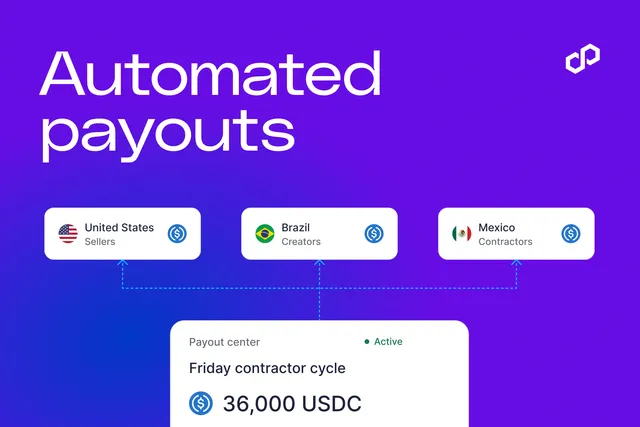
New to Polygon OMS: Automated stablecoin payout runs with rules your team sets
Polygon Open Money Stack now supports TRON
Meet Polygon at Money20/20 USA
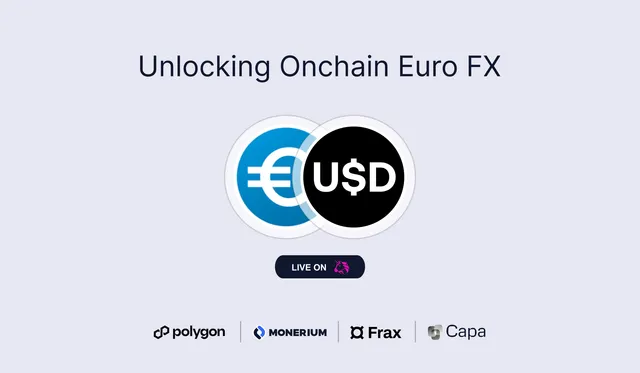
Monerium, Frax and Capa connect euro payments to onchain FX markets on Polygon
Introducing crypto checkout in Polygon Open Money Stack
Polygon passes $3 trillion in stablecoin transfer volume