Moving money is a stack, not a feature. A fast chain, a stablecoin, and a polished app are all useful. None of them, on their own, gets money from a cash deposit to a bank payout.
That job needs compliance, accounts, wallets, conversion, routing, settlement, and the rails that connect each step. Most payments teams end up with a Frankenstack of separate vendors, then spend their time keeping it upright.
Polygon Open Money Stack (OMS) brings those pieces into one single stack. A business can build the full flow or use only the parts it needs.
The ten primitives
Under the product surface, OMS breaks money movement into ten low-level operations. A real product combines several of them into a flow. A remittance app, for example, might use Receive, Convert, and Send. A dollar account might use Hold, Identity, and Ramp.
| Primitive | What it does |
|---|---|
| Send | Moves funds onchain to any wallet or address, and pays out to bank accounts and cash-pickup locations. |
| Receive | Accepts funds in reverse: cash at a retail counter, an onchain transfer, or a bank deposit. |
| Convert | Quotes and executes a crypto-to-fiat or stablecoin-to-stablecoin conversion at a locked rate. |
| Hold | Keeps fiat and stablecoin balances available across the chains a business needs. |
| Ramp | Connects fiat and crypto through RTP, ACH, same-day ACH, domestic wire, international bank transfer (SWIFT), debit card, and retail cash. |
| Bridge | Moves assets between networks, selecting the best available route for each transfer. |
| Swap | Executes token-for-token trades at a quoted rate. |
| Earn | Puts balances to work through staking, lending, and yield strategies. |
| Program | Adds splits, escrow, approvals, and policy gates so teams can build a specific flow without hand-coding every step. |
| Identity | Routes KYC and KYB verification to the right vendor for a customer’s region, so onboarding does not need a separate compliance integration for every country. |
The primitives are the plumbing. The product is how they work together.
The rails and records behind a payment
These are the parts nobody sees in a product demo. They are also the parts that have to work every time a payment moves.
OMS moves fiat through RTP, ACH, same-day ACH, domestic wire, SWIFT to an IBAN account or Canadian bank, debit card, and cash at more than 50,000 retail locations. More countries and card options are rolling out over time.
Settlement time depends on the rail:
- RTP: about 1 minute
- ACH: next business morning
- Same-day ACH: same business day
- Domestic wire: about an hour
- SWIFT (IBAN or Canadian bank): same or next business day
- Polygon: about 1 minute
- Ethereum or Base: about 5 minutes
Reusable accounts and addresses
A virtual account gives a customer a real bank account number. Incoming fiat can convert to a stablecoin as soon as it arrives, or remain as a USD balance for a business that wants to hold fiat.
A deposit address plays the same role for crypto. It is a reusable onchain address that can trigger a payout to a registered bank account when funds arrive. Both remove the need to create a one-time account number or address for every transaction.
The records behind each payment
Every OMS transaction references the same core objects:
| Object | What it is |
|---|---|
| Customer | An identity record whose granted endorsements determine which financial operations it can perform. |
| Wallet | A custodial or non-custodial source or destination for money movement. |
| Quote | A rate lock with a full fee breakdown that expires if it is not used. |
| Transaction | The quoted movement itself, tracked from processing to completion through webhook events. |
| Counterparty | A third party being paid who is not onboarded as a customer. |
| External Account | An off-platform bank account, wallet, or card used as a source or destination. |
Webhooks cover the full flow, so a developer’s system can follow the state of a payment without polling for it.
Compliance built in
KYC and KYB checks route through Identity to the right vendor for a customer’s region. Sanctions and AML screening run on every flow. Coverage today spans 48 US states and a growing set of international corridors.
Polygon Labs builds and operates the technology layer. Licensed, regulated partners handle verification, custody, virtual-account issuance, and money transmission.
What you can do with Polygon OMS
OMS replaces a chain of vendor contracts with one integration. A business can take the full stack or start with a single layer and add from there.
Run every layer through one vendor
Most payments infrastructure requires a compliance provider, a wallet vendor, a bridge, and a settlement chain. Those layers usually belong to different companies. When something breaks, a team starts calling vendors.
OMS keeps the layers in one stack. Polygon Chain is its default settlement rail, but a business can still use only the piece it needs: wallets on their own, Polygon Chain for settlement, or the full stack. The layers hand off cleanly without requiring a team to use all of them.
Offer both custody models
OMS supports non-custodial wallets, where users hold their own keys and no one else can move funds on their behalf. It also supports custodial wallets, where a licensed custody partner holds the keys while the business controls the product experience.
That means a treasury team and a consumer-facing product built by the same company do not need separate wallet vendors.
Hold USD before you convert
OMS lets a business hold a USD balance without forcing an immediate conversion to a stablecoin. Money arriving in a virtual account can stay in dollars until the business is ready to move or convert it.
Route across chains
OMS routes across Ethereum, Polygon, Base, and Solana assets and feature availability varies by network. Polygon is the recommended default for its speed and cost.
OMS exposes a live network catalog so teams can confirm what is routable before they build. The stack handles the decision about chain, bridge, and liquidity source. Teams that want more control can add Polygon Trails on top of OMS as a standalone feature.
Build smoother wallet flows
Non-custodial wallets use smart contract wallets with sponsored gas, batched transactions, and Smart Sessions. A user approves a permitted scope of actions once. The app can then operate within that scope without asking for approval again at every step.
Enable payments for agents
OMS supports x402, an open protocol that turns the HTTP 402 status code into a native payment step for APIs. It also supports ERC-8004 for onchain agent identity. Together, they let an AI agent pay for a resource or complete a transaction within a scoped limit without a human clicking “approve” at every step.
This is built for agent commerce. It is separate from the wallet features people use directly.
Lower settlement costs as volume grows
Open Money Stack has default settlement on Polygon Chain, which has processed over $2.7T in stablecoin transfer volume with 159M unique wallet addresses and 8B total transactions over its lifetime, at an average cost of $0.002 per transaction and 99.9%+ uptime.
Because OMS settles on infrastructure Polygon operates rather than rents, costs can come down as volume grows instead of accumulating through intermediary margin.
Set up dedicated institutional rails
Polygon Chain handles public settlement. Polygon CDK, or Chain Development Kit, gives an institution a dedicated rollup with 20,000+ TPS, built-in compliance controls, and native connectivity to Agglayer. Agglayer lets separate chains share liquidity and state.
It is an option for a bank or enterprise that wants OMS’s settlement properties without settling on a shared public chain.
Payment flows you can build with OMS
OMS combines the primitives into complete payment flows. Here are two use cases you can build.
Offer dollar accounts: Identity, Ramp, Hold
Verify a customer through Identity, issue a real USD account number through Ramp, and let them hold USD or stablecoins through Hold. Funds arrive by ACH, wire, SWIFT or RTP. Your customer does not need to use a crypto exchange.
Send cross-border remittances: Receive, Convert, Send
Receive fiat in the sender’s country, convert it to a stablecoin at a locked rate, then pay out fiat in the recipient’s country. The flow settles on Polygon in seconds rather than days.
The stablecoin stays in the background. It makes the middle of the flow fast without becoming part of the customer experience.
Build either flow without playing vendor Jenga across compliance, wallets, bridging, and settlement.
Start with the payment you need to make
Teams evaluating OMS can begin with a use case such as dollar accounts, payouts, on- and off-ramps, or remittances. From there, they can follow a guided integration path or go directly to the API reference for the full surface.
Disclaimer
This post is for general informational purposes only and does not constitute legal, financial, tax, regulatory, or investment advice. Nothing contained herein should be construed as a solicitation, offer, or recommendation to buy, sell, or engage with any product or service, nor should it be relied upon as the basis for any decision.
Users and institutions are solely responsible for ensuring that their access to and use of any Polygon product or service complies with all applicable laws, rules, and regulations in their respective jurisdictions. Polygon Labs makes no representation or warranty that any particular program configuration, feature, or use case will satisfy the legal or regulatory requirements of any specific jurisdiction. Users and institutions are strongly encouraged to seek independent legal counsel regarding their specific compliance obligations before engaging with any Polygon product or service.
The features, use cases, and illustrative examples described in this post are subject to applicable law and may not be available in all jurisdictions. All statements regarding future products, features, functionalities, or capabilities are forward-looking in nature and subject to change without notice. Such statements should not be relied upon as representations of future performance or availability. Polygon Labs reserves the right, in its sole discretion and without prior notice, to modify, suspend, limit, restrict, or discontinue the program or any component of the Open Money Stack (“OMS”), in whole or in part, at any time. Use of OMS is subject to OMS terms and conditions. Polygon Labs further reserves the right to restrict or terminate access to any code, feature, or support for any user or in any jurisdiction where required by applicable legal or regulatory obligations.
Blockchain technology, smart contracts, and decentralized protocols involve inherent and significant risks, including but not limited to technical vulnerabilities, regulatory uncertainty, and potential loss of funds. To the fullest extent permitted by applicable law, Polygon Labs shall not be liable for any damage of any kind arising from or in connection with the use of, or reliance upon, the program, the Open Money Stack, or any information contained in this post.
Introducing Polygon CDK Besu: Launch a Hyperledger Besu chain connected to other chains and their liquidity
Polygon Open Money Stack is now a U.S.-regulated payments platform with completion of Coinme acquisition
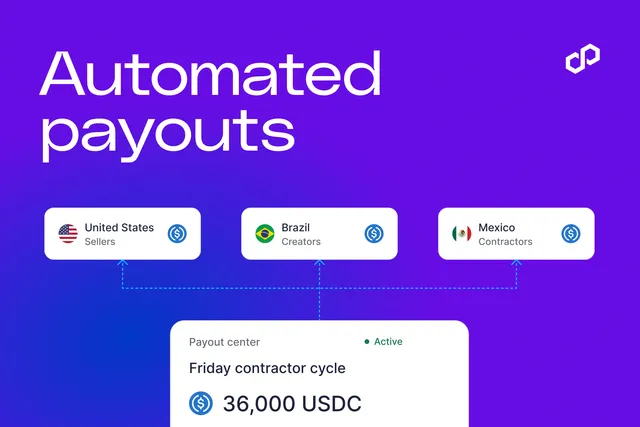
New to Polygon OMS: Automated stablecoin payout runs with rules your team sets
Polygon Open Money Stack now supports TRON
Meet Polygon at Money20/20 USA
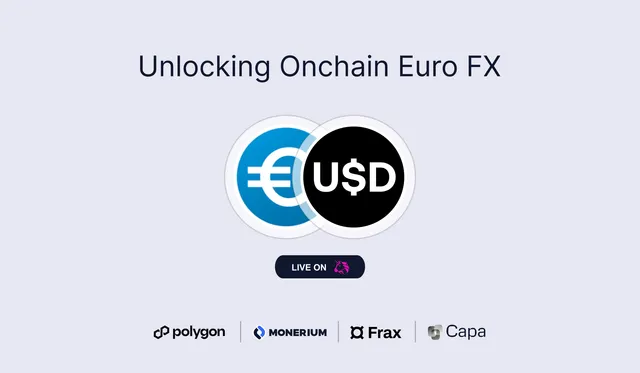
Monerium, Frax and Capa connect euro payments to onchain FX markets on Polygon
Introducing crypto checkout in Polygon Open Money Stack
Polygon passes $3 trillion in stablecoin transfer volume
Polygon Chain now supports 11 million payments per second