Card networks process payments in the thousands per second. OpenRouter alone now processes more than 10 trillion AI tokens a day, or roughly 116 million a second.
When agents begin paying as they consume inference, data, and tools, the unit of commerce changes from a shopping cart to the individual token, call, or task. An agent working through one task might buy inference from multiple providers, pulling data from one, calling a specialist tool from another, and then inference from a third. The agent can make hundreds of purchases across the world of atomic services before it concludes its task.
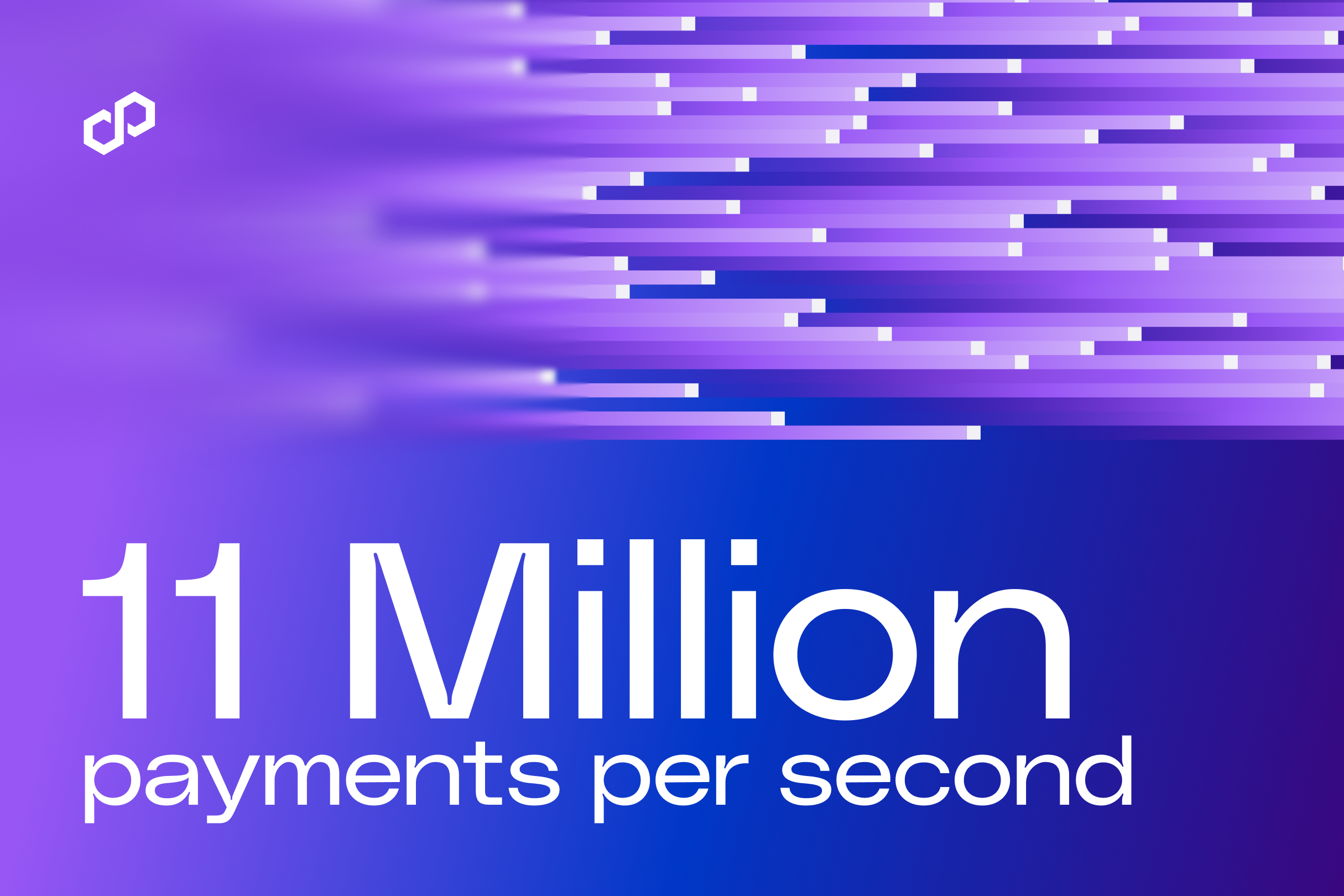
Polygon Chain can now support this emerging payment pattern and the radically expanded scale it demands. We built agent pay channels for Polygon and, in our tests, a 25-hub fleet processed more than 11 million verified payment updates per second. At the engine level, each update was confirmed in 20 microseconds, plus the network latency between the user and the hub. The architecture scales horizontally by adding independent hubs. Based on the 11 million payment benchmark across 25 hubs, a larger fleet could support more than 100 million payment updates per second.
That throughput lets payments follow the work. An agent cannot wait for a daily invoice while it works through a task, and putting every unit of usage through a conventional checkout flow would make per-token or per-call payments impractical.
Today, much of that problem gets pushed into prepaid accounts that lock up capital before use. Someone loads a balance, a database debits it, and the payment effectively happened at top-up rather than when the service was consumed.
With this new capability, a payer funds a multi-use channel once. The agent then sends signed payment updates as it consumes a service, while the accumulated value settles securely onchain in manageable increments.
Human commerce bundles. Agent commerce streams.
How agents can achieve over 11 million payments per second on Polygon
The architecture separates the speed of the payment stream from the cadence of onchain settlement.
1. Fund the channel
The payer deposits funds into a vendor agnostic channel contract on Polygon and binds a session key. The deposit sets the balance available to the agent.
2. Pay as work is delivered
A service uses x402 to request payment. As the agent consumes the service, it sends signed cumulative vouchers through a hub. The hub checks the signature, price, replay ID, authorization ceiling, and remaining escrow before returning a receipt.
3. Release the next unit of service
Once the receipt is valid, the provider releases the next token window, data result, tool response, or other unit of work.
4. Settle on Polygon Chain
The hub batches the accumulated payment state and posts an epoch Merkle root onchain. Providers prove their earnings against that root and claim them, while the channel can remain funded for the next session.
How agent pay channels work.
x402 and the payment channel do different jobs. x402 gives a service a standard way to state a price and request payment over HTTP. The payment channel safely handles high-frequency payment updates and batches their settlement to Polygon. Together, they support the complete x402 payment flow from the service’s request through payment confirmation.
Together, that makes streaming payments and per-call billing practical. A service can price each API call, the agent can pay as it makes the request, and the amount is deducted from the balance already committed to the channel. The provider receives confirmation before releasing the next unit of service, without asking the agent to maintain a separate prepaid account with every provider.
Participants choose their settlement cadence. They might settle after a single payment, after 50,000 updates, or after 100 million. The payment stream can move at the speed of the service without requiring an onchain transaction for every unit consumed.
Pay wherever the work goes
Prepaid accounts do more than lock up capital. They shape which providers an agent can use. The services that have already been selected and funded become the forced choices, even when another provider is better for a particular step.
An agent should be able to choose the best service for each step without waiting for a person to open another account or park money in another balance. A model can charge per token. A data service can charge per lookup. An API can charge per call. Another agent can charge per completed task.
Agent pay channels makes those small, frequent purchases practical by taking each individual payment off the chain’s transaction path while keeping the funds and final settlement anchored to Polygon.
What we tested
We tested the architecture against an OpenRouter-style inference API on a live devnet. Every 100-token window triggered a signed payment through the channel using x402. The payment path was real, while the inference provider was a stand-in.
| Test | Result | Conditions |
|---|---|---|
| Full x402 path | ~2,500,000 payments/sec | Agent, x402 website, facilitator and hub all in the flow. 100% success. |
| Single hub, engine-direct | 533,000 to 536,000/sec | One 24-core server, fully verified payments. |
| 25-hub fleet | 11m payments per second | 25 independently scaling hubs with 16 vCPUs each. |
The 11 million-plus result measures payment processing across the hub fleet. Individual payment updates move through the channels offchain, while Polygon secures the deposited funds and records settlement in batches.
Hubs partition payers and do not coordinate with one another on the payment path, so capacity grows linearly as hubs are added. In the benchmark configuration, processing one billion payment updates cost approximately $0.15.
Scaling Polygon Chain to unlimited payments per second
Polygon Chain is already the best and most reliable settlement layer for payments. This update adds a payments-specific operating mode for agent workloads where the number of payments can scale well beyond the number of settlement transactions. It is designed for the next generation of agent commerce, when services need to handle hundreds of thousands or millions of usage-based payments per second.
With agent pay channels on Polygon, developers can build markets where software buys compute, data, and services in real time, with payment attached to the work itself, greatly expanding the competitive market to the benefit of all ecosystem participants.
The same mechanism will soon connect to the broader Polygon Open Money Stack, linking how funds enter a product, where they are held, the rules that govern agent spending, and where the accumulated value settles.
To explore agent pay channels on Polygon, reach out to our team.

Polygon Open Money Stack is now a U.S.-regulated payments platform with completion of Coinme acquisition
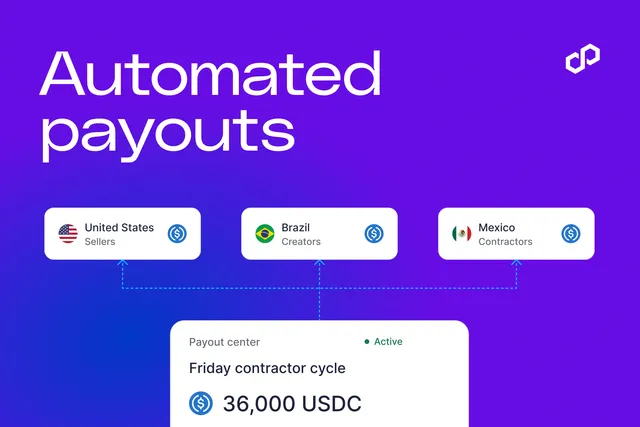
New to Polygon OMS: Automated stablecoin payout runs with rules your team sets

Polygon Open Money Stack now supports TRON
Meet Polygon at Money20/20 USA
Monerium, Frax and Capa connect euro payments to onchain FX markets on Polygon
Introducing crypto checkout in Polygon Open Money Stack
Polygon passes $3 trillion in stablecoin transfer volume
Polygon Chain now supports 11 million payments per second
New to Polygon OMS: Recurring Stablecoin Subscriptions With One Customer Approval