- MEV bots profit from seeing your transaction before it lands. Private Mempool hides it until it’s confirmed.
- It protects payouts, settlement, checkout, and trades, not just trading.
- One RPC swap turns it on, free to start.
Every transaction on a public blockchain sits exposed for a moment between submission and confirmation. Anyone watching that moment, bots included, can act on what they see before the transaction lands.
We launched Private Mempool to close that window. It’s a private transaction submission endpoint: transactions go straight to Polygon’s elected block producers, skipping the public mempool entirely. Nothing about the transaction itself changes. It just stays invisible until it’s already confirmed.
What MEV actually is
MEV stands for maximal extractable value, a complicated name for a simple idea: whoever controls the order transactions get processed in, can profit from that control.
Here’s the plain version. Picture standing in a grocery store line and saying your order out loud before you pay. Someone behind you hears it, sprints to the shelf, grabs the last one, and sells it back to you at a markup before you even reach the register. That’s close to what happens to a transaction sitting in a public mempool. Everyone can see what you’re about to do before it’s final, and bots exist specifically to act on that visibility faster than you can.
Bots do this because the incentive is real and the barrier to entry is basically zero. Every pending transaction on a public chain is visible to anyone watching, so spotting an opportunity and acting on it can run entirely on autopilot, without needing a relationship with anyone or any special access. Code watches the mempool and reacts in milliseconds, nonstop. That’s why MEV protection has become table stakes across every major chain: Flashbots on Ethereum, Jito on Solana, Timeboost on Arbitrum, Shutter on Gnosis. The demand to avoid this only keeps growing.
We built Private Mempool as a one-line integration on purpose. Swap in the RPC URL, keep every read operation on your existing provider, and every transaction you submit is protected. It doesn’t require new infrastructure, a new dependency, or a migration.
That single mechanism protects very different things depending on what you’re moving.
What it means for payments
Money movement runs into the same exposure. A payment visible before it settles is a payment something can happen to before the sender intended.
Cross-border payouts and remittance
The amount you send is the amount that lands. That’s non-negotiable for a fintech or PSP settling a cross-border payout. A settlement leg exposed in a public mempool, even briefly, gives something else a chance to interfere. Private Mempool closes that chance: the payout submitted is the payout that confirms. For a company already fighting corridor costs down from the 3-7% legacy rails charge, that predictability is the baseline, the thing they need just to stay competitive.
Marketplace and payroll payouts
A batch run is only as safe as its most exposed transaction. Platforms paying out thousands of sellers or contractors face the same risk, multiplied: not one transaction exposed once, but hundreds exposed in the same short window. There’s no room for a handful of those to land differently than submitted. Private Mempool protects the whole batch the way it protects a single payment: everything goes straight to the producer, none of it visible until it’s already final.
Institutional settlement and treasury
The protection here comes from the validator set, not a relay you have to trust. For a bank or treasury team evaluating Polygon, MEV protection sits on the same checklist as finality guarantees, throughput, and fee stability. Most MEV protection today routes through a centralized relay, trading one kind of exposure for another. Private Mempool routes to elected block producers instead, and the validator set can vote to replace any producer at any time. An institution gets the protection without adding a new centralization risk to its infrastructure review.
Stablecoin checkout
The customer pays what they authorized, nothing more. A customer paying a merchant in stablecoins expects the amount they approved to be the amount that arrives. That expectation breaks the same way a trade does, when a bot spots the pending transaction and inserts itself before confirmation. Private Mempool closes that gap at checkout the same way it closes it everywhere else, and that matters more every quarter more merchants accept stablecoins directly, with no card network standing between them and their customer.
What it means for trading and prediction markets
This is where the exposure is most direct and most expensive. A trader submits an order. A bot sees it in the public mempool and jumps in front of it, buying first and selling back at a worse price, or reordering a cancellation so it lands too late to matter. The trader gets a worse fill or a failed transaction. The platform gets a support ticket.
It’s also where the existing demand is clearest. Flashbots Protect alone processes roughly 3 million transactions a month on Ethereum, about 7% of total volume, and that’s before counting every chain-specific equivalent. Traders already pay for execution quality. Private Mempool gives Polygon-based platforms and their users the same protection, without asking people to trust a black-box relay to get it.
You don’t have to integrate directly to get it, either. bloXroute, the blockchain distribution network used by traders and validators across Ethereum, Solana, BNB Chain, and Polygon, already offers private transaction submission on Polygon through its own infrastructure. If your team uses bloXroute, this protection may already be available to you through their tooling. We expect more infrastructure partners to package it the same way, and we’ll update this as more come online.
Access and pricing
Private Mempool runs on a free tier open to every Polygon app today. Paid enterprise tiers add higher throughput, rate limits, SLAs, and redundancy for production workloads, gated behind an API key and payable in stablecoin or POL. We want broad adoption first, with enterprise-grade reliability there for teams that need it at scale.
Integrate directly or through a partner. Either way, the transaction that gets included is the transaction that was submitted, nothing extracted in between.
Read operations continue through your existing RPC provider. Only submission moves. If you’re an enterprise or fintech evaluating Polygon as a payments chain, reach out to learn more about private mempool today.
Disclaimer
This post is for general informational purposes only and does not constitute legal, financial, tax, regulatory, or investment advice. Nothing contained herein should be construed as a solicitation, offer, or recommendation to buy, sell, or engage with any product or service, nor should it be relied upon as the basis for any decision.
Users and institutions are solely responsible for ensuring that their access to and use of any Polygon product or service complies with all applicable laws, rules, and regulations in their respective jurisdictions. Polygon Labs makes no representation or warranty that any particular program configuration, feature, or use case will satisfy the legal or regulatory requirements of any specific jurisdiction. Users and institutions are strongly encouraged to seek independent legal counsel regarding their specific compliance obligations before engaging with any Polygon product or service.
The features, use cases, and illustrative examples described in this post are subject to applicable law and may not be available in all jurisdictions. All statements regarding future products, features, functionalities, or capabilities are forward-looking in nature and subject to change without notice. Such statements should not be relied upon as representations of future performance or availability.
Blockchain technology, smart contracts, and decentralized protocols involve inherent and significant risks, including but not limited to technical vulnerabilities, regulatory uncertainty, and potential loss of funds. To the fullest extent permitted by applicable law, Polygon Labs shall not be liable for any damage of any kind arising from or in connection with the use of, or reliance upon, the program, the Open Money Stack, or any information contained in this post.
Introducing Polygon CDK Besu: Launch a Hyperledger Besu chain connected to other chains and their liquidity

Polygon Open Money Stack is now a U.S.-regulated payments platform with completion of Coinme acquisition
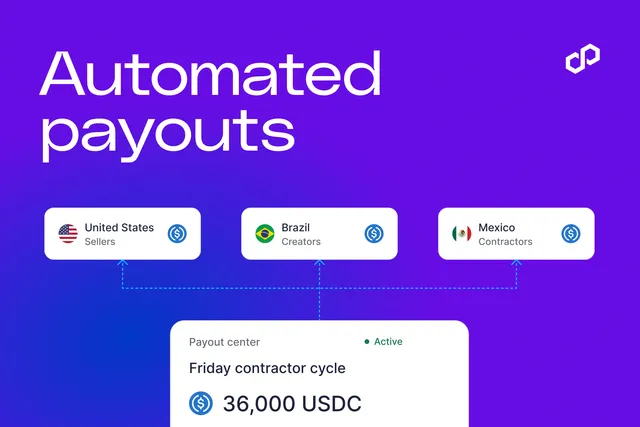
New to Polygon OMS: Automated stablecoin payout runs with rules your team sets
Polygon Open Money Stack now supports TRON
Meet Polygon at Money20/20 USA
Monerium, Frax and Capa connect euro payments to onchain FX markets on Polygon
Introducing crypto checkout in Polygon Open Money Stack
Polygon passes $3 trillion in stablecoin transfer volume
Polygon Chain now supports 11 million payments per second