tl;dr
- Let customers approve a recurring stablecoin payment once.
- Collect scheduled payments from their wallet within the terms they chose.
- Set an amount limit, approved payment scope, and expiry for each agreement.
- Let customers revoke the agreement when they want future payments to stop.
Subscriptions are everywhere. What started with newspapers and magazines now covers streaming, cloud storage, software, fitness, food delivery, creator memberships, and plenty more besides. When they work well, they fade into the background. You agree to a price and a schedule, then get on with your day.
That has been harder to recreate with stablecoins. A non-custodial wallet is built to ask its owner before money moves. That is a good default for a one-off payment. But it turns a simple subscription into a monthly request to open a wallet and sign again.
Today, we’re introducing recurring subscription payment rules in Polygon Open Money Stack. A customer agrees to a clear payment agreement once. When the payment date arrives, your product requests it and the wallet checks the agreed terms before it proceeds.
For a business adding stablecoin wallets or balances to its product, recurring payments turn that balance into something customers can use for more of their everyday financial life. The product can offer subscriptions, memberships, account plans, and other scheduled payments without a new wallet signature every month.
Why recurring payments have been hard in wallets
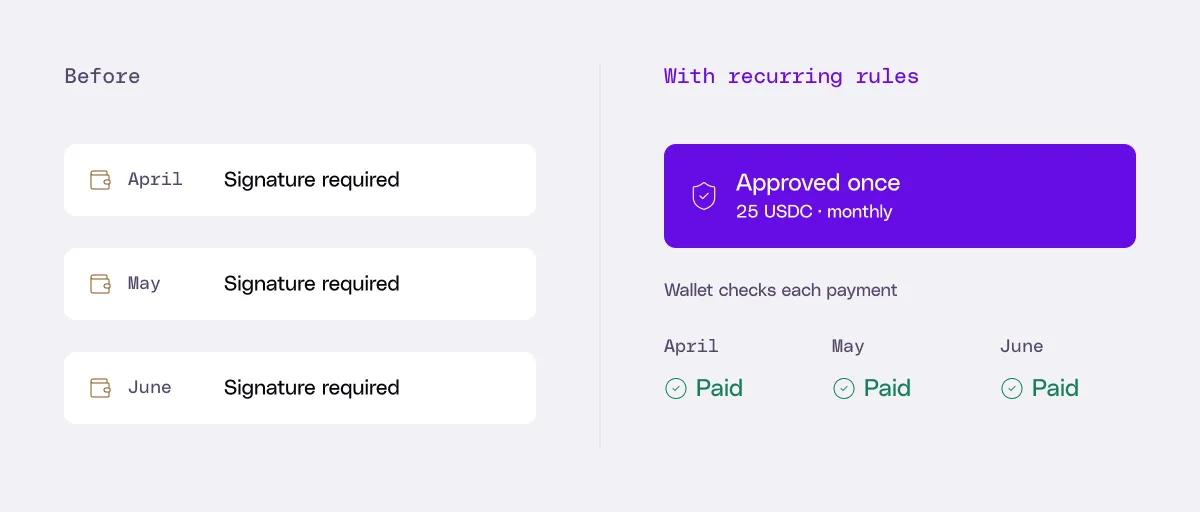
Every wallet signature confirms that the owner agreed to move money. That makes sense when someone is sending a one-off payment. A subscription is different. The customer has already agreed to the price and schedule, and the payment should follow that agreement when the bill is due.
Until now, a product that wanted recurring stablecoin payments had to keep asking the customer to sign, or build and operate its own way to manage that permission. Recurring payment rules in Polygon OMS give businesses a ready-made, customer-controlled way to add that behavior to a wallet product.
Give stablecoin balances another everyday use
Stablecoin wallets are becoming a way for products to help customers hold, fund, and move money. Recurring payments make those balances useful for familiar things too: subscriptions, account plans, memberships, and scheduled services.
You decide how the subscription looks and reads in your product. The wallet checks each payment against the terms the customer accepted, and the customer can turn it off whenever they want.
What the customer approves once
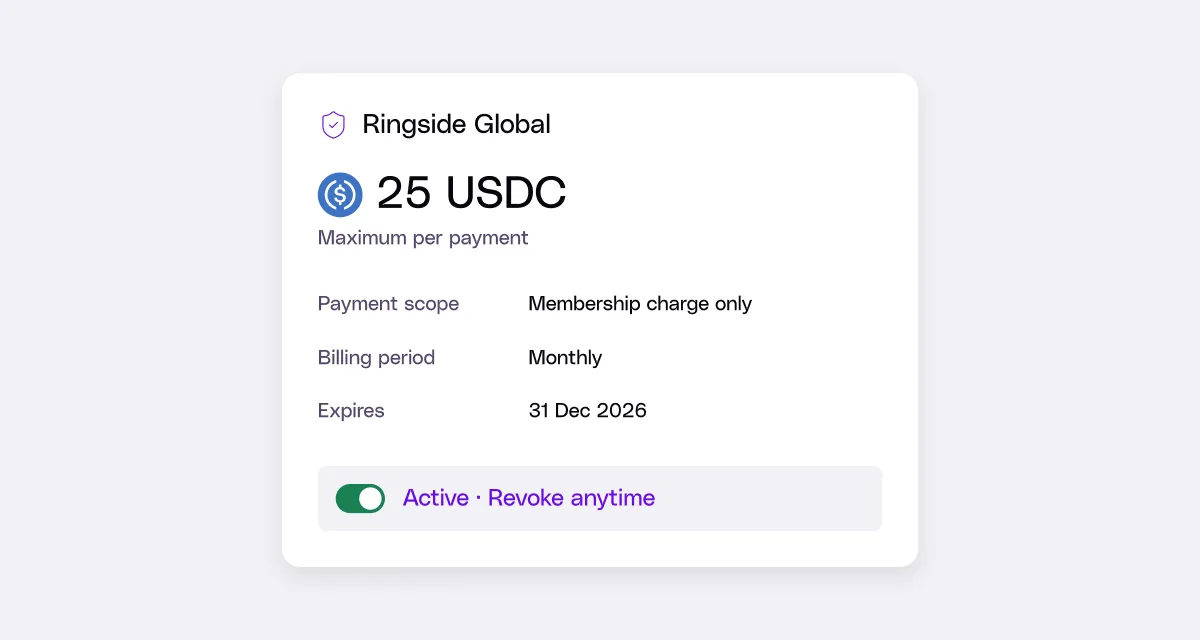
Your product can show the agreement in the same language and interface customers already use. The wallet receives the exact terms it needs to check each payment.
- A maximum payment amount
- The contracts and actions the rule may call
- A billing period and expiry
- The ability to revoke the rule
How recurring stablecoin payments work
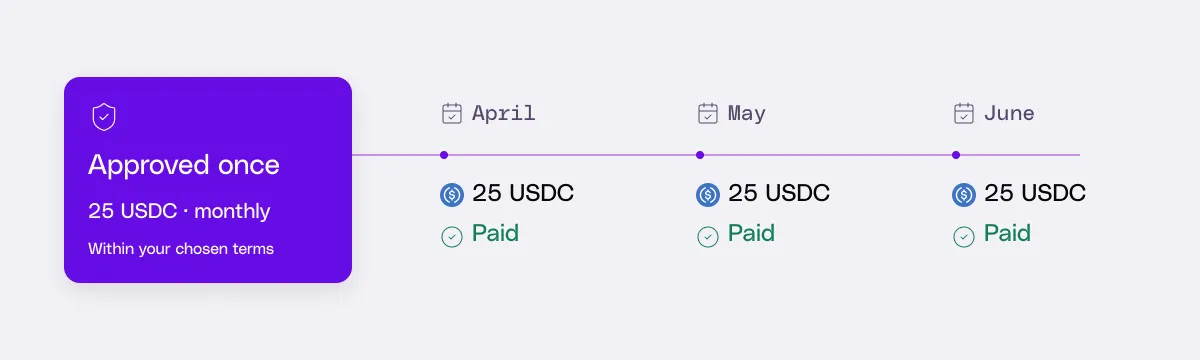
- A customer chooses a plan and agrees to the terms. They see the price, payment schedule, and end date in your product.
- The bill date arrives. Your product asks the wallet to make the scheduled payment.
- The wallet checks the agreement. It confirms the request matches the approved amount, payment scope, and time window.
- The customer can stop future payments whenever they want. Revoking the agreement closes the door on the next request.
The wallet equivalent of a stored card
For a card subscription, the customer gives a merchant permission to charge an agreed payment method. The merchant collects when the billing date arrives.
Recurring payment rules give a stablecoin wallet a similar job. The customer approves a limited wallet permission rather than handing over broad access to their balance. When the bill is due, your product sends the request. The wallet checks it against the agreement before moving money.
The rules live with the wallet
Each recurring payment uses a scoped wallet permission. The customer approves the contracts and methods it may call, the maximum token amount, and the expiry. Those terms are added to the wallet’s onchain Sessions Module.
This is important because the backend can request a payment, but it cannot loosen the terms after the customer has approved them. The wallet checks every request at execution. A request outside the defined scope is rejected at the contract level.
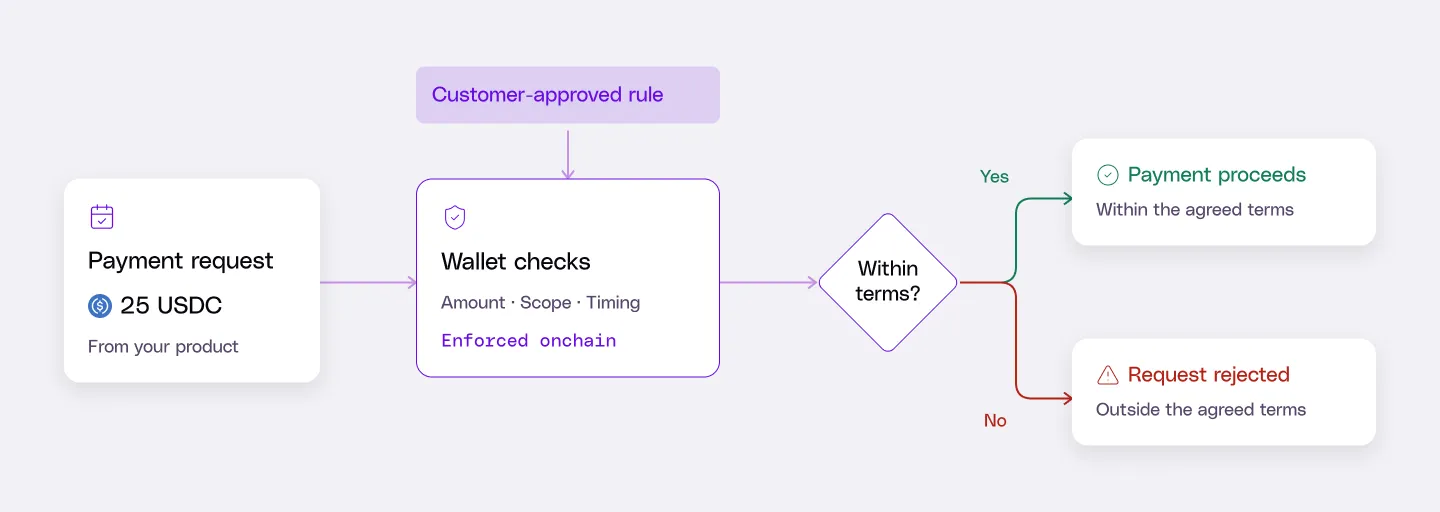
For a payments business, this creates the familiar experience of a subscription without giving a server broad, ongoing access to customer funds. Technical teams can review the permission model, wallet quickstart, and wallet configuration reference.
What a subscription payment needs
- Customer knows the terms: People should know what they are agreeing to before a recurring charge begins. OMS rules can define payment scope, spend limits, and expiry.
- The payment stays within those terms: A backend setting alone should not decide what a wallet can spend. The wallet enforces the rule onchain.
- The customer can stop it: A subscription needs a clear off switch. The customer can revoke an active rule.
- The product can grow beyond billing: A product that collects payments may later need funding, payouts, or cross-chain movement. OMS lets teams add the money-movement capabilities they need as the product grows.
One payment rule, a fuller money flow
Recurring billing is one way to put a stablecoin balance to work. The same OMS integration can connect how money enters your product, where customers hold it, the rules that govern it, and where it goes next. Add payins, payouts, routing, and settlement as your product grows, without duct-taping together a new set of providers for each step.
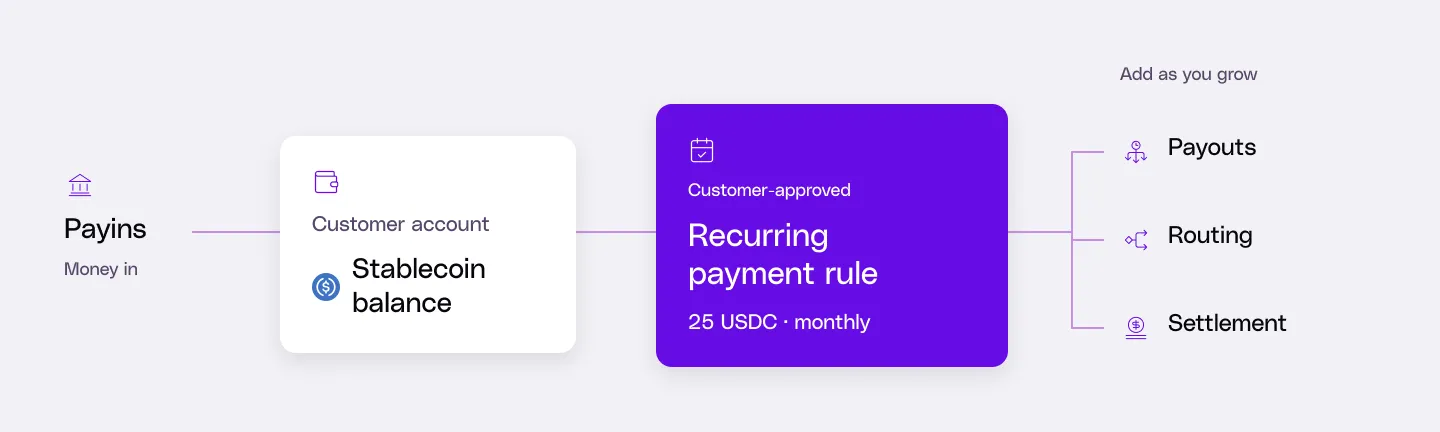
Read the technical reference for the permission model, or talk to a payments specialist about the money flow you want to build.
Disclaimer
This post is for general informational purposes only and does not constitute legal, financial, tax, regulatory, or investment advice. Nothing contained herein should be construed as a solicitation, offer, or recommendation to buy, sell, or engage with any product or service, nor should it be relied upon as the basis for any decision.
Users and institutions are solely responsible for ensuring that their access to and use of any Polygon product or service complies with all applicable laws, rules, and regulations in their respective jurisdictions. Polygon Labs makes no representation or warranty that any particular program configuration, feature, or use case will satisfy the legal or regulatory requirements of any specific jurisdiction. Users and institutions are strongly encouraged to seek independent legal counsel regarding their specific compliance obligations before engaging with any Polygon product or service.
The features, use cases, and illustrative examples described in this post are subject to applicable law and may not be available in all jurisdictions. All statements regarding future products, features, functionalities, or capabilities are forward-looking in nature and subject to change without notice. Such statements should not be relied upon as representations of future performance or availability.
Polygon Labs reserves the right, in its sole discretion and without prior notice, to modify, suspend, limit, restrict, or discontinue the program or any component of the Open Money Stack (“OMS”), in whole or in part, at any time. Use of OMS is subject to OMS terms and conditions. Polygon Labs further reserves the right to restrict or terminate access to any code, feature, or support for any user or in any jurisdiction where required by applicable legal or regulatory obligations.
Blockchain technology, smart contracts, and decentralized protocols involve inherent and significant risks, including but not limited to technical vulnerabilities, regulatory uncertainty, and potential loss of funds. To the fullest extent permitted by applicable law, Polygon Labs shall not be liable for any damage of any kind arising from or in connection with the use of, or reliance upon, the program, the Open Money Stack, or any information contained in this post.

Polygon Open Money Stack now supports TRON

Meet Polygon at Money20/20 USA
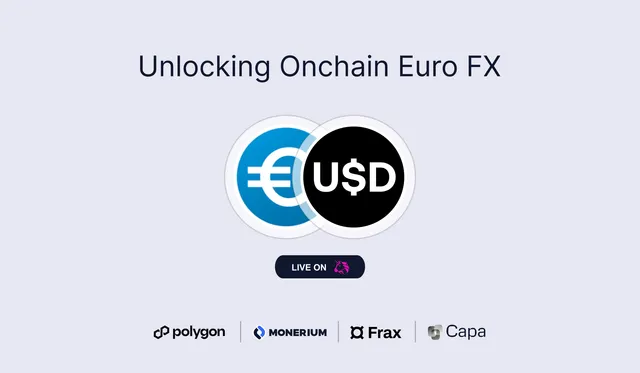
Monerium, Frax and Capa connect euro payments to onchain FX markets on Polygon
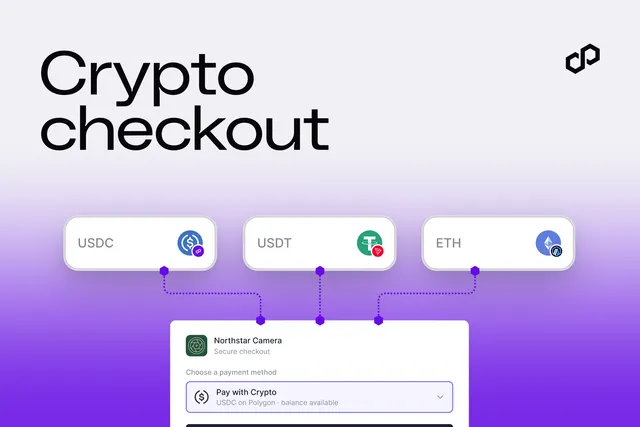
Introducing crypto checkout in Polygon Open Money Stack
Polygon passes $3 trillion in stablecoin transfer volume
Polygon Chain now supports 11 million payments per second
New to Polygon OMS: Recurring Stablecoin Subscriptions With One Customer Approval
Stable.com Adds Polygon for Direct-to-Bank Stablecoin Transfers

One API for Any Payment: Inside Polygon Open Money Stack