tl;dr
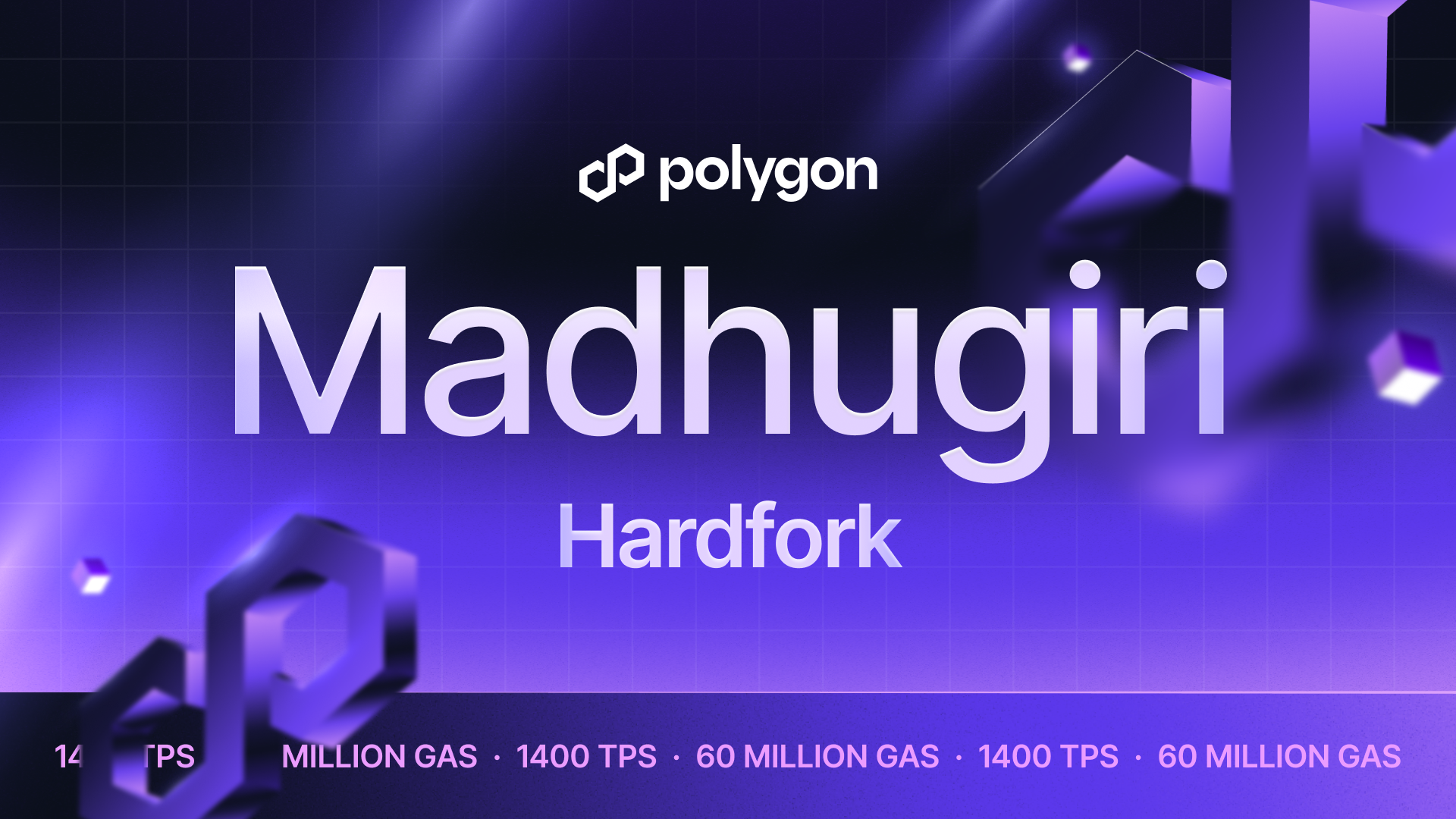
- Madhugiri hardfork brings adjustable blocktimes necessary for future speed, faster consensus, and in a separate upgrade, higher throughput, now ~1400 TPS on the path to 5K
- Future throughput upgrades via blocktime adjustments will not require hardforks
- Polygon becomes more reliable for enterprises
- Upgrade also activates Ethereum’s Fusaka EIPs, strengthening security
Today, Polygon continues to cement itself as the go-to payments chain with the Madhugiri Hardfork, an upgrade that coincides with 33% higher throughput and makes future upgrades for speed that much easier.
With this key upgrade, future blocktime adjustments made on Polygon won’t require a full hardfork. Instead, Madhugiri makes blocktimes adjustable directly within chain architecture, which means future throughput upgrades can occur without additional hardforks. Polygon can now process ~1400 transactions per second (TPS) throughput, moving towards a 5K TPS goal unlocked in an earlier upgrade—and all without disrupting reliability. In its current state, Polygon could have processed all 33.6 billion ACH payments in 2024 and still had more than 25% capacity to take on other transactions.
And without the need to hardfork for future blocktime adjustments, Polygon becomes that much more reliable for the major institutions and enterprises already integrated on Polygon, including Revolut, MasterCard, Stripe, Reliance Jio, BlackRock, Polymarket, and a host of others.
Additionally, Madhugiri makes Ethereum’s core Fusaka EIPs live, strengthening core security and mitigating potential attack vectors for an even more battle-tested network that enterprises can continue to rely on.
Twitter/X
This is content from Twitter/X. It only loads after you allow social networking cookies.
https://twitter.com/ethereum/status/1996226190399455358
No action is required from users or developers; the upgrade is fully handled by the network. Full-node operators will need to upgrade to the latest version.
Breaking apart the hardfork
Polygon is evolving at an accelerated rate.
Each additional upgrade ensures enterprise readiness through continuous security improvements, easier scaling, and reliability for the businesses on Polygon.
Here’s all the Polygon and Ethereum Improvement Proposals (PIPs and EIPs) included in this hardfork, as well as what they enable.
-
PIP-75: Change Consensus Time to 1 Second
- Enables configurable blocktimes with sub-second precision at the block producer level and standardizes consensus to one second
- Why it matters: Faster block production means lower latency, smoother UX, and future blocktime tuning without the need for another hardfork
-
PIP-74, Canonical Inclusion of StateSync Transactions in Block Bodies
- Adds a single, zero-gas StateSync system transaction to blocks that execute StateSyncs, committing these events to transaction and receipt roots.
- Why it matters: StateSyncs become fully provable and observable onchain, improving client simplicity, indexer reliability, and snap-sync trustlessness.
-
EIP-7883, ModExp Gas Cost Increase
- Reprices the MODEXP precompile to reflect its real computational cost and eliminate underpriced edge cases.
- Why it matters: Reduces the risk of DoS vectors and preserves headroom for future block gas limit increases.
-
EIP-7825, Transaction Gas Limit Cap
- Caps the maximum gas per transaction at 32 million gas
- Why it matters: Prevents any single transaction from consuming most of a block, which stabilizes block validation, improves node synchronization, and reduces DoS risk; especially important in the context of payments and financial infrastructure.
-
EIP-7823, Set upper bounds for MODEXP
- Sets an 8192-bit cap on base, exponent, and modulus fields for the MODEXP precompile
- Why it matters: Raises enterprise readiness through continuous security improvement.
Polygon is evolving to meet institutional appetite
Madhugiri builds on a run of upgrades and integrations for Polygon that cement it as the payments solution for payments solutions, including tokenized real-world assets.
Twitter/X
This is content from Twitter/X. It only loads after you allow social networking cookies.
https://twitter.com/0xPolygon/status/1990813289748836853
Institutional demand continues to accelerate, with recent announcements that include:
- Revolut, with more than $800M in volume on Polygon and in-app staking and trading
- MasterCard’s Crypto Credential program makes it easier than ever to send and receive crypto from web3 wallets
- Calastone, with £250B+ monthly, launching tokenized fund share classes on Polygon
- Flutterwave, Africa’s largest payments infrastructure provider, has selected Polygon as its primary blockchain for a new cross-border payments product
- And more
Polygon has also seen new highs of adoption in payments-focused data in recent months.
Polygon hit an all-time high in payments volume with $1B in November, including an all-time one-day high of $5.54M. Revolut has processed more than $800M on Polygon and Stripe’s volume on Polygon is second only to Ethereum.
An uptick in institutional integrations dovetails with a number of recent upgrades, including the payments upgrade in Rio that brought a new block production model enabling 5K transactions-pers-second, near-instant finality, an end to the risk of reorgs, and a lightweight network. Madhugiri continues this technical excellence, helping Polygon take another step toward an institutional-grade Gigagas future that can fully support the global demand for borderless financial infrastructure.
New to Polygon OMS: Automated stablecoin payout runs with rules your team sets
Polygon Open Money Stack now supports TRON
Meet Polygon at Money20/20 USA
Monerium, Frax and Capa connect euro payments to onchain FX markets on Polygon
Introducing crypto checkout in Polygon Open Money Stack
Polygon passes $3 trillion in stablecoin transfer volume
Polygon Chain now supports 11 million payments per second
New to Polygon OMS: Recurring Stablecoin Subscriptions With One Customer Approval
Stable.com Adds Polygon for Direct-to-Bank Stablecoin Transfers